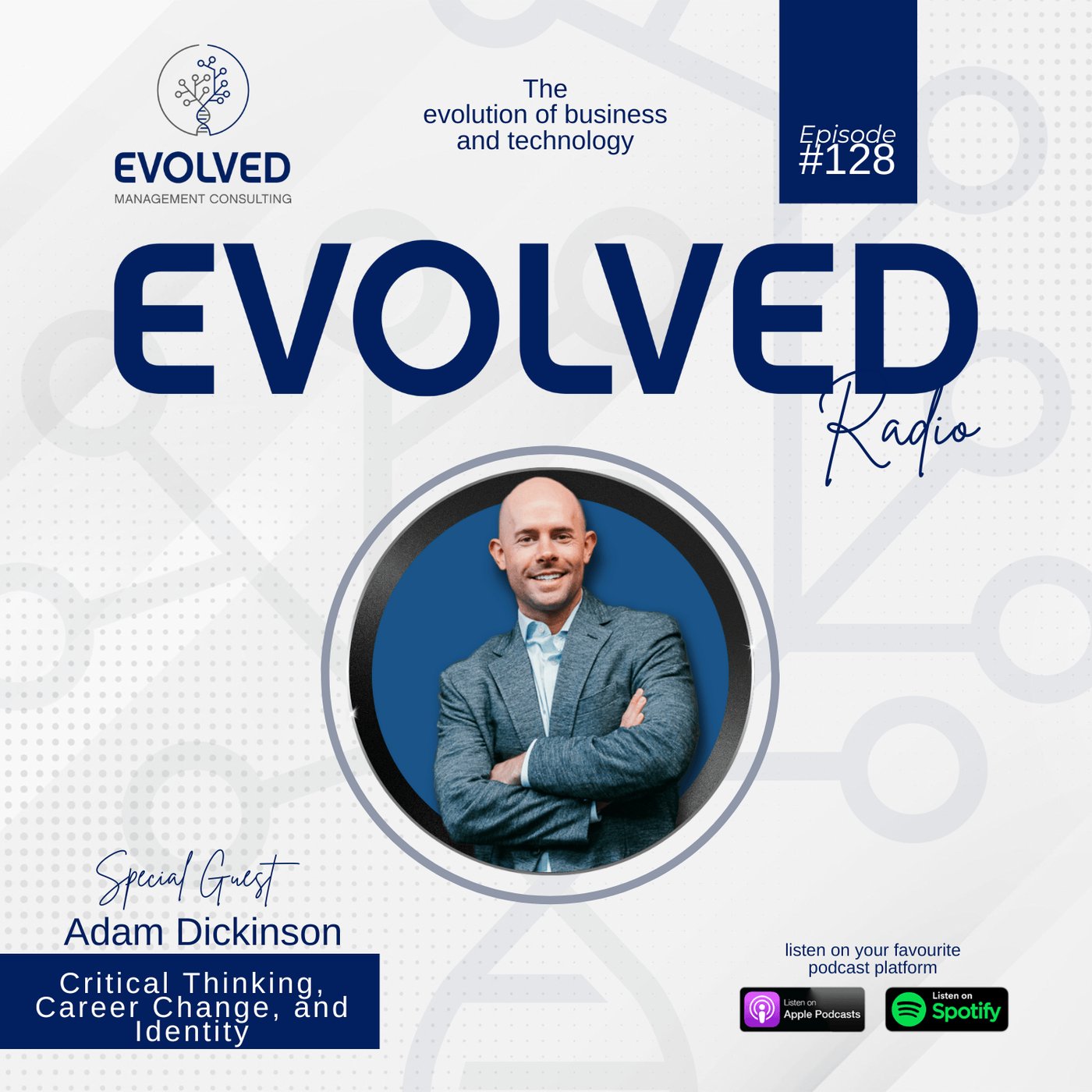
Adam, welcome to the Evolved radio podcast. Thanks,
Todd. Happy to be here. Great to have you. So,
got a fun story of like, how we connected and this lens to
kind of you giving us a bit of your background. You reached out to me
on LinkedIn and I had to take a little bit
to review your profile because it looked like one of those things of like, is
this legit? This can't be real. This person, like, sounds
far too impressive and like, all the qualifications and
where you worked, obviously a big component of this. So at
first I ignored it for, for a little while. Then I kind of recognized
your name from a group that we were in. I was like, wait a minute,
maybe, okay, maybe this guy is like legitimately reaching out to me. I was a
bit confused. So that's sort of the fun way of like,
you know, I was a bit suspect of, of you connecting with me on
LinkedIn and, you know, gives you a good intro as to like, who
are you? Why was I so. Of why you're reaching out to me.
Yeah, that's a really great point, Todd, because I'm also
finding that a lot of other people have been quite
suspect and in particular people I've been trying to help.
So I'm taking in stride. But to
your point. I have recently
left the Federal Bureau of investigation after 15
years as an intelligence analyst with them, where I
covered and was responsible for
cyber issues, counterintelligence issues
like tracking people that they, what they
weren't supposed to look into and they were
stealing things that they weren't supposed to, and then even terrorism
issues as well. So I have been responsible
for all the national security related programs at the FBI and,
and recently left where the US Government
had a deferred resignation program. And I resigned as
of late September, early October and then met
you and yeah, sent you that sort of weird message on LinkedIn. So
I appreciate you being curious about what's this guy
from the FBI reaching out to me about? Yeah,
yeah. I mean, there was, you know, I deal with a lot of
conversations and security and things like that, so it felt related. But
I suppose when the FBI comes knocking, even though I don't live in
America, at first I was like, what the heck? This can't be real. Is this
real? It was indeed real. So very cool. Really
neat background. I wouldn't mind spending a little time on this just because I think
it is an area that is just on its face,
a little fascinating of the work that you do.
Only so much that you can talk about it. But I guess what led
you to the FBI and the security
services. Part of that was that were you in security first or were you
kind of more into investigation and then security and
cyber became sort of the area of interest, I guess, which came first.
Yeah. So I might throw in a wrench in your
thought process. Thought process there and
select. See none of the above. I actually
was planning on being a doctor when I was in college.
Wow, that is a hard right turn, isn't. Is
isn't it? And at the time I
was learning Mandarin Chinese and really
enjoyed more about languages. This was like
2009, 2008 time frame, I think.
And the bureau was going to college
campuses and recruiting. And it just
happened that one day I was actually planning on going
to a hiring event for a
biological research company, put more emphasis on that.
And that was actually late at the FBI recruiting event
and ended up being in the back of the room. But
I knew that I wanted to do something more with languages. And
at the time the bureau was hiring,
had a hiring blitz. I think the phrase is for individuals
who had experience in certain languages like
Chinese or. Or Farsi or more
than the Asian languages. So
I decided to put in my
resume on a whim because I really enjoy learning
Chinese language. Not so I didn't really have a
goal of getting into security or investig.
It was more about serving my country and
also the enjoyment I had around
analytics and languages. So from that
point on, everything just sort of lined up at the right time
and it really worked out. But I think for me, looking back
on it in retrospect, it was just following my intuition, my gut
on. I really enjoy this and I'm just gonna go with it and see
what happens. But yeah, no interest in security
or investigation at that time.
So the work that you did, I don't know how much you can share, but
I guess you can probably talk about the broad strokes, I suppose, but like
intellectual property theft, those sorts of things. Like what types of
work did you do there? Yeah, yeah. So I started my
career looking at terrorist financing and
following, broadly speaking, where
individuals were, where they were sending
money and why. And because a lot of times, you know,
if you are. Looking
at different business opportunities and
activities, money is a big component of that. So
started off doing that, the money, as they say. That's right. That's right. And
then from there I transitioned because of my
Chinese language background, I transitioned to looking at intellectual property
theft issues and mainly looking at technology
transfers, how we characterize it. And
I really enjoyed that experience because I began
to develop more My strategic analysis mindset
and skills, I really honed in on how
I could look at the bigger picture from
looking at the entire United States, on what was happening on
specific economic issues and national security
policy issues and technology trends,
and looking at all the different intersections of everything. And it really
excited me a lot. And at that point,
actually I came to the aha moment, that.
Big picture critical thinking and analysis is what I really wanted
to do. And then from that, actually I began to
transition to doing more
mission management issues. So in the United States, the
intelligence community, the US Intelligence community, there's a group called the
Office of Director of National Intelligence. And that
organization is essentially responsible for helping the
intelligence community agencies work together.
So they're all generally on the same page.
They're working in sync, everyone's partnering with one another.
So I transitioned my expertise in
counterintelligence issues to that skill set because I really wanted
to get the big picture experience on how to
be more mission management focused. And then after that experience,
I decided I would do something uncomfortable and
learn about cybersecurity. I don't know, do you have much experience in cyber?
I always say I know enough to be dangerous, so I suppose I know more
than most, but it's not an area I consider myself an expert in either.
But because I'm in technology and it like it just
happens to be around me a lot. Yeah. So I've just, I've learned a lot
on the fly, but it's never been a sort of an area of focus for
me either. Yeah. Okay. Well, yeah, I'd say we, you know,
we may have similar expertise there, but just because I enjoy
the bigger picture. But when I transferred to the
FBI Cyber Division, I got
a lot of. Experiences
where I had a hard time translating the technical side
of, you know, the IP address and the router
and packets and all these very detail
oriented technical concepts. Whereas my mind
was a little bit more conceptual and.
Looking at themes and it was really challenging. But I dived
into looking at how hackers do what they do,
why they do it, what are their priorities and that sort of
thing, and helping protect us critical infrastructure. And
I really enjoyed that. And then I ended my career
on engaging more with the private sector. And it was a good experience
as well. Pretty cool. So
I think that lends, well, actually to what
we're sort of set to talk about here is. You kind
of got to a point where there was a bit of a transitional moment for
you. Right. And we were kind of talking about
the way that this approaches in Many people's lives. And I think a lot of
people, you know, listening to the podcast will sort of feel some
familiarity with this of like, you get to some moment in your life where
there's either an external event or just sort of a series of emotional
circumstances that. That kind of send you in a different direction or make you
at least very much reflect on, you know, where am I in life? Is this
really what I intended to do? Like. Like, you know, this is it. This is
the things that I'm doing. I think, to a large degree.
Luckily and unluckily, this came to me quite early in my life and in my
career. I worked basically in
corporations and fairly significantly sized corporations
even before I was out of high school. So worked.
It was very much a part of my core identity of the work that I
did, and then at some point recognized that it was
probably too much of my identity. And that recognition
was like, you know, you know, this. If I. I lost my
job, basically I decided to quit. But, you know, it, it things have gone sort
of sideways a little bit and realize, you know, I
don't really know who I am or understand sort of what I want in life
because all of that had previously been framed for the things that I
wanted to achieve in my career. And that was a really big aha moment
for me. And what I sort of feel was a transitional moment for me of
like, okay, I need to kind of go explore the world, figure some things
out and just spend some time with me and run into a bunch of wild
experiences and grow a little, and then figure out what I want to do from
there. And so I think that those types of moments, I think, are really
important for people. And I see a lot of this in business. You know, people
have run an IT shop for 23 years, and they're just
like, I don't know, do I want to keep doing this? And if I didn't,
what would I do? Right. So I'll maybe turn it back to you
because I think this is obviously something that you think a lot about and probably
had a very similar experience of, like, coming from your career. And then, you know,
what do I do now? What does this look like? You know, how can I
continue to grow and help people? Right. So what was your experience in that? Yeah,
I mean, everything you're saying, I can relate to a lot, actually.
Todd, where? On two fronts. The more recent
one, actually, I'm still like, exploring, as you will,
as a new business owner, what it's like to
send a connection request on LinkedIn for example,
and you know, seeing how that lands and like, do I really want
to be to keep doing this, posting on LinkedIn
and trying to talk to people and so forth. But
to your point on, what really
shifted for me on that pivotal transition earlier
on was about actually
mid point in my career when I was at the FBI. I
was in a relationship at the time and it was going
well and I really enjoyed my work as an
analyst there at the FBI. But unfortunately
I ran into a personal situation where.
My identity was sort of wrapped in with
this individual and, and the Bureau at the same time.
But unfortunately their relationship ended. And after that
I was kind of at a
crossroads where I'm like, okay, I'm single
now and I kind of knew who I was, but I
really didn't. Most of my identity was wrapped up doing my
best work and trying to really exceed
expectations at the FBI. But then personally I was like,
who am I? What's my purpose? What's, you know,
what am I going to do from day to day? And so I
started to really explore what that would look like.
And I was encountering emotions
of pain, sorrow, sadness,
but also a little bit excitement like, oh, I can
explore this. Actually, funny enough, I had a bucket list that I
tried from break dancing to rock
climbing to, I mean, a lot improv acting
actually. But through that
transition, it was really difficult to
come around the corner and figure out what I was going to do next.
And you know, the short version is I
became very much an intuitive person, started to meditate
to help me heal and move on. And then from there
I came across an idea of a
business that I wanted to do, but it just took a long time to really
get to this point, to be honest with you. Coming, you know,
trying to identify my purpose, which is to show and teach
others how to integrate logic and intuition to make
aligned decisions and then figuring out
how do I make this into a business. So it took a long time, but
the breakup really. Created a
rift and a big pivotal moment for me.
I mean, important growth points. I think
a bit of that exploration and just sort of throwing yourself in different
things for those experiences. Again, kind of similar in my experience as well.
Right. So I think that what I was going
to say is the lead in earlier aligned well with
where I knew the conversation was going as well. You
followed an intuition in your career that led you to a great place,
had a great career, and had all of this success and growth
in a professional capacity. And I think not to
put words in your mouth, you can Tell me if I'm wrong here. I felt
like that intuition just took you in a different direction at another moment.
And I think it's interesting because a lot of what you talk about, what you
do, revolves around intuition. And the part that I find
really fascinating is sort of the. Usually people
are intuitive or intellectual. Right. Like, I do behavioral
profiling. I'm sure you guys, you've done tons of sort of study on this in
your work as well. And those are usually opposite poles
in behavioral profile. Right. Like, usually someone is very, I'll follow my
gut, or, you know, I need to think through this. So
you kind of having expressing sort of the marriage of those things and
understanding how to leverage both sides of that, I think is a really
interesting component that lends to another piece that we'll kind of get
to there in a second. But as I sort of, sort of
dump this word salad, how's that land with you of like, the following, that intuition
and how it's been a major character in sort of the arc of where you've
gone in your life? Yeah, it lands really well. And it's a. That's a good
capture of where I'm at now and how I've gotten here.
In particular. When
that sort of life pivoting moment occurred,
everything logically just did not make sense.
I. Everything. Had you been logical up to
that point? Yeah, I mean. I mean, yeah, very heavily,
heavily used a lot of analytic.
Frameworks and structures and critical thinking approaches.
But I mean, there was always sort of a gut hunch
of, oh, let me try this, like the Chinese
language example of how I got into the FBI. But
I was very much driven by.
How I could solve a problem logically. And
when I didn't have a. I had a support
system, but my support system at the time was this one individual.
And when that individual left my
life, it. Really
changed my mindset around how to. How to
solve my problems, how to survive, how
do I have fun now? And so the intuition
part really started to grow at that point
because it was really the only way that I could
cope because everything else was thrown out the
window and I didn't see any
sort of solution at the time. And so I was just sort
of following what it felt like. Oh, I'm like, okay, let's.
This feels good. I mean, I was also trying to
heal at the same time. So it was
really much an exploration of what does my intuition feel like?
Am I safe doing it? How am I going to use it to make
decisions, so on and so forth. So I really started to hone in
on more the intuitive side and what my body was telling me at that time.
So this is perfect because that lends to one of the
major themes that I wanted to talk with you on the here today
is, is critical thinking. And I think that
that is, you know, one of those frameworks that probably has
a large logical component to it, but also I
think is better fit when there is more of an
emotional or intuitive element that is. Is at least sort of
woven into it in some way. And I think this, this helps strike this balance
because one of the things that drives me crazy is like, I feel that
critical thinking is something that in my mind is difficult to
actually teach people because it requires a bit more of that intuitive,
that gut feeling, or at least kind of the wisdom or experience
of seeing certain circumstances, understanding how you can approach
it, what your options are. And what I find with business owners
is this is an area that they really struggle with, especially sort
of junior growing to senior staff as they're like, well, you
know, they just don't seem to have great critical thinking skills. Like, they don't think
through these problems the same way that I do. And part of my
feeling is because those people don't also have 15 years of experience
of encountering similar scenarios and they can't draw upon the experience,
but yet, you know, you can't teach that either. Right. So
what's, I guess, what's your broader thinking on, like, how
do you learn critical thinking skills? And the how
does sort of that, that, that line up between,
you know, the objective and the subjective experience of
seeing something and thinking through it? Gosh, Todd, do you want to run my
business? Because that is a great insight.
I have not heard many people capture it in that way,
summarize it in that way, but we're on the same page. So
I think first, if I heard you looking at it
objectively, if I'm looking at a problem objectively,
I could go a lot of different ways. I could
relate to my previous experiences, as you touched
on earlier, on how to approach the problem.
But if you don't have experience solving
that problem, there are a couple ways you could
look at it. First, if you have a problem and
you have. Some data that could
lead into breaking it apart, you could start that
way. So categorizing the issue in different
themes, concepts, ideas, so you can
break it up in little pieces so you can better understand it and have it
more relatable to you, that's one approach. You could also look
at it From a big picture and a small picture point of
view. I like doing that often because my go to,
as I mentioned before, is strategic big picture thinking. But
often as you're looking at it from, you know, a forest versus the
trees sort of mentality, you have
to be mindful of how long you're looking at
the big picture or the small picture and whether you get down a rabbit hole.
I know oftentimes when I was doing analysis at the
FBI, I started to and I would actually get
into the flow state and really enjoy the analysis and the puzzle
I had to be mindful of. I was
going to many different directions and wasn't getting
anywhere. So then you have to also
incorporate the subjective side that you mentioned, which to me
is more the emotional intuitive component.
And so looking at it from
the emotions and intuition part
of the critical thinking. Framework
or equation.
Following how your body responds to data I
found is a major factor
in how you want to navigate the critical thinking
equation in your mind. So for example,
if I'm looking at, we'll say,
okay, Todd, we'll go back to LinkedIn for example, for a minute as an
example, if I want to send a connection request, I'll look at it.
And that's my problem, I guess, actually honestly at the
moment. And I want to figure out, you know,
looking at it analytically, how do I want to approach it? Does the
individual have the
ideal target profile that I want to look at? Does the
individual have a background where I feel I can relate to the person?
Does the individual have like an issue
that he or she may have communicated on LinkedIn so that,
you know, logically looking at it that way you can see
that makes sense. I'm going to approach that person now intuitively.
You could incorporate, well, how do I feel
in my body about assisting
individual with a certain problem? Like if the individual has
mentioned on a post or something that.
You know, I'm having trouble doing an interview or I'm having
trouble networking on so and so problem,
you can look at it, how big of a,
an emotional resonance does that have on you?
I'm talking about me as a business owner with at that
point in time, what ideas are
coming up within my consciousness, within
my awareness that I could assist that individual
with? So often for me,
intuition is not only how your body responds, but sort of the,
the immediate sort of nudges or gut
hunches that you get on how to approach
helping that individual. And so the critical thinking
equation or framework becomes even, I'll say
more complicated or more simple Depending on how you want
to approach it and what feels right to you in that current
moment. Because the next day or the next
week, how you approach the same individual could change. So that
also. Either broadens
the options of the critical thinking approach or
it minimizes it, depending on where you are in that state.
So maybe I'll just pause there. I know it probably said a lot of different
things, but a lot of different
complexities to it. Yeah, I almost
see the difference between objective and
subjective inputs on decision making. And sort of like
understanding something I think is actually now that you talk about it, is maybe more
of a spectrum than sort of previously a thought. Right. Because usually
objective data is things you see, you can measure, you can point to subject
data. Subjective tends to be more sort of like feelings,
intuitions, those sorts of things. But, you know,
maybe those intuitions and that sort of, that gut is data
you can't see. But you still have to factor in and sort of figure out
how to apply those things. That's sort of an interesting way to sort of think
about this of like, because again, people that
may be intellectual or more intuitive, one side or the
other is not necessarily the right way. You know, I'm very much
a logical thinker. Like I'm, I'm almost overly cerebral about things
I've been told by people. And so
yeah, I can make good judgments on good data and I always go hunting for
data. But I know people that are incredibly good at what they do and
have a huge track record of success and they're entirely intuitive.
Right. So there's not necessarily one that's better than the other.
So I think like not thinking them as polar opposites
and thinking of it more of a spectrum, I think maybe benefits
that of like they absolutely matter. Having, you know,
the poles of those that spectrum to help you to complete sort of your
picture of your understanding of things can be really helpful.
And you know, I've described using data for your
managerial detective, hat is how I describe it, right? Like,
I think this is true. So this is my assumption, this is my
thesis. How am I going to go sort of verify that some of
these things are the case or that my gut sense is correct? Or
if this data tells me this is true, do I know that that's
correct? And like, who do I have to talk to? What do I need to
know in order to validate those things? Right. Like it does take this
full spectrum of information and inputs to make
good decisions in order to not only satisfy your
need to feel like you've made A good judgment about something, but also that you
can point to something and validate. Like, yeah, this is why I did this.
Because in my mind it's always been because it felt right. Doesn't
necessarily feel like a good answer, but as I said, some people have been
incredibly successful with that. No, you make a
good point again. And I like the way you describe.
Looking at critical thinking from as a spectrum point of view,
especially when the data that you have
available may not be telling the entire story
and. You may be left
with following your gut on what's telling you
to do next, maybe telling
you what to leave out, maybe telling you to
reframe a data, a logical data point that you have,
maybe telling you to leave it out altogether. But
the the spectrum part, overview summary
that you talk about really hits home for me,
especially right now as a business owner, since I
don't really have a strong business.
Experience around having to solve a lot of
problems. So I'm using more, you could say more or
less the intuitive side, but looking at things
strategically as well to help navigate my next decision.
I think one of the points that you made of the impact
that some of these changes in your life and therefore led to some of these
decisions, I think is a really important one. Maybe we can talk a
bit about how you know those things to be true because of
potentially feelings or, you know, some objective data that you see
around you. But I think it is really important, you know, in any
person's life and certainly in business, that you, you,
you're looking for some of those indicators that things are not
working the way that they need to, to serve you right. This
can generalize in, you know, certainly stress. I think any business
owner will certainly have a level of stress, and some of that is good for
you because it keeps you motivated, it keeps engaged. I've always
joked if, you know, running your own business were easy, everyone would do it.
It's not. Guess what? But I also
know I learned very early lessons of entrepreneurship,
of the hard lessons that I took note
of in the people that I saw as mentors in my career,
including my own dad and some CEOs, in the
companies that I worked for, where a lot of damage was done to their personal
life in pursuit of business. And that was something that I was very conscious of
protecting myself against. I want to do well. I want to grow a
business. I want to help people and be successful, but not at any cost.
And that was always front of mind for me. So I've always been very
sensitive of, like, how much is too much and not kind of giving
myself an out because, oh, well, maybe this is too hard. Maybe
it'll impact things and be negative. Right. I feel like that's a
difficult line to balance between, of wanting to be able
to pursue things and be successful, but recognizing, like,
my body is starting to scream at me and, you know, it's showing up
as, you know, panic attacks or, you know, God forbid, like
a heart attack or something like that, or your family starts to fall apart.
Right. Because you're not paying attention to your family. You're not available.
I think, like, you had a similar experience of this, of, like, your. Your professional
and your personal life, you know, kind of had a bit of a cross in
between them. And part of the reason that I go down this line of thinking
is like, you're simply just mentioning the fact that you've started to spend more
time meditating and things like that, of looking after, you know, the
temple a little more, of reflecting on what makes me a good
person and keeps me balanced despite my need to pursue things
that challenge me and grow me. Right, yeah,
that definitely resonates as well, especially as I'm trying to
figure out how to balance all the different responsibilities as a
new business owner, especially as a solopreneur,
and being mindful of not being spread
thin and having to.
Keep track of every little task and
making sure I'm not going crazy. And
so everything you're. You're talking about definitely
lands with me, especially as I figure out,
like, my posting routine on LinkedIn, for
example, or what am I going to do Monday through Friday,
even maybe sometimes on the weekends, but
making sure that I'm not doing too much
altogether in the very beginning stages, so I don't get burned out,
essentially. But, yeah, I definitely
feel what you described right now,
especially as I'm looking to build more
momentum going forward. What
would you advise to someone kind of in a similar position to maybe what I
described is like, hey, I've run this business for 20 years. It
feels kind of hard. And maybe I question sort of, is this worth it?
How do you. How would you sort of advise that person to sort of reflect
on where they're at, what they want, and potentially how they should move forward? Yeah,
that's a great question. And I can relate to that
as well, because I did that sort of earlier this year in
2025, when I was
contemplating leaving the FBI. So, for
example, one first
step, I would advise is you could look at it logically.
Looking at that critical thinking logically, you.
Consider. What
have I accomplished so far and what do I still want to
accomplish? So looking at more that goal setting frame of
mind is probably an easy go to
direction you could explore. From there you could build
upon that answer if there is more
to do that you, you could then break it down further
and look at different priorities that
surround that goal and how it may impact
your life in different areas. So how would this decision
affect my family? How would it affect my day to day
situation with how I feel
from day to day? What's the energy is it going to take
to do all these responsibilities?
Do I have the resources to continue.
Making this decision and moving forward?
And then from there you could break that down even
more and say, is this
goal that I want to do.
Align with my purpose and what I meant to do
while I'm still here on planet Earth, for example, and
making sure that the vision for yourself and
any sort of.
Next steps that you decide to do is continuing to be
in alignment with that. And then you can make it
even more complex or fun. As I say, have a puzzle
and integrate more of your intuitive side into the intuit
and look at it from. You know, what's my
gut telling me? Is it telling me to
go in a certain direction over another that may not logically make
sense? You could also look at how your body is responding. So
these different decision points that you have, are you
excited, are you sad, are you frustrated with
certain decisions decision points
that you have come up with? So there really is
a lot. The puzzle just keeps getting larger and larger. Like you
said earlier, like that spectrum, it can get
cumbersome if you don't apply
certain approaches. So just to recap there.
I would advise someone. If they
are a seasoned business owner and they are wanting
to figure out what they do next, I would first
start with that long term goal and
see if it's still in
alignment with their vision and their purpose, and then break that
down from there into subcomponents where
you could look at impacts of that decision to their
life and others and to the globe writ large.
And then as another component,
incorporate more of your gut and your body's
responses to these certain or these new
frameworks that you've created to think through your decision.
So there's like a lot of different layers you can add on
after each. Round of
of exercises.
Great. I imagine there's many people in
business in general, but certainly in the federal
space that are either leaving on their own accord or not,
I suppose as well. Any advice for them in.
Your initial journey in this or potentially how you can help some of those people
with your own experience. You know, if there is a person
in transition, I think it would, would provide
similar guidance to a business owner then.
I think, though, for especially the federal workers
that I'm supporting right now on transition, identity
is really baked in to the
mindset and embodiment of
what they're leaving behind or what they could be leaving behind. So
I think approaching that
challenge is going to be key.
Looking at how will my identity shift? Why perceive
myself? What do I need to do to
keep going when my identity
changes? What's going to excite me on the other
end of the, the journey once I leave?
You know, how do I keep momentum? Do I have a support system
in place to keep me
going? All those different areas I think are really important to
consider, especially if you're, you know, if you are
leaving the federal government like I did, Identity
is, I think, a critical component.
Okay. And if people wanted to connect with you, continue the
conversation, understand a little more, get some further thoughts from you.
Just DM you on LinkedIn, I guess.
Any other avenues? Yes, it would be a lot easier if
someone could DM me. But yeah,
you can find me on LinkedIn. My moniker there is
Adam R. Dickinson. D I C K I
N S O N on LinkedIn. And yeah, feel free to, to
reach out there. That's kind of where I am housing my business
operations at the moment.
Perfect. All right, thank you so much.