Episode 91October 17, 202240:31
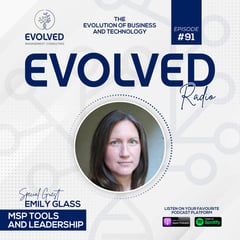
ERP091 - MSP Tools and Leadership
0:00 / 40:31
I think being very intentional about your core values and how they drive decision making, tying into how we drive decision making and priorities is really key.
Show Notes
Today on the Evolved Radio Podcast I'm joined by Emily Glass, CEO of Syncro.
Emily and I chat about the future of the PSA and RMM in the MSP industry. How emerging MSPs needs differ from large MSPs and how Synchro is developed to support that community.
We also talk about running an all-remote company, the importance of mental health in the remote age, and a great discussion about how values help you manage decisions in a company.
It's a great conversation about the MSP industry and company leadership. I hope you enjoy it.
Read Transcript
I think being very intentional about your core values and how they drive decision making, tying into how how we drive decision making and priorities is really key. And then the second thing that I think is important, although there's many things, is data. and sharing as much context with folks around the business performance, but around personal performance, team performance, whatever it is, that gives them context to empower them to make decisions. Welcome to Evolved Radio, where we explore the evolution of business and technology. I'm your host, Todd Kane. Do you like getting paid? Then make it easier for your customers with Go into payments. Do you teach your customers not to click on links from strange domains like mymsp.monkeypayments.com or slowbooks.com? Go into payments uses your branding and domain name, no redirects, no confusion. Go into Mobius is trusted by over 1,000 MSPs to sync financial data. Their new product goes into payments is built with the same care and empathy to make payment process easy for your customers. Go into is a family-owned business dedicated to making software suck less every day. So go to g o z y n.com/payments to learn more and get started. Today on the Evolved Radio podcast, I'm joined by Emily Glass, CEO of Synchro. Emily and I chat about the future of the PSA and the RMM in the MSP industry. How merging MSPs needs differ from large MSPs and how Synchro is developed to support that community. We also talk about running an all remote company and the importance of mental health in a remote age. And a great discussion about how values help you manage decisions in a company. It's a great conversation about the MSP industry and generally company leadership. So I hope you enjoy. Emily, welcome to the podcast. Thank you, Todd. I'm happy to be here. Thanks for having me. Absolutely. It's uh going to be a great conversation all things MSP again today. So well, maybe just start out if you could give us a bit of background, uh a bit of origin story for yourself and who you are, where you've come from. Yeah, I I certainly am happy to share. So I was born in Montreal. So I'm Canadian. I live in the Boston area now and have for about 20 years. But I travel back to Canada often. Yeah, I started uh with my computer engineering degree as a programmer. and moved quickly into support and then product management. as I found people very fascinating and code code was interesting and solving those challenges was interesting and technology is always been interesting. But figuring out how to get people to use the technology that was getting built was even more complex and interesting to me. So I I quickly moved into product management. and fell into the MSP industry when my company got acquired by Dato. I was working at backup of fi. And uh yeah, and I've been in the MSP industry kind of ever since a brief interlude. but now back at Synchro and I'm really happy to be back. I love the space. Again with technology and it's always changing, so there's always something uh new to learn. It's funny that you mentioned the fascination with sort of people as puzzles. I found the same. I before getting into the management side of the world and operations side, I I looked at management with some disdain. sort of funny considering the the the business that I now run is a management consulting organization, but that was the part that really changed it for me honestly was I I always loved computers. I didn't like programming because I found it very limiting as soon as I I hit a problem, I found it difficult to get around it until I found the solution. Whereas with systems I could continue to kind of tinker and try and figure things out. And that was really what what attracted me ultimately to people management. was viewing all of the people issues and the people the issues that people had as puzzles and as problems to be solved. And then I got really, really hooked into it. So. Yeah, I'm someone who loves a challenge. So engineering was a challenge and I mean it is there's still lots of challenges to solving technical problems, but when I found people, my eyes got opened even wider to all the complex problems and more complex problems that there are uh and trying to get them to negotiate and agree and explain their problem. and use software or or negotiate. It was just a fascinating world and I love to learn. So I find that I'm continually challenged. managing people, working with people, trying to figure things out and how to motivate them. So, yeah. Yeah. Yeah, it's a it's a fascinating space, definitely. Um, all right, so Synchro, you are the CEO of Synchro and Synchro being a combination PSA and RMM, which I would say for me personally is kind of the future of this industry if I had to sort of uh make my suggestion on on this. Uh I'm curious sort of what what's your view of sort of the future of the tool sets in the MSP market, the PSA and the RMM combo being sort of central for your guys's business especially. Yeah, I mean, I agree with you. I think it was kind of inevitable and when we look back sort of hindsight is 2020, but it feels like, you know, the PSA and the RMM were always core products that every MSP needed to operate and then grow effectively, right? And run their business. So it was almost inevitable that these two things kind of come together and they are essential as they're essential components for any MSP. And I think that there's so much magic that can be created when they're they're on the same platform and talking to each other, uh, you know, very uh naturally. There's so many things we're able to do that that blow people's minds when they come from and have been in the industry for a while and experienced separate PSA and RMMs that are integrated somewhat together. It takes us even a while to do some education as to like the capabilities that exist because I think their minds are like, no, that's not possible. But it is when the PSA and RMM are on the same platform. So, yeah, I think it is the future of how MSPs are going to operate and grow more efficiently by having those two tools together. I don't know if you want an example. I thought what you're going to say. Well, you did tease that. So now I'm curious. Like what are some of those aspects of like the the aha moments for people that come from the the especially disparate systems. You know, they don't necessarily have the PSA and the RMM even from the same vendor. So to have them as an integrated platform might be even sort of a second step function above, right? What are some of those examples? One of the best ones is dynamic, what we call dynamic billing because we have visibility into all the assets, but we also have visibility into all the customers or contacts, the users at an end client. We can automate all the billing on a monthly basis based on pretty much anything that we can count in our system. We can automate how many um AV licenses are installed or maybe you charge for some other software license that you're reselling. Any anything that we can see with the agent, you can automatically count and bill on. Maybe you charge by user at your end customer, we can count those in in the system. So all of that is automated. You set it up once and the bill is generated every month without any additional work, which is just on the platform, easy, you know, you fill it out one time, you save it and you're done. And all of the different options and and things to count, assets, whatever it might be, are right there for you. And this I think people don't assume that's possible. It's something that we continually have to explain. We're like, we have dynamic billing. They're like, what's that? Well, we count things for it like it happens automatically. They're like, what? And it just it just takes a while. It's like a mental shift almost, right? Like you can do that? How does that work? And then they get there and they see the light. So that's that's one of the best examples. Okay. Uh on the RMM side especially, I find like in in sort of my experience in the industry is it's definitely one of the most underutilized systems that MSPs tend to have. A lot of it tends to act just as a sort of a fancy way to count assets and to connect to those assets and remote screen capability. I'm curious sort of what your insights are or what are some of maybe the fancy stuff that you've seen from an automation's perspective. Like what are sort of the cool ways that either you have seen or are starting to see people leverage some of the automation and the capabilities of the RMM side. Yeah. a few ways and definitely I identify like you said, sometimes the RMM is like a glorified remote access tool or it's used basically just for for desktop support and very reactive measures. So I think one of the ways that we're seeing that evolve is more in the preventative or proactive side. So, um, you know, OS patching or keeping everything up to date, again, without any manual work, having a dashboard to view all of all of your assets and make sure that everything's up to date and and functioning well in a more proactive way is one thing that I'm seeing more of. And then automated remediation. which is again, something that you can do with the PSA and RMM connected together, but is more a function of the RMM where you can say, you know, I want to do this thing every time this this alert fires, but because the PSA and RMM are together, you can say, I can I want to do this every time this user does this or if like this ticket is submitted or something like that. So there's a lot of more proactive ways that MSPs are becoming more efficient through the use of the RMM. And I think that's really the future direction more so than the reactive support, although that will still be required in some instances. Of course, of course. So some of my imagination on this, like one of the things that you again, some of the base features of the RMM that are maybe not even set up and hopefully, you know, most MSPs get to this place where something gets triggered in the RMM, it creates a ticket, the RMM tries to maybe do some actions. And and I think I'd not really considered this because I suppose it's not really that practical. It's maybe possible, but not not that common in other systems is if a user submits a ticket for something, if the machine can read sort of what that user is requesting, based on that, then go fire an RMM script to try and do something. Is that is that sort of what you're suggesting? Yeah, and that's something that Synchro can do today. So we can have actions created or or like done by the agent on the RMM machine based on certain triggers within the PSA system like a ticket, for example, if it follow a certain workflow. Yeah. Right. So it's not even the like the agent that recognizes something, it's the user, but then the agent can go do something for them without a human intervening in the process, right? Correct. Yes. Cool. I like that. That's that's definitely sort of more advanced automation in my mind. Yeah. Yeah. And what we're seeing too, um you you talked about the RMM um and people not getting much value out of it. I think there are a lot of RMM tools today. You know, it's it's viewed as a glorified remote access, but it's also kind of the method of delivery of for software or or to access an endpoint or an asset. And I think that that whole functionality set is kind of being commoditized. So where we try to focus is how can we improve the efficiency? How can we take advantage of the fact that the PSA and the RMM are on the same platform and create some magic? which magic for us usually means saving time, making things easier, automating something so that you don't get it wrong or the user doesn't get it wrong, those kinds of things. Yeah, right on. So that kind of leads to one of the things I did want to hit on here is Synchro being a smaller portion of the market and a smaller company than some of the larger competitors. But we're certainly seeing like this very, very accelerated consolidation in the MSP market. I think one of the things that people tend to have some level of disdain for is the development cycles in some of the bigger MSP vendors. And it just seems to sort of take forever for certain features to get turned out and there's a lot of discussion as to sort of the value of the features that get delivered ultimately. And uh Synchro being a smaller organization, more nimble, I think maybe you would agree sort of closer, more attached to the customers themselves directly. And how do you think about sort of your ability to move and develop the platform at a faster pace than some of the larger companies that you're competing with? So certainly like large vendors have a lot of resources, they have larger teams, but it also comes with larger uh partner bases. So, you know, larger amounts of viewpoints and needs that they have to satisfy from their customers or their partners in this case. Um and I think one of the benefits we have is that we are able to really listen closely and be responsive to our partners' needs because we serve a very specific segment of the market, right? We are about getting MSPs who are early, start just starting out, just starting to run and grow their businesses. And so we have a contingent that's sort of focused on some of the similar needs uh that allows us to dedicate our time to like what they really are listening to and prioritize based on like what they need. I think in the larger vendors what tends to happen is they're trying to serve a lot of constituents. So, although the teams are larger and they have the best intentions, it's getting sliced up into many different factions and maybe not always what an early MSP wants is prioritized because of where they sit in the in the hierarchy of needs there. And also, I think larger businesses start to get distracted with processes and um maybe uh internal uh uh efficiencies and, you know, uh diverting engineering resources to work on those things. And also they become, I think a bit more risk averse. So at Synchro, you know, we're still early, innovation and trying different things is part of who we are. I'd like to preserve that as we grow, but that's not always the case. When you have a larger vendor with like a very big revenue stream, they want to they don't want to mess it up. So introducing a new feature or changing something fundamental um or even adjusting pricing or packaging can pose a larger risk. And that sort of uh stifles I think innovation and new features that MSPs really need to move move forward. So I think we're we're we're lucky and and we're in an advantage advantageous position. Yeah, it's it's interesting as a as an operations guy and I appreciate bureaucracy, but bureaucracy is interesting is like it's kind of a just enough type thing. And you know, the bigger organizations certainly run into this risk of bureaucracy just layered on bureaucracy because we forgot why we had the bureaucracy that that that lower layer, right? Whereas a smaller organization, I think can be a bit more intentional about why you're doing things, I think. The other part that you mentioned there that I think is interesting is like you mentioned that you you guys are intentionally focused on the smaller MSPs, the the more nimble MSPs as we like to call them. How intentional is that? Is that based on sort of the feature set of the product? Do you have interest in going more towards sort of the larger segments of the market? Yeah, that's a great question too. So definitely, you know, when we started and launched the platform because we were, you know, just new and we didn't have a full set of functionality. We tended to get more of the early adopters just starting out willing to, you know, forgo some features in order to to pay less and and have us be very responsive to their needs and and move quickly. But, you know, those partners have been with us now for many years, they're they're larger. So certainly we are continuing to move up market from like a one user MSP. But we're still very focused and a lot of our partner base is in that sort of one to 10 employee section of the market, which is not where you see like the larger or more legacy players, you know, specializing or serving really well. And I think why we continue to attract um what I call emerging MSPs, you call nimble MSPs, uh is is a few reasons. One, I think having the complete platform or the combined platform is very attractive. I think it is like you said, it's the new way of doing things. So why if I'm starting an MSP now, would I go get two different products when there's plenty of options where where it's fully sort of combined. And then I think we still have a really affordable price point, but I think it goes beyond affordable because I know some people just tend to look at the price and then they're like, oh, great, it's it's cheap or it's it's easy, right? I think it's really the the way we structure our contracts. So it's you can sign up month to month, there's no commitment, you can cancel at any time and it's per tech. So that's another huge advantage again of having the platform is that we don't have to price by endpoint. We just give you unlimited, you know, RMM usage effectively and a per user price. And people tend to like that because it maps to how they're scaling their business, right? They can control, okay, I'm going to hire another person, I'm going to pay one more license. And so I think like we we just have a business model that is aligned to helping them start very easily with less commitment and grow as they need to. Yeah, it it also from my perspective, like needing, I don't see going up market as a need, right? Because the MSP market uh like far and away is the smaller MSPs. You know, I I don't know what the stat is directly, but I would guess it's easily 60% of the market is under 10 staff, right? Like it's just a huge space of a lot of very small and uh tight run businesses, right? Yeah, it's a huge space and there's more and more new MSPs every day. It's an ever ever evolving uh space and and people coming out out every day that need need a solution. So, yeah, uh we've done quite well there. Of course, we don't want people to outgrow us. So we have to continue to add functionality as our our partners mature. And as we get better at growing them, we're going to have to increase the rate of that too. But, you know, uh we're getting we're getting there. We're helping them. Yeah, it's an interesting challenge because it will be like as you said, it's it's perennial, right? Because like we're in this consolidation phase. There's a ton of M&A happening and everyone's kind of getting gobbled up and becoming bigger as a result, but often what happens as a result of that is fragmentation. There's a few people that, you know, were maybe directors or or team leads or or senior people within that now consolidated organization that are like, you know, I think I know enough that I could go start an MSP. And then they they splinter off and it starts to expand again, right? So it's always this expansion and contraction of the market that we we see through time, I think. Yeah. And we're very honest too about, you know, who we can help and who we can't help. If you're a really large mature MSP that has, you know, a national chain, like we're probably not the right solution for you and we're okay saying that, right? Uh but we do want to make sure that we grow with our current partner base and they don't feel like we don't have what they need and we're supporting their growth. So that's a that's a delicate balance, but we do feel like for that emerging MSP, we're pretty a pretty good choice and pretty compatible in the sense that we're prioritizing their needs, not our needs like for efficiency or or profit or anything like that. Okay. You guys don't have an HQ. We do not. You're 100% remote? You're going to you're going to embarrass me because I keep meaning to do this, but we have an address on our website because every business needs an address. It's in Washington. I don't know what it is. I don't know if it's a PO box. I don't know what's actually at that address. It's a Regis office probably, right? I shouldn't admit that uh publicly, but I don't. Um we get mail there, so it does it does work. It is a real place. Um but yeah, we have no physical space other than people's homes. Um and if they choose to go to a co-working space, that's their choice as well. But we have no um yeah, physical office space anywhere on the planet. So all of the machinations that other companies are going through about, should we bring people back or should we do hybrid and how's that going to work? We don't have any of those debates, which also is great. I I would hate to be stuck uh talking about that every day. Yeah, or carrying the uh overhead cost of a lot of physical office space that you've got a five-year contract on. Don't have to deal with those issues either, right? Don't have to deal with that and don't have to deal with some of the business transformation of trying to figure out like, well, how are we going to track performance if everybody's remote? Or how am I going to uh have a career path for a junior employee if we're all remote? All of these challenges that people are trying to wrap their minds around because they had very well-established, well-functioning processes that worked in the office. But now they're completely broken or they're wondering if they will be broken uh in this new way of working. And so I see a lot of fear uh in some of the companies saying like, come back, you know, because they want to go back. They want to go back in time. I don't I don't think that's going to be possible though. I don't think that's going to work out very well. I agree. Like the genie's out of the bottle and either everyone is hybrid or fully remote at this point. Like there's just no future where you don't support work from home in some capacity in the organization. I mean it's tricky with MSPs because there is work that physically needs to be done. Like you know, new workstation builds or projects on site, but given that some people are are are sort of currently trying to map their way towards either a hybrid nature for work or experimenting with fully remote, which I've seen. Like I know I know a few MSPs that don't even they have like 30 staff and none of them are even in the same state and most of them are not even in the same country. So it does work. I'm I'm sort of curious kind of what would be your either prescription or or sage advice to people that are considering more remote work. What what do they need to know or or what should they consider or what can they do to to be more successful as uh as that work from home and starts to bleed into their work. Yeah, I mean, I think I have a few I have a few thoughts on that because even though Synchro's been remote for a long time now, as we grow, right, things break. So a process that worked really well needs tuning, needs to be examined, needs we need to ask ourselves if we had that time zone, is this still going to work or we had, you know, another language or this, you know, what's going to break? So, um we're constantly learning and iterating on it. I think having a very deliberate approach to defining your core values is really key. Because you don't have any other cues, right? To let people know what is our culture like? How do we interact with each other? Um you don't have like the in-office, large gatherings, celebration, like you don't have all these social kind of supports to clarify that for people. So I think being very intentional about your core values and how they drive decision making, tying into how how we drive decision making and priorities is really key. And then the second thing that I think is important, although there's many things, is data and sharing as much context with folks around the business performance, but around personal performance, team performance, whatever it is, that gives them context to empower them to make decisions. Because again, they're getting less time to informally check in with folks and wonder like, how's this really going, right? So being clear with here's the data on how it's actually going. Let's have a collective understanding about what that means and therefore that sort of clarifies why we're going to, you know, change direction or keep going forward, whatever the the outcome is. But I think having people have a shared understanding about where the business is at, backed by data is you know, really takes a bit more time, I think, um because folks are remote and making sure every team understands that in a language that makes sense to them is really, you know, some place that I don't think people take a lot of time and it leads to silos. And you're already at home in your own little space and now you're going to be, you know, at home with your own, you know, understanding of data or where we're at. I think it adds to the the problem to bring people together towards a common purpose. So I think those two things are really important. Yeah, it's one of the things that I feel people get wrong about values a lot. Like you people talk a lot about values and they it's more in the sort of the strategic and ethereal like it like sort of the we put this writing on the wall or we wrote this mission statement, but you know, it doesn't really mean anybody to anything to anybody that isn't in the room that sort of decided these things. And I often find them very aspirational, not really practical. But, you know, the the what you noted, I think is where these things become incredibly practical is is decision making, right? I I worked in this organization that was very strong on values to the point where I can still quote them in my head, right? Like they be and that was the important part of it is that they were so important to the organization. They described them as the lighthouse that keeps everyone off the rocks in decision making, right? Because you can make those decisions based on how does this align with the values that we know and we live by, right? And the live by part is I think what people get wrong about values. They're not there as sales material. They're there to inform those decisions that people need to make because they're closer to the problems, right? And where I think people get stuck in this this sort of being the bottleneck for everything in their business, especially for small business owners is they have not given people the tools to make those decisions by themselves. And even if they have values, they're not living them in a way that informs people like, I made this decision based on this value. This is how I thought about it. And that type of active discussion with staff, they're like, oh, okay, now I actually understand why this is practical. And the next time something like this comes up, I can actually make a decision that is better aligned with what you would see as the natural decision to make in this context, right? 100%. I really I love that lighthouse quote. That's a great one. Um I almost think of core values as like a framework for decision making. And I agree, it's really the actions and tying it back to the core values that that makes them useful rather than just superficial or or marketing speak or or whatever. So to give you some examples, one of our core values on our website is like have have empathy for our partners, which sounds like fluffy, okay, whatever empathy. Uh but how we put that into practice is we have partners at our company all hands. They come and they talk and we talk about how like this is how we have empathy for our partners. This quarter, we have a goal about everybody talking to a partner, no matter what department. Some some departments do that all day, right? Tech support. Uh but others, HR, for example, not to not to name any names, rarely do. Um have that occasion in their day-to-day because they don't want to, they just don't get that opportunity. And so one of our quarterly goals was to have everybody learn about or talk to an MSP for at least four hours. And so we tie that back to our core value. Like this because how else are you going to have empathy for your part our partners if you don't understand their day-to-day life and what their business is like. So just some practical examples about how we tie the core values into like our practices. Oh, actually one more that I find is like blows my mind and I don't take credit for this. This was in place before I started. But we have an engineering internship program. We're a 100% company. I think for the size that we're at, it's phenomenal to have something like that. We've had a couple of people so far graduate from other careers into being engineers at Synchro because of the investment that our engineering team has made into mentoring and putting people through that program. And this ties to our core value of nurture your sprouts. So, like I would feel like BS if I went around saying like, our core value is nurture your sprouts. And people are like, what do you do? Oh, I don't know, I give them an education stipend and send them on their way. I don't know. This is like a very tangible way that we are prioritizing. We are spending a ton of our people's time, our business time to create engineers at our company because that's our core value that we believe in. That's sort of how I feel is if you go a week as a manager and certainly as a as a executive leader in an organization without referring to one of your core values, like maybe it's just a missed opportunity. Week to week, you should they should pop up once in a while. If you go a month without referring to your core values, they don't govern your company. Like they they are just sort of the the pretty words on the wall as it were, right? Yes, 100%. If you if you can go a week, you can't go a week without making a decision as a leader. So if you were going a week without, you know, quoting your core values, you're either not making any decisions, which you have problems. Or, yeah, maybe they're the core values aren't that useful. Right. Interesting. That sort of leads to one of the other pieces that I wanted to to hit on and I think it it's very relevant in the work from home world is mental health and and sort of mental wellness being a major prevalent topic because as you said, you can exist in these silos. And that is some of the risk is losing some of the social fabric that we have had in having a place to go work. Uh and I have worked remotely for a very long time and I can speak from experience that it is isolating. Like I I at the beginning of the pandemic, I joked as like all like all of us introverts, this is what we were training for. Like everyone is now sort of in our world. But as an introvert, I went through a period of time where it it became painful. Like I I realized that I would invent reasons to go for coffee with people locally. And when that was that was a nice to have, it gave me some energy. But when it became not an option, I recognized the value of it where I hadn't in the past, right? So, I know this is something that that you're fairly passionate about as well. I'm I'm curious sort of how you think about this as uh as the CEO of Synchro or just sort of more broadly about about how you're checking in and kind of really getting past the how are you? Okay, and moving on because it is very important in a remote organization. Yeah, I I completely agree and fellow introvert uh here. I'll raise my hand. Hands up. So, yeah, I think, you know, what people might want to pretend and I've had even these discussions with some folks at Synchro that, you know, social issues or things that are happening outside of work or stress in the world or mental health, things that don't, you know, strictly fall under the umbrella of like a professional issue or work that we have to do today are kind of distractions or things they'd rather not talk about at work. And I think like we talked about remote work is here to stay. I think this concept that like you have a separate self that exists outside of the office and when you go to the office, you're like the Emily that goes to the office. There's these two versions of yourself is like, we can't do that anymore. Like it's impossible. So we bring everything from home, everything else that's happening in the world that's affecting us to work and to pretend that like that's not a thing. I think is foolish. Um so we do spend a lot of time at Synchro and even actually folks I mentor who who don't work at Synchro talking about like, well, how's work going? But then also, like how's your life going? And and what kind of issues are you dealing with? And just actually educating each other and learning from each other about what people are struggling with. How can we help them? And how can we come to some common sort of understanding? Because sometimes you it's hard to bridge that gap, right? Like we're not going to close political divides by talking it through. But we can understand where each other's coming from. Uh we can understand where our commonalities are. And I think that's what breeds human connection. And that's what is hard to maintain, you know, going back to the remote work uh when you don't make time for these informal conversations or exchange of information that's not just work-based. Uh you lose people and it might work for some period of time, but I don't think it's sustainable because everybody goes to work, yes, for money, there's basic needs. But then for a sense of connection, especially in today's world, people have so many choices of where they want to work. If there's not some other purpose that they're coming to work for beyond a paycheck, you're going to you're going to lose them. Um and you're not going to get the best of them, right? You're going to get the uh quiet quitting version of themselves, not the full version and their full potential. Uh and so it's at Synchro, one way we do that apart from a lot one of many is uh meditation. And we do that, we have a meditation group that meets weekly, but we also do it as an executive team frequently together. We're lucky enough to have one of our exact team members that is a meditation instructor. So we're fortunate in that sense. And we can start meetings off with meditation. And I can't tell you the difference between, I can't tell you or exaggerate enough, the difference between a meeting that starts with meditation and one that does not. It is like night and day. And I I don't think I've done meditation and I I've done a meditation before a meeting or after or whatever, but having the team do it together, you would think we're two different teams. It's so calm. It's so people are listening. The pace of conversation slows down. People are more reflective. They're less like amped up, right? They've been given a chance to just calm, uh have a pause before they come into the meeting. So I'm definitely uh a fan of meditation at work. I love that. It's uh kind of like downshifting a gear for everybody before you start the meeting, right? I've seen this in other aspects. Like I don't know, like some of this maybe requires some buy-in because like I've done in certain meetings that I run, I sort of borrow from the level 10 traction methodology of good news as as just a segue of like, okay, like forget what's going on. Let's talk about something good that you've seen going on in the organization. It's great for as sort of a positive point of feedback and looking for the good things that are happening around you. But it's it is also just that, all right, like step away from the noise, like just shift gears and think about something else. I would love to be able to sort of use a meditation in that aspect, but I have to imagine like, did you have some people that were a little resistant to that idea of like, what are we doing here? Like, can we just run this meeting, you know? Yes, I I imagine. No one, no one was really vocal about it the first few. We've done it so long now that like I have to I have to reflect on the first few times. I think there were some skeptics for sure, right? There were people who didn't meditate before we did it together. So I think there were skeptical. But, you know, we we decided to give it a try as a team and then even after the first time, like seeing how the meeting went, how the tone was, it was undeniable that there was a benefit. And, you know, we don't meditate for hours. We're not talking about a huge investment of time. Sometimes it's 10 minutes or less. Uh is enough to kind of just get people in a different mind space. The benefit was just undeniable. Like you couldn't argue. It's data, right? Yeah, I love it. Uh I did uh talk for another vendor at one of their summits and uh at the end, it was about sort of mental well-being and and protecting your mental health and things. And at the end, I had everyone do a breath practice and it was just a box breath. It's a a 4x4 breathing. And it was really interesting because I I recognized there was going to be a bunch of people that just like, what are we doing here, right? And I'm like, just play along. Like regardless of what you think about this, just play along. This will take two minutes. Like yeah, like you got two minutes in your life. Just follow along with us. And I I got email from people afterwards that said like, like that was really interesting. Like I'd not done anything like that before. I recognized how different I felt. I tried it with my team and now we're we're like we're scheduling some time to actually do this together. So like I I think you're right. Like you hit on exactly that of like, you know, especially in our industry, I find a lot of people are looking for proof before belief, right? And the best way to do that is just try it. Like like activity. If you think it's poo poo, whatever, like don't you don't have to participate. But um just taking that action and and seeing how these things can actually be integrated into your life, I think is really powerful. Yeah. And I think, you know, what what have you got to lose? It's 10 minutes or two minutes. Uh you could spare that. If if it's a complete failure, you know, don't don't do that again, but it only cost you 10 minutes, so it wasn't that bad. Um and I also think that what from what I see and like metrics and I've been I've been reading articles about it, I think people are operating at a different level of amped just as like a regular frequency these days. And so it it doesn't take much, right? It doesn't take as much as it used to take to like push us over the edge or cause a a greater reaction. And so I really use those meditation opportunities as a as a way to calm and think about like, you know, you had that separate method about talking about something positive, just take a step back for a second. Because I don't think we're doing that enough given the state of the world. Um and MSPs especially, they have a ton of stress. There's a lot of things that have changed and coping with all of that, it's it's a lot. So if we can give people 10 minutes once a week or whatever at work to maybe take some of that stress down. It's totally it's totally worth it both for their personal life and for their professional career and and progression. Yeah, I agree. Like because as you said at the beginning, like it's so impractical. There is that old sort of management methodology of leave your personal life at the door. Like that doesn't apply here. And I I think like that worked for kind of our parents' generation of just show up, do work and then you kind of kind of pick up your personal hat, put it back on as you exit, right? But I just don't see that being practical anymore, especially in a work from home world because there's such a blend between what is work and what is your personal life. And and we have to recognize that that the state of the world is different for sure. Yeah. All right, very cool. I'm curious, Emily, like going uh sort of forward, what are the things that you're generally looking forward to kind of over the next year? Any conferences or events or things that that you guys are doing internally? It's like you read my mind. The first thing I was going to say is I'm really excited about getting back on the road to meet our partners or potential partners. We were at Datacon, um we were at Techcon unplugged recently uh this month and uh we're doing a few more events the end of this year. We have and we haven't done any since before the pandemic. So we really haven't seen many of our partners face-to-face, although we've done tons of zoom calls and everything else. Uh we haven't been in person and the teams that have gone to those two conferences and come back and given summaries, it's like out of this world excitement. They're like so happy to be with the partners. They took pictures, they took crazy pictures. They're just ecstatic to be out there again. And I'm ecstatic to have Synchro back out there again too because we talked about remote work, uh but I do think that there's a value to face-to-face interaction at the end of the day. You can't you can't avoid it forever or you don't and I don't want to. So I'm really excited that we can get back out there and I think we'll be doing more events next year. And looking how how we can connect our partners to each other in person too while we're out on the road. So that's one thing I'm excited about. And then, you know, I think this year we spent a lot of time on our platform, like making it scalable for the future. So we've invested a lot in that this year and our RMM. And next year, um a lot of the road map is more focused on PSA functionality. and how we can really help people become more effective at running their business. So I'm really looking forward to like helping our MSPs grow next year with some of the like road map items we have planned and that kind of thing. So that's on the professional front. I'm trying to think if there's something on the personal front. I'm looking forward to not being on my first year of being a CEO. personal. This is kind of a hybrid answer, personal and professional. I think second year of CEO sounds easier. So I'm looking forward to that. The learning curve, I think will will at least ease off a little bit, right? Like any anyone starting a new role, CEO is I think nth level above anybody else starting just any role. But like the the the the the learning curve for any new role is is pretty steep. Like just to find your footing, right? I often used to tell people like it takes realistically three months for a person to really understand their job. And it takes six months for someone to be good at it. Yeah. Yeah. So I'm looking forward to year two and what year two brings and not feeling like, not I'm behind, but not feeling like I'm on that ramp up curve, feeling like I'm ramped. And now, you know, we're we're moving forward. I I'm personally looking forward to that. Excellent. I'm the same. Like I uh again, you know, uh hardcore introvert, but I I do love the events and I love that's one of the things I love about this channel is just like going to those events and seeing how excited everyone is to see each other and and like all of like the offline friendships that are that are that exist and then like one or two times a year we get together and get to high five each other. It's really I don't know that that's unique to the industry, our industry, but it it sort of feels like it is and it certainly feels special. So I'm looking forward to that as well. Actually to tie that back to some of the remote conversation we were having before, um specifically with MSPs, I feel like the conferences are going to be interesting because I think the relationships between MSPs are evolving because of the remote nature of the world. So when I when I came I was I was away from the MSP industry for a little bit and came back to to run Synchro and started to talk to partners and I was shocked that they're like remote from their customers. That to me was like mind-blowing because when I left, that wasn't a that would that I would like how how would how how are you doing that? I don't understand. Um of course, you know, they are doing it, but I think what's going to become more important is like relationships between partners. And like, can you help me out? Like I do need to go on site, but I'm in California and my customer is in New York and like who's my bud? Who's my friend? Who's who am I going to get friendly with? And you scratch my back, I'll scratch yours or whatever the arrangement is. I do think that we're going to see more sort of cooperation because MSPs are more remote from their customers and just remote like from a central office location. It'll necessitate sort of more more cooperation and more sharing and more relationship building between MSPs. So I'm looking forward to the evolution of that too. Awesome. Plus one for community. Woohoo. Yeah. Well, this has been great, Emily. I really appreciate your time. Uh if uh people are interested, they want to check out Synchro, where should they go? I have two great places for them to go. One on our website, you can sign up for a free trial. No strings attached, just try it out for 30 days, get everything for free, no credit cards, no crazy barriers to entry, nothing like that. So go try out a free trial. And then the second thing is if you have any feedback on the podcast or the product after trying it, my email is CEO@synchromsp.com. I am a real person. I have no bots to answer these, although maybe I should do that in my spare time. Um I answer all the emails I get uh and I'm happy to hear from anyone out there. Awesome. Appreciate it, Emily. Take care. Thank you, Todd.
The Ops Brief
Weekly MSP ops insights, in your inbox
Frameworks and field-tested tactics for service-delivery leaders. One email a week.