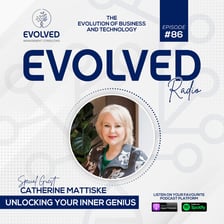
What happens is once you know your archetype, then you go, wow, that is me. I do use that language and people hear themselves using that language. And they go, yes, that is how I process new information. And then it's like, okay, everyone around me is different. Well, that's a bit scary. How do I then relate in a new way? Welcome to Evolved Radio where we explore the evolution of business and technology. I'm your host Todd Kane. Are you still relying on frustrating patchwork of legacy solutions? Modernize your cyber security and data protection with Acronis Cyber Protect Cloud. It's a single solution that combines backup, anti-malware and endpoint protection management. As an MSP, you can easily improve client security posture, eliminate complexity and generate more recurring revenue. Learn about Acronis Cyber Protect Cloud at acronis.com. Today on the Evolved Radio podcast, I'm chatting with Catherine Miskie, founder of the performance company. Catherine and I talk about a topic that's important to everyone, learning. Everyone spends a huge part of their life learning. But we're making a mistake in our approach to learning. You may have heard the terms visual learner, but in fact, there are many more modalities that we can leverage. If we understand how we learn and process information, learning becomes easier and our ability to acquire and use information, we're learning grows dramatically. Understanding these learning modalities is crucial in business as well. Knowing how your staff, your peers and your clients learn can be a massive competitive advantage to your ability to communicate. So let's dive in with Catherine as we discuss how to unlock your inner genius. If you enjoy the show, please consider leaving a rating and review in your favorite podcast app. It really helps to spread awareness and bring more listeners to the show so we can share the message with more of the community. Now, on with the show. Catherine, welcome to the Evolved Radio podcast. Thanks for having me. So, we got lots to cover here. Definitely going to be talking about the future of meetings, how people we should be considering how people learn. I think it would be a really interesting conversation illuminating some ideas where people have not thought about how they should be communicating with people and engaging with the people around them. So, uh, lots of good stuff if uh, you'd like to lead in, perhaps just gives a quick bit of background and tell us about your origin story. So, I'm from Australia and I'm currently in Melbourne, Australia, but most of my work is in the US and in Europe. And I do very little in Australia. And I actually grew up in the computer industry at the era of when PCs were just coming into offices and Microsoft launched their first products, Word and Excel and PowerPoint. They weren't even in Microsoft Office at that point, that's how that's how long ago it was. And when those products came into the market, everybody in business did training on them. Everybody, everybody did Microsoft work training and Excel training and I was that trainer. So, I was training five days a week and that's what started my career. Okay, so a very long history and in what I I'm interested in getting into here is adult education, I guess, right? Yeah, it is. And and I've always been in adult learning and I've never had a desire to teach children. Because adults are so complex, you know, children you can say sit still and listen, adults just don't function that way. So it was even in those early days of training for me. It people showed up and some people showed up and they were just there to check a box. And some people showed up because they really wanted to embrace this new technology. And there was everybody in between. Right. And it was those people who really wanted success that I started to look at and go, wow, that's interesting. Why are they different? And now 30 years later, there's still the same mix of people on a training course. That actually humans haven't changed. But what has changed is obviously a whole lot of technology and a whole lot of research around what really makes someone become that high performance learner. Which nobody knew back then. Hmm, interesting. Okay, so we're going to come into this I think a little sideways, definitely going to come back to this as well. I am interested, what are your thoughts on sort of the future of work and the fact that work from home, I think everyone agrees is now here to stay. In what element, to what degree, I think will vary from company to company. But I think it's an important consideration and I imagine there are some some adult learning models and considerations to go in here around having people in a room, having more social cohesion in that that respect. All the elements that people in a room helps with a meeting is not always going to be an option, like some people just simply work from home and they live in the same city. And a lot of organizations are now spreading to be global. And I I assume this is something that you have a lot of experience with in the fact that you as you said, you know, living in Australia, but a lot of your work is is in fact global. So what are your thoughts on sort of the hybrid work model going forward and how that impacts our our meetings? Well, Todd, I'm really opinioned about virtual working. Right. Let her rip. Yeah, I'm very opinioned. And when the pandemic hit, I thought, what do I know that I can share with people who are struggling to then take their workforce virtual? And in 2006, I took my workforce virtual. And it was the greatest decision I ever made. And I made the decision not through great management, it's because I didn't like doing performance reviews. So I thought if I didn't like doing performance reviews, how can I do that much more on a project by project basis and then build up a global market? That was really my intention. What actually happened at 90 degrees of that is I then became really good at virtual work. And so I wrote a book called leading virtual teams. So my opinion around the workplace is why on earth do we have office buildings? You know, that's where I'm at. I can see no reason in the world to have office buildings. Because I think that working virtually with the technology that's available now is an amazing concept. And I know that many organizations are going hybrid. But what we're finding there is that people who are in the room physically are being treated like first class passengers on an aircraft and people who are virtual or calling in are a bit like economy coach down the back of the aircraft, like you to get a bag of peanuts. And so there's that lack of equality for now in the hybrid workplace. Now, we're only just coming to grips with hybrid now, and I know that some organizations have done it for years. But we as a broader business structure are just coming to terms with that. And we're helping some organizations do that right now to say what technology do you need, what do you need as far as people goes, what do facilitators have to do in a meeting, what does in room participants have to do, what do virtual participants have to do? Because it's a whole new gig, right? And so, but I'm still not a fan. Personally, I think hybrid's pretty nuts, right? Just take them virtual, set them up with great technology, and if you want to meet, you can let literally for the amount of money that people pay for office leases, put that in a bucket and send everyone to Paris once a year, you know? So if you want to have an office environment to have drinks on a Friday night and lovely lunches. There's more options available now. Because when I started in 2006, there was no technology, it was just at the beginning of Webex, right? And so there was no real technology around. But now with the technology and the collaboration platforms that are around now, and I have never stopped being a bit of an IT nerd, even from those early days, even though now I don't do any IT training. But I've never lost that piece and now I love all of those collaboration tools. So, I think I'm I'm much more on your side of this equation. But I I certainly hear people sort of push back on this. So I'll play a little of the devil's advocate on this as well. What about those interactions that happen just circumstantially and bumping into each other in the hallway and those random conversations? Those are the things that I think people feel that they're missing and also a cultural element that definitely feels easier if you're in an office environment. What what are your thoughts on those two elements around the random interactions and the culture building that does come as a part of a in the office work structure? Absolutely, and I call that the water cooler chat. And often the water cooler chat in an office is where the connections are made between co-workers or even people that don't even work together, connections are made. And connections are made in in a very valuable way. Well, in a virtual space, that has to be more planned. But some of the things that we do is we just might have an open zoom call for three hours and you just show up and do your work. So you can chat if you want, or you can ask people questions, or you can just do whatever. But we just have like an open call to say, who wants to work with someone today? Yeah, this zoom call will be open for four hours. If you want to join, join, and people show up or they don't or whatever. Oh, hi, how are you going? And it's a bit more like a meeting room, more random. So you do have to plan for that. And other things that we see our clients doing, which are really interesting, is there'll be like a roulette wheel of coffee chats. So you just dial up someone and you go, do you want to be part of this, do you want to be part of this coffee roulette? And then they say, oh, Todd, you're match with Catherine. Okay, have a coffee. And then it's, Todd, what do you do? Where are you in the organization? Oh, well, I'm in this country and I'm in that country. Oh, that's really interesting. Great to meet you. So you do have to be more planned, but the culture is different, but different is okay. Yeah, I like the the coffee roulette idea. I've introduced people to that a few times and and seen it in in interaction. I think you're right to sort of uh caveat that with like this is voluntary, like we're going to not going to force people into uncomfortable interactions. It's not it's not a way to to gain their their confidence in the system. But some people do really need that type of outreach, right? Well, it comes from their personal preference of the way they like to work. And people who are really collaborative need that collaboration for fuel. Whereas other people who are much more independent, they go coffee, I don't need to do coffee with anybody. You know, I'm perfectly okay. I'm just over here banging away on my work, right? Yeah. Absolutely, and we often think that some industries are more in tune with being independent workers than others. Like there is that perception that some industries, you know, there's there's people in little tiny rooms doing things eight hours a day and they actually don't need anybody. That is absolutely false because there's as many people in those work environments who are collaborative workers who need and get fuel from other people, but they need to have that opening to do it. And so all of those people and culture type initiatives. Things like one of my clients did a walk from LA to San Diego virtually with their team. And so everyone for a month walked, some people were in an apartment and they walked around their apartment during lockdown, other people walked down the street, they could do whatever they were doing, and they went from LA to San Diego. And then they said, where are we going next? And so they said, okay, let's go to Vegas, so they walked from San Diego to Vegas. They've now walked around America. And so each time they get to a new city, they celebrate in Vegas. They're not there, they're virtual, but they set up a Vegas celebration. We made it, we're going to the casinos, we're going to shows, we're doing this one. Next one, New Orleans. Okay, we're going there and they all wear beads and blah, blah, blah, blah, blah. And it's like, for some people they go, oh, that is ridiculous. I would never do that. And other people go, I have got my shoes on, I'm walking. I'm in that team. So it needs to be tailored the whole virtual piece needs thought. You can't just say, oh, well, we're all virtual, too bad, so sad if you're a collaborative worker, bad luck. Or all of the culture pieces because it is a different culture. Yeah, culture is something I I think about a lot. You're hitting on a few things I think that that really are striking to me. Is that leaders often make the mistake of thinking that they have some level of control that they don't over culture. But you definitely plant the seeds for it and I think that's what we're talking about here is how do I create the conditions of what I want to see? And I think where people get this wrong in thinking that the office is necessary in order to develop the culture is because it is unintentional. Despite the fact that it's still in the office, they're not really thinking about it intentionally and they're just hoping that, well, because people are here, that is what develops the culture. So I I I think you're right, like it's not the office itself, it's the circumstances that it creates and those circumstances can absolutely be created in a virtual setting, you just have to be thoughtful about it. That's the distinction. And and you're right, the one size fits all is not how you approach any any people. We're all individuals and and I think being intentional again and understanding what people desire so that you can facilitate that and create those conditions to adapt your culture is is really, really meaningful. So that that kind of leads again towards team engagement. So if we want to expand on on that idea, I think these types of things are the things that will definitely facilitate an engaged team as you move to a remote situation. What are some of your other thoughts on on team engagement in a remote or hybrid environment? The one thing that I've been working on in the last 12 months is to take what I know about adult learning and learning preferences and people working in an agile business structure. And say, how do I take that piece of what I do out of Fortune 100 companies, because that's where we operate in in learning and development and take that to the broader business base. And the underlying premise of that is that in a learning and development space, we know about people, what their learning preferences are. How they can hook into new information quicker, better, faster and go and apply it. And so then how does that work then for a leader, a manager, a team member? And one of the most basic of basic principles is that underneath all of our communication, underneath everything, right under the surface of our being is our learning preference. And people don't know how they learn. And with that gap, it means that they don't know because of no fault of their own, how they can take on information quicker, process it better and then become more efficient and more effective and reach their goals. We're not taught how we learn. And so one of the things that I've been working on is the principle of what I call unlocking your inner genius. And what that is is to say in every communication, people are different to you, most likely. And I've come up with 12 archetypes that are easy for anybody, you don't have to be a learning and development professional, anybody to go, okay, what archetype am I and who am I communicating with? Now, coming back to what you just mentioned, the thing is that when you're working in a virtual environment or a hybrid environment or even a local environment if people are back in the office. The thing to remember is that everybody has these different nuances with the way they take in information. So, if you're working as a leader, a meeting facilitator in a learning situation and you're just giving out that information your way, that's one of 12 archetypes, but what about the other 11? So the trick is if you're talking to a group, then the question is how do I hook in all 12 archetypes, the 11 that are different to me? And that means translating the way you communicate. And they are the tools that I've been creating. Because what's happening, especially heightened in a virtual environment. Is people come into a meeting, they go, blah, blah, blah, blah, blah, blah, blah, they expect everybody to get it and they close the call. And so meetings are becoming shorter. Have you noticed the 20 minute meeting popping up now? It used to be an hour and now it's like 20 minutes. Which I think in general is a good trend, right? We don't need to fill the time, right? I love the trend. Yes. I love the trend, but my goodness, as a meeting participant, you've got to be on for that 20 minutes, you have to be focused because it's kind of like power hour, like everything in that hour is now done in 20 minutes. So it's a great thing, but. As a the person who is speaking in the meeting needs to make sure that their message is hooking in everybody else in a rapid time. And the people on the other end of that message, the receivers have to be translating that message and going, okay, have I got it, have I got it? And asking the very high impact questions, not just, you know, is everyone okay? That's a low impact question. But high impact questions, making sure everyone's on board, done, end call. So communication is going through a rapid change and I believe it's because of the overlay now of virtual in our lives. Because it's giving people the opportunity to go to way more meetings every day than they ever used to. Yeah. Have way more work than they ever used to. Because they're not commuting to meetings, even across a campus at work, even across a building, even going from floor to floor. They're not doing that, they can go from one zoom call to the next, to the next, to the next. So it's time now to say, hang on a second. I need to get underneath my general communication and say, how am I actually communicating in the most efficient way possible? What this reminds me of is a lot of great quotes from uh management leader Mark Horsman and one that that this reminds me of is communication is what the listener does. And I think is a great way to to sort of frame this is like you feel like you're communicating well and you're hitting on all the points. But if the person you're trying to reach is not hooking in and not understanding what you're asking in the way that makes sense to them, it's kind of just blah, blah, blah, right? Like the Charlie Brown's teacher at the front of front of the class, right? Exactly. And it's so easy, it's it's a skill and not many people are born with that skill. It's an absolute skill because what happens is we have our own learning preference. And our language and our choice of words that we use, all of us, is built on that learning preference. So I might say a phrase like in light of or at first glance or let me take a look at that, or oh, this is a new perspective, because I'm a visual learner. So my language is visual. Whereas for you, you might say, I've got a feeling that or you might say something like in concrete terms, or let's switch gears, or let's tackle the issue. That's a kinesthetic learner. Now that comes out in people's language. So I can tell that within two minutes of talking to someone, I go, okay, that's the language they're using. And instead of speaking my language, I speak their language. Yeah. So it's actually quite easy. But to your point, you have to be a very astute listener. To be able to go, okay, what's that language there and then start to translate your language into theirs. Because if I speak in your language, Todd, you go, hey, Catherine, she's just like me. Yeah. And she she gets me, she understands me, and I just get what she's saying. Yeah. You get what I'm saying because I'm talking in your language. Yeah, this is this is interesting because like honestly, this is something that I was kind of loosely aware of. Like I always understood that some people are auditory, some people are visual learners. But I never really ascribed the importance to this that I think was necessary. Especially as I started building educational material and courses, this became like this really hit me in the face once I started getting feedback from from people on what I was building. Because when I take courses, for example, like the quizzes don't really seem that meaningful to me, it feels like it's just a hurdle to get over. So I never included that in in the stuff that I was building. And then got this mountain of feedback from the first cohort that went through some of the the courses and they're like, I'd I'd like some some quizzes or something and at first I was just like, well, the managers are trying to judge whether or not the people are getting this and that they're actually like reading the material. But then I I I talked to people and they're like, no, like this this helps me understand what I'm what I'm supposed to be learning and it helps in my understanding of this process. Same thing with like downloadable resources or how much of this is verbal versus visual, all of those things and then the final one being those exercises and putting some of this stuff into action. So this became really front and center for me and and I started to to better understand this as I read more material on it because like you said, it it's one of those things that like subconsciously it's important to us, but unless you have an awareness of it, it really doesn't it's not as practical. It it has to be put into use and it has to be understood in context in order for you to really leverage these invisible languages that we have, right? Hmm. Exactly. And I'm doing a a program at the moment, I'm facilitating a program and we're halfway through. And there's 23 people on the program and when we did the team map for their different archetypes, they're all over the place and that would be normal in a group of 23 people. So I'm one archetype, the facilitator, and I've got all these 12 archetypes in this group of 23 people. And I've said to them, let's now go behind the curtain and once you do that, you can never go back. So they're saying, great, show us, how do I translate this of what I'm communicating to my team and so on? Now these people are giants of industry, massive big companies, military, and they're all in. And I said, we're going to learn this tool called the translator tool. Where you can translate your message, email, report, presentation, to speaking to someone into a different language. And they did it yesterday and they went, oh my goodness. Look at the difference when you actually translate, it's like translating from English to French. It's you translate your message into the recipient's language. And then when they get it, they go, whoa, yeah, got it. Okay, good. Next. They hook into your email or your presentation or whatever. And they all just said, how have I been through my whole life without doing this, because now I can never unknow this. Right. Because once you know, you can never not know. And I warned them before, I said, this is going to mess up your life. I said, because you're now going to review every email that you wrote to your senior leaders and why they never responded and you'll know why. And now your presentation that you did for that customer and you didn't get that customer and you'll now know why. I said, if you're willing to know that, then come on the journey. If you don't want to know, if you want to live in a beautiful place of denial, then just go and do that. And they went, no, no, no, we're all in. And so then it was just like blowing their communication apart. Yeah. That's great. So just to give a quick review because I think we we maybe skipped past this, sort of the learning modalities are visual, auditory and kinesthetic. And kinesthetic, not a common term, which is basically touch and feel, right? Are those sort of the three major categories of of the learning models? Yeah, there is. And that's the sense base, so you've got your five senses and that's how we take information into our brain, basically, through those five senses. So, uh, visual is is seeing, learning by seeing, auditory, learning by hearing, and kinesthetic, learning by doing. So, kinesthetic's got the word kinetic in it, so that's the movement and doing. So, language mirrors each of those modalities. And so those phrases, listen out for the phrases. So visual is, I see what you mean. Auditory is things like talk to me, or tell me about, or that's unheard of, all of that is like auditory words. And kinesthetic learners say things like, I've got a grip on that, let's switch gears, let's have a balanced approach, let's change tracks, that's the language of a kinesthetic learner. So in a genius, that's one part of it. And then the other part of it is so that's how you take in information with your what I refer to as brain fuel, which is visual kinesthetic. And then the next part of it is how do you process that information in your brain and I've got four of those different dimensions. And then the intersection of the three brain fuels, visual kinesthetic and the four processing powers makes your 12 archetypes. So you it ends up on a matrix of 12 archetypes. So what happens is once you know your archetype, then you go, wow, that is me. I do use that language and people hear themselves using that language and they go, yes, that is how I process new information. And then it's like, okay, everyone around me is different. Well, that's a bit scary. How do I then relate in a new way? You had a quote in your book a couple of times, which I absolutely love, which is know thyself. All right, and I think that that's incredibly powerful. And and in these types of learning models, I think this is a really important point is the first stop is understanding yourself. Like what is your preference, how do you learn so that you can apply that in future learning? And then the second step is understanding how how those languages interact with the people around you and being able to leverage those. And I do a lot of work in behavioral models like disc, for example, and I saw a lot of similarities in in sort of how you're you're sort of encapsulating this into the matrix. And seeing it in that same model. Of it once I understand this, I see sort of how people interact and I have a better awareness of this. So I'm able to leverage it. Whereas before I was kind of blind to it, it happened, but I was unaware. I think that's a really sort of powerful shift that people can make. One of the other parts I wanted to hit on is I love this this quote on the power of story that you're hitting on in the book as well. So I'll give you the quote from this Harvard study that you quoted, organizational psychologist Peg Newhauser found that learning which stems from well-told story is remembered more accurately and for far longer than learning derived from facts and figures. Similarly, psychologist Jerome Bruner's research suggests that facts are 20 times more likely to be remembered if they are part of a story. Like if that doesn't sell it to you, I don't know what does. But if you're trying to communicate a complicated PowerPoint deck and you're just smashing people with all the logic. And everyone seems to be like, yeah, sounds good. I don't really understand this though. You're you're missing that that element of story. This is certainly something that I've worked really hard on. I don't come by story naturally for some reason. I kind of have to back my way into it. I'm a very logic-based person. But it's certainly something I'm trying to build into any presentations that I give is always thinking, what am I trying to tell and how can I attach this to a story? Because I I recognize that as well is that if you if you can get people to relate a story to you, they get the details way more accurate than if you just try to tell them the facts and figures. And this is born out by by that Harvard study, obviously. I think there's two approaches that you can immediately take. The first thing is, there's a group of learners, three of the 12 archetypes are under a pillar called connect. And those people, before they go into all the facts and data, they are the people that say, why am I doing this, what's in it for me, they need to be really feeling a connection to what's going to happen or to their team or to whatever. That's where they live, eat and breathe their world. Now, those people can easily be hooked in at the beginning of each meeting or at the beginning of each presentation, before you go in, as you said, all the facts and figures. By really answering the question for them. What's the benefit and what's the advantage for me? So putting yourself in the meeting participants shoes, whether it's a client or a team or whatever, and saying, what's in this for you, what's the benefit? And if you can then attach a story, one of the easiest stories to tell is around who is the person who's going to use this thing. What is the meaning for that person? So to think of, for example, if you've done, let's say you're an IT person and you've done persona mapping of who are the people that are going to use this system or whatever. If you give one of those those personas a name, it doesn't matter what the name is. But if you give one of those personas a name and say, if I was this person, this is how this would link to me. Immediately, you have that connection forged with three out of the 12 archetypes. They then get it, they're connected to it, they're their question around asking why and turning that information right there into some sort of image is there in their mind. Then follow that up with the detail. And when the detail is coming in, attach that detail to the story. So your detail might be around, well, we heard about how Max would use this, well, this is the part that Max would use for this. This is the part that Max would use for this, so putting that real life slant onto what is often a myriad of facts. So and then into from there into the more practical processes after that. But that ability to tell stories is not natural for many people because it's not your natural archetype. Okay, so it's not. It's it's a learned skill. And so one of the first things to do, I would say, is start with that connection piece. At the beginning of every presentation, even at the beginning of every email. Try and get that connect in the first sentence. This is why we're doing what we're doing, this is why I'm sending the email to you. And think about those words benefit and advantage. And then go into it from there. But storytelling, try and put yourself. In the shoes of the person, you don't have to have a story from history. Or a story from the newspaper or a story from a book, just get into it yourself from your experience. It will work every time. Yeah, I think there's an expression I heard from somebody recently. It says, the story doesn't have to be true as long as it's not a lie. Which I thought was a good way to frame it. Right. Like you don't necessarily have to have a real life example that is that is from your own experience, but just framing it in the context of a story in order to wrap the message into it is the key point. I think was a good sort of understanding for me in that, right? Yeah. And exactly, Todd. And if you start that story with the word imagine, so imagine, comma, a situation when this happens. Just by using that word imagine, people go, oh, okay, we're about to imagine something. It's just a hook to get people in. And then, you know, you might be doing. Let's say a new IT initiative. So you could say, imagine the organization with an error-free rate on whatever, whatever. Or imagine our organization where we didn't need to have customer complaints area because there were no complaints. People immediately, they go, oh, wow, yeah, okay, that would be amazing. That would be nice. Sure. Where do we sign up? Where do we sign up? Exactly, and then our system that we're building is driving towards that future state. And people go, oh, hello. Rather than we've built a system to reduce customer complaints by 4% over the next three years. It's practical, it's efficient. It's here's all the facts and here's the plan. Here's the 30 page report that we've done. It's like, oh, please. You know. So it could be the smartest system in the world, but who's listening? So that's an important point that I. I did want to circle back on. Is there has to be sort of a maybe a shortcut in using this, like obviously you want to you want to tailor your communication, especially if you're trying to educate or if you're trying to connect with someone on some of this stuff. But I I have to assume there's sort of a people are cut into a strata and there's there's a dominant learning preference in society and you know, I I may be surprised, but are you suggesting that that it's not everyone that will appeal to a story? Or it's just that certain people have have a stronger connection to that. I realize that's two questions. So maybe we'll start with. Do you have some data on what the strata is on how much of a percentage of people as a whole are visual, auditory or kinesthetic learners? Just so that we can kind of shortcut to the to the larger group first and then appeal to the others after. Well. Up until two years ago. It was definitely visual and kinesthetic and for all of the people, for the thousands of people that did a basic VAK profile. In our training processes, in our training programs, it was very rare that we saw an auditory learner. And I'm in the business of teaching trainers and instructional designers and people putting together training. And I said to them and I've said it for years, if you have an auditory participant come into your training room, you will be, it may be the only one that you've had in your whole career. Now. I have a new hypothesis because now that we have in a genius, which is a much broader based profile. And very different. It's it's certainly got the VAK baked into it, but that's not the only thing. I have a new hypothesis that I'm working with a university on right now in the US. My hypothesis is. Because of the technology changes and the upswing of things like podcasts, here we are today. Audio books and so on. There is my hypothesis is, is there a shift in the learning preferences of adults? Because what's happening as we see all of the results of course of the ingenious profile. So if an organization does the ingenious profile and we see the results, we can see who's who. And what we're seeing is very balanced across the 12 archetypes. And it was such a shock to me, I went back to the team that developed the profile and I said there's something wrong with the algorithm. Yeah. It's interesting. It's interesting. So, another point I wanted to touch on was uh something you hit on sort of later in the book that I thought was really, really important. Because I think especially adult learners, we tend to be very hard on ourselves. About what what we should be learning and especially at what pace we should be learning. And you noted kind of overload on information intake and people I think criticize themselves about their ability to learn something new. And to be able to make it actionable far too early. Uh and they they end up doubting their own ability when it's really it's our own expectation of our own performance that's wrong. You want to hit on that and maybe expand on on sort of how we should be maybe a little softer on ourselves. And allow time for us to kind of collect that information and master something before we expect the results to come right away. Yeah, there's a a mindset that I refer to as the growth mindset. And a lot of people have written about it. And and one of those things is that I see people show up in a learning environment. Every day of my life. And people with a growth mindset, one of the attributes that I see is that they go slow in the beginning to go fast in the end. So they take the time to lay the foundations and it could be slow in the beginning. But what happens is because those foundations are rock solid, they can really speed ahead in the end. So that's just one of those attributes. I the other thing is that. I know that we are not taught how we learn. And if you can unlock the way you learn and it's not just your archetype, but there's another piece that I give people called a power up. And that's really how to accelerate your own learning. So you can have two people with the same archetype, but they'll have different power ups. And that's if you can get into that expert zone. As I call it, when you're learning. You're unstoppable. People's learning ability is so fast and so incredible, but only when they get into a zone where they can take in information their way. And the problem. Is that they may be one particular archetype and they're trying to struggle through. A college education that's been given to them, like poured on them. In a way that is not the way they learn. So it's the ability to say, that's not my way. But I know how to make it my way. For me, the worst thing you can do to me is put me in a three-hour lecture. That is my idea of going to jail. It's hideous for me. But I know that the way I learn is by taking lots of notes. By making things visual. Everything's in color, everything's color coded. And I have absorbed that three-hour lecture. And I go, that's just my system of taking notes. What do you use? And they go. Oh. I don't have any notes. I don't have any notes. But can I take yours? It's like, really? Yeah. Just do it your way. And so you've got to find your sweet spot. However it is, you learn. If you are one of those people, as you said, you clamoring for podcasts, then you would record that three-hour lecture and play it over and over and over again and then you're sweet. Or you might be somebody who says, I'm going to take that recording. And I'm going to go for a walk in the park. I'm going to take the dog out. And I'll listen to that there. Or I'll put that into action in some way. Whatever it is for you. You've got to find your expert zone. Because once you find it. Life becomes so much easier. You go. Oh. New system. Okay. Off we go. Because you know how you learn. And you can take any old message and translate it. That's so key. Right. I think that that's what people misunderstand. Is that they feel like this is too hard, I feel like I'm really forcing my way into this. Because you're you're trying to learn in a way that your brain is just like, you know, constantly having to translate and doing so much extra effort. In order to to kind of push that information in. Another thing that you reminded me of. That I I I haven't seen a lot of lately. But there was a period maybe 10 or 12 years ago. Where a lot of meetings I went to. There would be a facilitator silently in the background. Doing a visual note taking. I thought those were amazing. They would just have like an entire wall full of of visual like and it would it would flow like a path around what was talked about. What the lessons learned were, what the outputs, the action items. I thought it was such a cool way to take notes. And that I would often just like take pictures of them. Because they were actually kind of a beautiful representation. Of a three-hour meeting. Right. Absolutely. And at conferences, you know, in the in the old world. When we could go to conferences. They would put them up in the lobby area. And they'd have each day. Those people are so talented, aren't they? Really. Yeah. And it's not only their ability to draw, it's their ability to take from a speaker. The key information and put it down. What's amazing is that those people. That's completely normal for them and natural. They don't have to think about that. Right. So that's just there. That's their archetype. Coming out in play. And they happen to be able to earn money from that. So happy days. Yeah. And so and there's lots of people that can do that. And that's their way. And then for people that don't have that skill. Like you, for example, you go, wow, that's amazing. And that becomes a great job aid for you. Because you can then immediately associate with it. But everyone has that sweet spot. Everybody. And it's just about finding that. And on the flip side of that, Todd, you know, when you're facilitating a meeting. Or perhaps you're running a training course or whatever you're doing. So many people say to me, oh, Catherine, I've got such difficult participants. They just don't get it, whatever, whatever. And there's no such thing as a difficult participant. They're just different to you. And as you experienced, Todd, when you were doing your design. And people say, we need practice, we need the review. We need that review quiz at the end, we need to have job aids and downloads. They're just different to you. So in your first cut of that program, you wrote that for you. You wrote that how you learned. And you could have easily taken a negative approach to that, like, oh, they're just difficult. They want all this stuff, I'm not doing that. But no, they're just different to you. They need different things. So the trick is for the facilitator, for the meeting leader, for the manager, for the team leader. Whoever it is communicating, the salesperson. You know, it is about creating the message for everybody. And to have a look in the mirror, you know, as you brush your teeth and go. Are they really difficult or is it me? Am I just not giving them what they need? Yeah. This has been fantastic, Catherine. Obviously, we'll link to the book and to yourself in the show notes. Anything that that we we haven't touched on that you want to drop as final knowledge for for any of the listeners? I think the main thing is that we're all okay, we're all normal, we're all doing life our way, and for those people that want to sharpen up how they're working. How they're communicating, how they ultimately influence others. It's a skill. And no baby is born with that skill. You know, it's not genetic. It is a skill that is learned. And it's never too late to learn the skill. So if you're listening to the podcast and you're 15 years old, great, fabulous. You've got a whole lifetime ahead of you. And if you're 70 years old listening to this, fantastic, because it's never too late. You can just polish up what you're doing. And actually it makes it easier for yourself. So this whole realm that I work in is not a natural born thing. It's a skill that can be learned. So if you're willing to learn the skill, it's available. Excellent. And if anyone wants to know more or wants to to reach out to you or to follow you on social. Where should they look? So the first thing is, is that I'm really active on LinkedIn, so just chat with me on LinkedIn, connect with me on LinkedIn, and if you want to have a coffee with me, send me a message on LinkedIn. I'll send you my calendar. And have a coffee with me. So that's easy. And also our websites, which we'll put in the show notes and my email address, whatever. And just reach out and and I'm Todd, I'm in the Mother Teresa phase of my career. I just am at the point where I'm giving out knowledge to help people. If I can help someone, I'm happy. So call me. Have a coffee. Whatever. Virtual coffee, because I'm not doing the whole in person. That's amazing. Really appreciate your time, Catherine, this has been fantastic. And wish you all the best and appreciate your your inputs on on growing people as well. Thank you, Todd. Great to be with you.