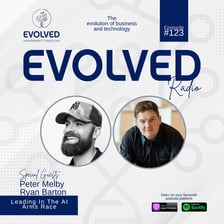
We can't look at the problems of our organization and think, oh, technology will save us. Like we have to build organizations that can handle the chaos that's coming in the door every single day. And the chaos that we live in. And so we have to have the strategy, the people, the culture that can really wrangle that well. And automation of course is powerful. I think that AI is really interesting because all along, all of us in the MSP space should be doing a better job of keeping clean data. Should be documenting in better ways, should be doing more automation and should be focusing on RPA. But it's really hard to do those things. It's like really hard to get traction on all of that. But AI is kind of like the gold in the hills that's like, okay, I'll do the long hike that I know I should have done anyway because maybe I'll pick up some gold nuggets at the end of it. And so I think AI is that inspiration to do all that hard work. Welcome to Evolved Radio where we explore the evolution of business and technology. I'm your host Todd Kane. Tired of fighting the MSP fires alone? The Opsleader Pro group connects service delivery professionals who understand your daily challenges. From KPIs and workflows to career planning and team management, Opsleader Pro has systems for you to use. Join operations leaders from successful MSPs who are sharing real solutions for managing client expectations, optimizing service delivery and making your service delivery team as effective as possible. Opsleader Pro because your service desk deserves more than just survival mode. Visit opsleader.co that's O P S leader.co to join the public community. Hey and welcome back to another episode of the Evolved Radio podcast. In this episode, I'm joined by Peter Melby and Ryan Barton with New Charter Technologies. Sure, AI is everywhere these days, but we cut through the hype and talk about how things actually changed when Chat GPT hit the scene and suddenly put powerful AI tools in the hands of everyone. Ryan shares how the breakthrough moment inspired him to roll up his sleeves and experiment with AI in real business scenarios. Peter talks about why New Charter decided to take a hands-on approach with AI instead of just waiting around for vendors to figure it out. We talk honestly about what's working, what isn't, and why sometimes you just need to make your own path with new technology. If you want an inside look at how AI is impacting MSPs or just curious about what's really possible right now, tune in. We've got practical insights, plenty of candid takes, and even a few laughs along the way. Enjoy. Peter, Ryan. Welcome to the Evolved Radio podcast. Good to be here. Thanks, yeah, this is great. So, we're going to be digging into a topic that gets a lot of air time. But I think we're going to be taking some maybe some some interesting hot takes on this a little bit. AI is something everyone is certainly familiar with. And I have some feelings about sort of how much the term is used and it's used properly in a lot of cases, which is certainly something we'll we'll dig into. Maybe to start off. Let's talk a bit about sort of like uh Ryan, you described this as the way that the day the world changed. And introduction of Chat GPT kind of for a lot of people came out of nowhere and really revolutionized things in a in a pretty pretty short term. You've gone pretty deep on this, Ryan, I'm curious on sort of like where were you, what happened? Like how did you end up becoming so captured by by AI and its capabilities? Well, I hope I haven't been captured by AI. I hope we're capturing AI, that's the that's the hope. Yeah, you know, I think like so many of us have always been fascinated by trends and been in the tech industry long enough to see things change dramatically. So, I've been keeping an eye on AI for years and reading books and trying to understand the technology. And LLMs have been around for a long time. I think what happened in November of 22 and then specifically in April of 2023 when the underlying intelligence was upgraded to GPT 40. Was that everyone saw this sort of phase shift in the AI landscape. Where now this wasn't just about the capabilities of this underlying intelligence, but it was about the arms race that started all of the companies around that started a very direct race. That had a very specific orientation towards a certain kind of future. That was clearly going to change things dramatically. And at the time I happened to be um one of the ventures I was doing. I was actually building a nonprofit alongside one of the world's leading cognitive scientists, his name is Dr. John Verveki. And so I was with him all the time when this happened and to see his response as a professional researcher of intelligence. And then to be surrounded by researchers and top thinkers in the world gave me this fascinating lens into it. And as I started to look back into the MSP industry with that lens, I asked myself, do we know where this is going? And I think the answer for everyone in every industry then and largely now is no we don't. And that's what spurred a lot of action for me. Okay, interesting. And Peter, like uh your sort of your first take on on AI and how it ended up becoming like really, really important for your company as well. Yeah, it's it's one of those things where I think we can recognize the importance of it while also acknowledging that not a lot of us have expertise in it. And you know, for for me, if I rewind eight years, you know, from from that date, that's the date that Ryan and I started talking. And it obviously at that point wasn't talking about AI, it was talking about the world and we were building MSPs and we had a different take. You know, on what, you know, our businesses meant, how we wanted to build them. And so it was it's interesting, I I processed this in a few different ways. One of them, you know, as a consumer looking at it and saying, okay, wow, there's all of this this power now that I haven't, you know, been digging into. It is new to me, you know, not as a macro topic, but as you know, a a tangible, you know, real thing for me to be using. And then started to connect with, you know, the people that I saw that frankly knew more about it than I did. And had shared, you know, share world views. And so for me, it was a point of humility and looking at it. And recognizing that my view has always been how do we be ahead, you know, of the understanding, you know, and ahead of the practical application, you know, of these things. And so where I was, you know, I'll say, you know, I don't want to say caught off guard. But, you know, it it it was new. You know, it was this thing where I looked at it and I immediately got to change my way of thinking. You know, and and connect with the people who have been, you know, tracking this a lot more. You know, in that that process. And so that that my very much started, you know, at that point. Um in terms of figuring out both how how it was going to impact my day-to-day and the business overall. And maybe for both of you like like how is this different for you? Because like AI has been a term in our industry for a long time, right? And it's largely just been machine learning. And Ryan, as you said, like LLMs totally changed the game. But like like I guess what was what did you see as different or or the opportunity or why that was particularly interesting? Considering like AI was not new, but there was obviously these these sort of like really strong capabilities like seemingly all of a sudden. And is was that your sense of it, was this sudden or did you like were you tracking some of this beforehand? There was a pretty common consensus that AI was going to change the world someday. And that this growth of intelligence would be significant that LLMs would play a real part in it. I mean, we all saw that Google Translate dramatically changed its capabilities and I think it was 2017 when they switched to an LLM based. I mean, we all saw YouTube recommendations get better and better and Meta completely changed their strategy with AI. But it was the province of huge companies with enormous budgets and massive amounts of data. It wasn't available to the SMB space. And I think that what Open AI did was they unlocked some scaling capabilities. And they got the world used to AIs that weren't precise. I mean, that was a lot of what held these big companies like Google back before. It was like, well, this isn't precise, this isn't exactly correct, so it's not that useful. And Open AI got it close enough that it opened the imagination for everyone. And I think that chat was interesting, but it was realizing the underlying intelligence and then the rate at which it was going. And the dynamics that were spurring the rate of that intelligence growth. It said, okay, for me as I started to get closer to it, I was like, all right, what is this like? And the answer is not like very much. Like this is actually a novel category. And when we have a novel introduction, we have something that is novel, we have to be careful about how we frame it. Because we want it to be like something we've seen before, like something we're familiar with. I think that any rigorous scrutiny of of modern AI development where we have LLMs with this kind of scaling power and compute behind them. We'll see that this is a novel technology that has different properties than the technologies we've seen before. And that that it is very difficult to predict how it's going to go. And that our previous mental models of every other technology and how we've seen it roll out and what it does and how it changes the world really can't be trusted. I was just going to say for for me in in my perspective of it. When Chat GPT came out, it was so much more generic and broad than anything that we had seen before that. So you mentioned Google Translate, you know, I I remember Pandora, you know, back in the day. The first time that you could put in, say, I like Master of Puppets by Metallica and it can curate, you know, all of the songs and play them for you based on that. That was amazing, we looked at it and said, wow, this, you know, there was. But we but but it was very specific, it was very confined. You know, and so Chat GPT for for me was the first time that I could go to it and say, I want you to help me process this business. You know, uh problem, you know, and help me generate content on this. Or if I want you to build a Dungeons and Dragons campaign for my, you know, son and his friends. So different and so broad and so open. You know, and that was that was brand new based on what I was, you know, experiencing at at the time. Yeah, I think that's an interesting point, right? Because like the AI beforehand was was like a reason why I sort of balk at it being called AI is that it was very programmatic, right? Like it was a lot of if then statements masked as machine learning and then masked as AI. And it really was not intelligent, right? It required a lot of sort of preceding and understanding branch chain and and all of that the sort of the programmatic procedure for that. Uh and LLMs are very different from that. One of the things like I brought this up a couple of times, but like I still I find it so fascinating that I still think it's relevant to bring up. Is like as much as we call the current AI models intelligent, we know that they're not, but the way that they actually work, I don't think is commonly understood and is kind of wild if you think about it. Like it's functionally a parlor trick. Right? Like it has no idea what it's doing other than predicting the next string of letters to put together. Yet, you know, it can pass bar exams and score high on SATs and write incredible business cases, analyze all kinds of information. But, you know, under the hood, if you really conceptually understand it, like it has no idea what it's doing, right? Like yet it can generate amazing like photo realistic images. I find this absolutely fascinating. I'd I'd love your take on that part of it, Ryan, that that it's it's not actually intelligent, but holy crap, can it play it well. Well said, Todd. I I agree with everything that you just shared. And I think I think that artificial intelligence puts it in a category in our brain where we think it's like our intelligence. And it's not, it's completely foreign, it's different, we can't extrapolate onto it. And yet it is incredibly powerful. And I think that the the fact that AI models are divorced from reality is a really important underlying fact that doesn't get talked about enough. They are just models. Where we've built these neural networks that are essentially hungry to learn, they want to learn. And then we have these interfaces that just want to please us by delivering the right next token of something that we that that thinks that we would want and that we're happy with. And that we do this reinforcement learning around that. And that's it. It is not connected to reality. It does not have a body that's evolved over billions of years of species development that can actually connect to reality and see what's true and connect to something that's beautiful. There are no there's no awareness of that, there's no ability for these AI models to actually understand what is relevant. It requires humans to say this is what's relevant, this is what's true, this is what's helpful. And yet there's this tremendous power in these layers of understanding, well, understanding is not the right word for it. Here's here's where we have to try to be careful with our terms. There's these layers of capabilities and these properties that are emerging as we scale these models. That are novel and powerful and can solve real world problems and make an enormous impact on our real world day-to-day. And yet, what is the thing? Is that actually intelligence if you have something that's divorced from reality that requires a human to tell it what's relevant, is that intelligence or is that something else? Yeah, really fascinating. Okay. So, let's sort of pivot towards um, you know, what you guys have have developed here. And maybe Ryan, we'll start with uh sort of what you were working on and then we'll spin to when you and Peter connected and and saw sort of the the joint business opportunity here. So give us a bit of the background here, Ryan. Yeah, so what I was really hungry for was a prediction model that could accurately predict how the development of more power within LLMs would show up within the MSP space. So we could prepare business and we could lead appropriately. And I don't know about you, but my experience of the AI space in general is one that is just like rank with bullshit. There is just so much hype, there is so much. And I use bullshit, it's kind of fun, it's actually my favorite philosophical term. Harry Frankfurt, this philosopher wrote a book called On Bullshit where he technically defines bullshit as something that is has no relationship with the truth. Like a lie still has relationship with the truth. Bullshit just has no relationship with the truth. And so I'm using it in a philosophically technical sense. Uh which I like to tell my teenage nephews that that's the way you can use bullshit. So. It's bullshit. I'm educated. Yes, exactly. So, there's so much hype and there's so much emotion around this and so much prognosticating about utopia and dystopia that's coming. That it really clouded like, well, how is this actually going to show up in my business? Like you'd go from these conversations about utopia and dystopia to then I have chat that can help me. Like, okay, Where's the in between? And so I had a really good friend Aaron Bassett who I've known for for decades, who's a great startup DevOps architect, startup leader. And I was like, hey, let's just partner in this, we pulled a team together. To actually build the tooling that would allow us to take the underlying intelligence to solve real challenges within MSP business processes. And our goal was to build the tools, but really the tools are just the MVPs, the minimum viable products that would allow us to test the broader assumptions. And build a model for on which we could build a prediction model, strategy, service design, tooling, and then underlying models and architecture for that. And that's really what we were about is for me, how do we actually build the right strategy and the full stack in something that starts to bring this transformative power in MSPs. And we kind of built it and then said like, what do we want to do with this? Who's who wants to buy the stack, we don't want to just be a tool vendor, it's that whole vertical stack that's compelling. And Peter was like, well, let me tell you more about New Charter, which of course I knew from all those years. Um but I got I got a better education about the strategy at New Charter and that's really where where the genesis of this partnership came out. And Peter, I'm like particularly curious, like just to to to frame frame your your response on this, like one of the things I'm particularly curious about is sort of your approach to this. Of like, you know what, we need to inhouse this. Right? Because there's not that there's a lack of vendors that are interested, talking about and developing AI. Right? So like I'm really curious about your approach to this in that that that the like this you saw this as an opportunity to directly for the company to integrate this as as a sort of a core part of your platform. I think this is a really sort of innovative and brave way to approach this. So I'd I'd sort of love your sort of your approach on that. Yeah, so it it it's a great point. There's no shortage of vendors who are working on this. There's no shortage of funding going into that. And there's no shortage of influence that New Charter has in the vendor community. So you would think that that would lead to us being able to have the best outcomes, you know, of anybody based on what's happening, you know, being able to to leverage hundreds of millions of dollars, you know, of development and investment. Here's the challenge. That we saw. So, New Charter is a platform that's been, you know, built, you know, through acquiring best in class MSPs, bringing them together. You know, looking at it from to to the lens of how do we preserve what makes these companies great. And also build, you know, centrally and uniformly in a way that that that builds scale. And so we we had this critical mass. Um we had all all these customers, we had, you know, great service tax. Um and we have all kinds of people who are out in the market, you know, sourcing what's happening with vendors, technical opinions, technical investment. And we really struggled to get anything meaningful out. And the thesis that I developed over time was the fact that. When there's an issue, especially a a widely publicized opportunity and challenge in the market, the way we've seen with security, the way we've seen with, you know, some of the emerging trends over the last 20 years. There's a rush of investment dollars, there's a rush of investment time. You know, there are vendors that pop up, there are vendors that, you know, remobilize around these efforts. Um and all of that's good. But every time we go to engage them and they're in that startup mode, they're trying to figure this out themselves, manage the uncertainty of it. We have to morph our business to the way that they think. We have to morph our business, you know, to, you know, and they're still figuring out how they think. You know, and if anybody comes and says, oh, we've already got to figure it out, it's obviously lying. So, the thesis that we developed and Ryan and I started talking about this. Because I said, you're so deep in this, I just need to understand how you're viewing this. We have a shared view of, you know, not wanting the vendors to be our to to set our future. We want to own our own future, you know, in how we've developed this. So he he was first first person I went to this as and just said, tell me how you're thinking about it. And yeah, I know you're you're doing some of this stuff, yeah, I'd love to hear what you're doing. And as those conversations emerged, what came out was not the ability for us to say, you know, turn our back on the vendor development and vendor community. But in that whole stack that he was talking about, that was very important. But also the process and the as as he very quickly, you know, told me he's like, this is a flywheel. It has to be a flywheel. We have to iterate, we have to iterate based on the knowledge that we're getting, you know, moment to moment. And the vendors are not going to do that for us. So the way that I, you know, learned articulated is I said, I don't want to replace what, you know, is happening in the market when it comes to innovation. But we have to perpetually own our next 18 months of this. Because that it'll take me 18 months to get meaningful results from a vendor. I would rather dive in and have an iterative approach, people to trust, you know, close to the business and say, we can make, you know, these these micro improvements. We can learn ourselves. We can improve this and then when there's something off the shelf. That we can replace this with and there's a robustness, you know, and we can consistency to it. That's great. We'll move on to the next thing. You know, and so it's really about owning our short-term reality in this rather than having to wait for the impact of these things, you know, and having to morph to vendor strategy. Yeah, I think that's really insightful. Because like I always joke like part of the fun of the IT industry is that everything has a six-month shelf life. So like everything is brand new and fresh like all the time. And now like we're in this weird space where, you know, the the AI space, like the revolutions are like monthly and sometimes weekly, right? So I think that that's an important insight of like waiting a year and a half for the next development cycle of a major vendor, like that's a long time in the AI space. You know, you don't know how long it's going to take till you get deep faked or something like that. Right? Like the the change the pattern of change is so rapid, right? It's funny, I I looked at it, you know, and and the investment, you know, trajectory changing, especially in the vendor side of things also has had a big impact. Because I think that in you know, that development cycles have gotten longer because profitability has become such a key aspect, you know, in these investor sponsored tools. And not just profitability, but massive profitability. And so that's going to to squash innovation, you know, in some way, shape or form. I I believe that that organizations need to be healthy that if you have an organization that's not, you know, profitable that it also has a shelf life, but that there has to be a balance, you know, in that. And that was one of the things when Ryan was sharing with me what what they had built. His first thing I said is, wow, I haven't seen that level of impact in anything. Any vendor, you know, has has shown us. He said, yeah, we've we've we've got something, you know, really special here. And I said, you know, he's like, we we could go be, you know, a vendor and go compete with them, you know, on who has the best tech. But a lot of that comes down to who has the best marketing, you know, and. I said, well, we don't even as I I I can't imagine you being a vendor. He said, yeah, it's not really the future I want. And so, um, he said, all right, well, we we have this unique scale. You know, we have the ability to invest, you know, in this. And so that was the start of the conversation that ended up being quite a long conversation because it didn't make sense to a lot of people. You know, including our ecosystem, you know, our investors, you know, and so we and we had to be ready for it as an organization too. So that really was the journey pre acquisition of orchestrate, um that was. Arranging ourselves. In a way that made sense as well. Yeah, and I just want to underline really quick for anyone who's listening, who's working for someone who sells software. Build cool shit and we will buy it. Like we want the best stuff. Build great stuff. We have our own innovation flywheel for a couple of reasons, like one is that we can do the hard work of implementing. The RPA tools, the AI tooling that's already existing out there that's hard to do at scale. That we can put focused leadership and team on it. Two is we can run our own experiments so we get really close to this, we can build our own tools so that we can we can get immediate impact from those tools. Specific for New Charter. But we can also get the kind of insights and the understanding of this that allow us to thirdly prepare strategy. And own the preparation of the organization. We want to outsource tools, we don't want to outsource strategy. And I think for us, from getting to like for me, my interest is in like all of our psychology of work. Organizational design, long-term, great enduring companies and how technology supports that. And so that flywheel allows us to continually spin these experiments and do this implementation so that we can prepare and lead the organization well, which is the people, the strategy, the atmosphere, the culture, and of course the tooling and the data and all of that. And that's a lot to own. And that's what used to be called Orchestrate AI Labs, it's now the New Charter Innovation Center. We get to lead across all of those different areas and ultimately we develop our own tools so we get experience. And we can develop cool stuff. But the cooler the stuff out there. The more we'll buy of it and we want to see it. Yeah. Yeah. Ryan, it's funny that that one of the early conversations we had on this that I remember was when, you know, we were talking about what you all had built. You know, and the success that it was having. And I remember looking at it and saying, the success. The early success of that is because you were laser focused, you know, the the use cases. Were very, very tangible and very, very close to you. It wasn't a use case for 100 MSPs, it was a use case for a service team. And I remember, you know, the the conversation about what it would take to bring that to market would be largely a dilution, you know, of it to make it work across the entire market. And so I think that that's the thing where we look at it and say the maturity of these tools, you know, we expect to come. You know, and that's our challenge to everybody. Is, yes, absolutely, we want to be able to leverage the significant investment that's out there. But our ability to to laser focus, you know, means that our path to success is so much shorter in the short term. You know, and and. But, you know, our goal isn't to own own, you know, our our platform forever. You know, we've got. For everything that that we're doing now, in 18 months, in 24 months, we'll have new things we need to be doing. So, Ryan, the idea that you're not trying to duplicate the efforts of other organizations, I think this is an important one of understanding how you sort of imagine this is going to work forward and how you guys are going to leverage some of the existing tools out there. Because I often bristled against people saying automation will save us and I I ran into so many business owners that were struggling under sort of this title wave of tickets. And they're like, if I could just get this automation tool to work, all of my problems would be solved. And I don't find that that's true in most cases, like larger MSPs can get pretty good at automation because it takes a lot of time, a lot of effort to build it, to maintain it and to make it effective. And then a lot of the tool tool vendors started talking about RPA. And it's like, well, RPA is cool, but again, like it takes a lot of work to skill this up and implement it. But where I see a lot of the value potentially is utilizing the LLMs to make the RPA building and that process of automation easier. Right? Like I I I feel like a lot of the vendors once they started getting hip to the idea of like, oh, okay, we need recipes around specific use case implementations and that becomes useful. Whereas I I am maybe I'm guessing, but like is that sort of like imagining what you guys are doing, be able to to extract that information directly and be able to partner with the existing tools to make them more effective faster? Yeah, I love this. And I think there's so much lighting up for me as you say that. I'm I'm in wholehearted agreement with everything that you said. One is that every yeah, we can't we can't look at the problems of our organization and think, oh, technology will save us. Like we have to build organizations that can handle the chaos that's coming in the door every single day. And the chaos that we live in. And so we have to have the strategy, the people, the culture that can really wrangle that well. And automation of course is powerful. I think that AI is really interesting because all along, all of us in the MSP space. Should be doing a better job of keeping clean data, should be documenting in better ways. Should be doing more automation and should be focusing on RPA. But it's really hard to do those things. It's like really hard to get traction on all of that. But AI is kind of like the gold in the hills that's like, okay, I'll do the long hike that I know I should have done anyway. Because maybe I'll pick up some gold nuggets at the end of it. And so I think AI is that inspiration to do all that hard work. And then it also loops back around to make some of that hard work easier like you said, like we should be able to roll out RPA automations with the help of AI tools that are scraping data and getting it into the formats we need. And identifying where the trends are that we should be addressing because we get to look at data in different ways with these LLMs, we get to scrape it. We get to vibe code and build tooling that's way, way, we can build it so much faster. To do these kinds of automations and then we should also be bringing the raw underlying intelligence into processes. In direct and specific ways. And then as we do that, it's like, okay, we got to build some stuff. We got to procure some stuff. There's an overall strategy there that ends up being powerful over time, but there's never an easy button in any of this stuff. It's never just like, oh, automation solves this. It's like, no, automation and AI can help us to do a better job. If we are focused on building quality organizations that deliver quality service with precision to our clients. And I think that yeah, that's that's a huge point, you know, for for me. Is that when we say it helps us to do a better job. What are we talking about? And my challenge with the MSP space for 20 plus years. Is that we get together, we talk about ourselves. We get together, we say, how can we run better businesses and it's mostly how can we be more efficient, make more money. Spend less time with customers, you know, higher gross margins, you know. That's relevant, but it's it's relevant in terms of how we build value in the market. How we build value to customers. You know, and aligning around that, I think gives a very different lens for what automation means. What, you know, AI can bring. It's not there's a shelf life on how much we can just improve our own businesses. And our own efficiency without ever doing anything for the customer. The customer has to feel it, the customer has to see the benefit of it, you know, if we really want it to be a lasting impact. All right, so I'll I'll give you guys my uh my AI prediction uh timeline. Uh so this is now two years old, right? So uh well, actually no, it's probably closer to three years old. Okay, so. I said when uh 3.5 came out and started sort of toying with them, being like, holy crap, this is different. Okay, like now how are things going to start to change? People started making like a lot of guesses about what what the future was going to be in AI. So my AI timeline was one to two years, it's spaghetti at the wall, everyone's just experimenting, there's some novel stuff, but it's not terribly useful. We're now in that three to five where I said like, we're actually going to get like live use cases and stuff will become very, very practical in specific areas. And I I would say we're kind of at the midway through that, kind of that three to four year time time frame where things are actually starting to pick up and we're seeing a lot of viable use cases. And then I said sort of five to 10 is this wide frame where AI will start to decimate major parts of the industry and potentially starting with the service desk. Because, you know, I am an old nerd who used to work on compacts. And those compacts had literally a floppy disk that was called self-healing, right? Like this has been promised to us a long time. I'm talking like 1995 type stuff, right? So like sure, I think that like you I think people are right to be a bit sort of suspect of like how practical will this be or are we just sort of getting too excited about this stuff? But, you know, I see a future in the very near term. Where we have like telemetry data where like an alert goes out, AI analyzes things and provides a fix or and self-heals some system out there. And to the extent of like AI chatbots are actually pretty useful now. Where, you know, you know, we have some companies that are starting with uh triage and at least like correcting data and getting good inputs uh from the users. But I think pretty soon we're going to have, you know, a useful chatbot that people don't mind using. Because this is a generational shift as well. Like I am of an age, like kind of an elder millennial where if I go to a website, I'm not going to phone. Like I look for the chatbot, right? Like that's that's my first spot. I'm going to start chatting with someone. So I think there's a very natural inclination in the in sort of the younger users that they will engage in chatbots that will actually be able to provide a result or actually fix things. Now, we're not in the business of saying that, you know, we're trying to use AI in order to eliminate jobs and make more money, right? But I think there like there is a space where we can start to work on the more important things, right? So can we work on more automations, can we work on more consulting? Right? I almost feel like we're going back to the 90s where a lot of IT business was built around consulting and less on the commoditized work of of like doing the things and turning the wrenches. So I'd love you guys's uh take on sort of my my prediction timeline. And, you know, where my thesis is right or wrong, I suppose. Well, first, all right. So a lot of thoughts. One of them is is elder millennial in your LinkedIn profile. Because that's a pretty good. No, maybe it should be. It's a pretty good title. And part of my brain is now thinking about those self-healing discs in my first Packard Bell and first compact computers back in the day. So thank you for that. Uh you asked if it's right. Like man, it I I share a similar view. And no one knows what's right. I think that's what we have to all one of the underlying principles that I think we all have to keep in mind is how much uncertainty we are living in. We are always living in more uncertainty than we like to realize as a human species. But now especially the uncertainty level is high. And I would propose that our best response is thinking about how we're orienting towards uncertainty rather than getting absolute clarity on the future. Having said that, my timeline has been similar to yours. I thought that by 2025, we would have some pretty good use cases and some products and some tools in the market. That would be providing meaningful and measurable results. I think we're actually a little bit behind where I thought that we would be in terms of the ability to actually see it showing up in products in meaningful ways. And having people's adoption, I think it just shows how sort of alien and novel AI actually is that it's taking this long to see really good use cases. And we certainly have some of built some. And as and have seen some others. Um but I think that's starting. We're early in that phase. And then what happens beyond that, I I think, you know, it's sort of depends on how you want to set the sliders on a bunch of different assumptions here. And how much will the scaling laws hold for the underlying intelligence of the models? You know, there's a. There's some experts thinking we're seeing some slowdown in the intelligence growth. Uh I've talked to some other very, very high up AI researcher who's like, nope. It's like physical powers are bottleneck right now. Like we're not like it's it's and it's organizational restructuring so we can get money to flow into ideas and transform into these new models even faster. I think that I certainly have not seen any slowdown in the underlying growth of the models. Even if the model development stopped, even if we were like, GPT 4.5 and Claude 3.7 is the last models we get. We have years of implementation into business that will dramatically impact things like the service desk. And the service desk is an easy one to see. And so I think we are absolutely facing an automation of some core things that we've always done manually. And the access in the SMB world to do it. That enterprise has done for a long time, which is actually use automation to solve large amounts of things like help desk tickets. And then then that is a loss. But it's also an opportunity to extend in lots of ways. I mean, most IT departments are still messes. Most MSPs clients have a huge backlog to actually become technically clean. So there's a lot of work just to be done there. And then there's a lot of work to deliver the kind of experience everybody actually wants their IT department to deliver. And then there's real automation that allows us to extend and to grow with current staff size. And then I think it does open up more opportunities like you said in consulting. Which is how does this kind of technology like AI change business? And if we can go first, we who are in the tech space can go first, how can we then use those lessons and that competence to help our clients who are facing a lot of these same challenges? Yeah. It's funny to me that that for the position that we're in. Is that yes, I I think those spin outs. You know, and the creativity and the fringes that that that creates. It's it's incredibly beneficial. But it's it's at a limited scale. It's at a limited, you know, there's a limited investment. That that can go into that. Or the the application has to be so broad because it has to capture a significant market segment. So to be able to essentially control and understand, okay, we have control over the scale of who we're applying it to. And we have the scale to innovate, you know, and invest at a significant level. You know, is it is a little bit yeah, we'll call it a moral imperative. But it's that thing like we did this for we built the platform for a reason. You know, and we didn't and this is exactly exactly it. You know, this is exactly the opportunity that a platform should be able to maximize. You know, and then be able to grow, you know, through the benefit provided to the companies that we bring on, the customers that we bring on. You know, and and make it much more than than just. Do we get the right investment, you know, or did we get the right multiple? And like maybe this is too far of an extrapolation. Let me know if it is. I I'm curious if you've kind of thought about this because it feels like you kind of referred to it earlier. Of like, like we won't keep this forever, you know, is this an opportunity that something gets spun out? Like you guys like sort of dial in a product that's really, really key and and it does get spun out as as an offering for the broader community. Or like. What are your thoughts on sort of the longer term vision of how you guys are are treating the innovation cycle internally? Yeah, I think. I think I'm uh. I'm I'm scarred enough to know that there's a big difference between a service business and a software business. And you don't want to conflate those two. I have enough scars from a career in uh in tech to to know that. And so we are a service business. And building tools to further a service business is really different than ultimately building a software business. What kind of opportunities will have down the road, who knows? But that is our guiding light in all of this. And then I think that it comes to some of your sort of innovation thesis that you're teasing there, which is that it's really easy in the MSP space to essentially outsource innovation to a handful of big software vendors. And then the consultants that circle that sort of find the most successful companies, get all the data on them and say, here, just follow this playbook. And then ultimately isn't innovation, it's paint by numbers. And there is innovation happening in the ecosystem, but the question is, is it happening at the speed? And in the way that is that can actually harness what we're doing with AI effectively. Both the threat and the opportunity. And I would propose that every MSP should be setting aside some percentage of revenues to be doing direct innovation. Playing directly with underlying power of technology. Not waiting for vendors and consultants to sort of give the paint by numbers playbook that we can fall into in peer groups. And that this is a great chance to rediscover that love that Peter was saying of creativity and technology and birthing something new. And at New Charter, we just get the advantage of being able to do that at a little bit more size and scale and investment. And then be very intentional about keeping clear air around the innovation center, but deep connection and like we spend a lot of time trying to design this so that it works and doesn't get bogged down. Awesome. All right. Peter, any last words? I'll I'll I'll I could talk to you guys all afternoon, but we we we can wrap up in a few minutes here. I think like you said, we we we do talk, you know, most afternoons about this and and it's the thing that I I'll say is I. I feel fortunate to be in this industry during this phase. And I know that there are people who don't feel that level of excitement around it. Because there's a confusion. You know, or there's, you know, a a just anxiety around what we're not doing. But it's to to echo what Ryan said about embracing the uncertainty of it. And really recapturing that view of what are we building for the market? What are we building for the customers? What are we, you know, let's you know, zero based design some of these things. In a way that that is disruptive, you know, and not let people come in from the outside and tell us how we should be disrupted or how we should disrupt. You know, we know our customers, we know this industry. You know, let's do the disruption ourselves. That's awesome. Great call to action. Uh I love the idea of of, you know, take this upon yourself to to innovate internally. And and and sort of uh strike at this yourself. I think that's a a great call to action for the community as a whole. Really awesome. Appreciate you guys coming on and and sharing your thoughts on this. I think it's a really exciting sort of pivot in the space and and I'll absolutely be watching to see how this how this plays out for you guys. Thanks, Todd. Yeah, thanks, Todd. I'll just say this was a great conversation. I could talk to you for many hours as Peter said. We would love this to continue. And thanks for all that you shared and how thoughtfully you've been about this, it's not a lot of voices that we get to talk with that have thought at this level of strategy and depth in this industry. And so I really enjoyed and appreciated. Um all you added to this conversation today. Awesome. Thanks, Ryan. All right, take care, guys. Part of the MSP Radio Network.