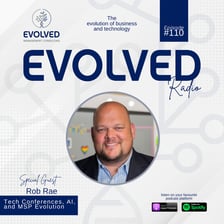
Obviously co-managed IT, we've been talking about it again for a number of years. Uh I'm I'm now running into uh some MSPs that are turning down MSP opportunities in favor of co-managed opportunities. That's super interesting because that kind of you know, it's kind of always been lingering around. We've been talking about it probably for about four or five years. Uh and now all of a sudden, uh it seems to be really catching on and and we've all figured out how to make money, how to position it, how to sell it, how to overcome those objections, all those types of things. So, you know, I'm starting to see more and more co-managed revenue uh within MSPs, which I think is a fantastic thing for our space. Welcome to Evolved Radio, where we explore the evolution of business and technology. I'm your host, Todd Kane. This episode is brought to you by Evolved Management Training courses, a whole series of courses built specifically for your MSP training needs. There's a project management for MSPs course, an MSP service manager boot camp, MSP security fundamentals, and an IT documentation done right course. Check out the full suite of courses at training.evolvedmgmt.com. Or look for a link in the show notes. In today's episode, I chat with industry veteran Rob Ray. Together, we explore the dynamics of technology conferences from choosing locations and handling logistics to balancing network opportunities amid distractions. Join us as we uncover the future of technology events, transformative role of AI, and the continuing evolution of the MSP and IT landscape. Let's get started. Rob, welcome to the Evolved Radio podcast. Thank you. Super happy to be here. Thanks for having me. Of course. So, we'll do an intro for you, but I I kind of wonder if you need any intro. I feel like you're kind of the MSP goat, channel champion, probably easily one of the most recognized people in the industry. Uh both because of sort of your tenure in the industry, how visible you've been through events and channel promotion and just being very visible. And also being incredibly helpful. It's one of the things I've always appreciated about you is that you're genuinely interested to just connect with people and see how you can have a conversation and provide any insights. So, first of all, thanks for being here and thanks for everything you've contributed to the channel for sure. Brian, I appreciate that. And I I mean, I'm just being myself. I appreciate all the kind words, but uh it's very humbling, so thank you. Of course. Uh so, one of the things I heard you talk about recently that I wanted to get your insights on is the future of the MSP distribution model. So, distribution has certainly changed, uh and, you know, you're now at uh Pax 8, which is a major digital distributor. And just I'll I'll sort of queue you up there on how are you viewing and how is Pax 8 viewing sort of the the future of the disty? Yeah, absolutely. And and thanks for the opportunity to talk about this. It's actually super interesting. And so I um I spent uh the last 10 years working for uh Dato. Um one of the technology like creating actual technology, bringing technology to market. We owned our IP, we owned patents around that IP and we were bringing to market and used the MSP channel to sell exclusively. So, you know, I left uh in October of 22 and decided that uh kind of at the age I'm at, if I'm going to have another one more kind of journey here, uh ride some unicorn off into the into the sunset, then I would need to uh career change. So, you know, I started looking around and had lots of opportunities, great technology companies that were doing some really, really cool things. I was kind of looking for the next dato that I could spend the next 10 years at and kind of take them off to the next level. And, you know, I've known the founders and and a lot of the executive team of Pax 8 for a while and they came to me and said, hey, why don't you come work here? And uh, you know, I kind of looked at it and went, well, I mean, you don't really do anything from a technology standpoint. You're not generating or or creating any technology, you don't have a road map, those kinds of things. But those are the things in my mind that are like really sexy. So, uh then they showed me what they were working on. And that's when I realized that, you know, they're not only um transforming into an innovation technology company. But they're actually blazing a brand new path. And, you know, the D word, disty is something that we've actually stopped using at Pax 8. Um and to be honest, I kind of cringe every time I hear it because it we're talking about kind of the new buyer journey. And the new buyer journey is more around things like marketplace. Now, you know, you're going to say it's just a catchphrase, what's the difference between disty and and marketplace? And I think that if you if you take a second and kind of like a a deeper dive and we've been talking about this pretty much in all the presentations that I've done. When you and I met there in in New Jersey, we talked about this. It's basically harnessing the data in in a way to actually help the MSP grow their businesses as opposed to just selling other people's stuff. So, you know, it kind of takes all of the information that we've got and uses it in a way in which the vendors are going to succeed more. The MSPs are going to succeed more, uh and then it matches up to the way the buyer is actually changing. How they are consuming technology in from an SMB perspective. So, it's interesting because the way that you're describing this and sort of what I took away from the presentation. It reminds me of uh the sort of the old days of like people getting into Microsoft partnerships. And it's sort of the uninitiated in those relationships had very high expectations and big dreams about how they'd become an MS partner and all of a sudden they'd get a ton of deal flow from Microsoft. And I would always tell people like, look, like that's not how this works. Like occasionally you may get something if you if you match up in uh sort of a certain expertise in a certain city. But like vendors and distribution organizations have traditionally very very been been very transactional. And I also feel like that's a part of what I see is the the marketplace has the potential to change where it is actually sort of servicing the needs on a more localized basis. And there's potential for actual business to flow through from that. Do you think that's true? Yeah, absolutely. Like probably more so than ever before because if you think about, you know, kind of traditional distribution. The big value back in the day was pick pack ship. You know, here's the product, store it for me because we don't have the facility, deliver it directly to this because I don't want to deal with the shipping of it or the size of it or whatever. And then the MSP shows up on site and does the implementation. Um, that's not kind of the way anymore, especially when you comes to SAS. So, you know, what is the value of what it is that we can do both from the MSP perspective as well as the vendor perspective. Um, vendors, uh like any vendor that wants to reach it to the SMB IT is going to have to do it through a managed service provider. The MSPs have established themselves as the go-to for everything SMB IT. So, you know, from that perspective is how do how do we get all like best and breed technology, best and breed innovation into the hands of the MSPs so that they can go and sell it to those SMBs. Um, but then, you know, I think the big pivot here is the way in which people are consuming these things. And there's there's kind of two factors in my mind that change this, right? Number one was the pandemic. We all immediately had to find different ways of consuming the things that we did before in a world where we could physically go and see each other. But now we're being forced to do it without physically seeing each other. And it's testing the fences on things that we weren't necessarily comfortable with. Buying things online without like sight unseen. So the idea that, you know, now all of a sudden, we don't have a choice. You want to consume this, you're going to have to do it. But then once you venture down into that world and get super comfortable with buying a shirt that you haven't tried on, right? Uh you know, in all honesty, I actually bought a car online for the first time without even test driving it this weekend. And went through the entire process without talking to a single individual. Now, as an IT provider, as an MSP, you know, that should scare the crap out of us from the perspective that people are going to start doing things without talking to the experts. But as a consumer, and you know, from an IT perspective, as an MSP delivering services to your clients. Once they are doing those things, anything that they can do from a self-help perspective is only going to save on your bottom line. So there's pros and cons here through all of this. I think, you know, what's important is is that, you know, people are still going to the SMB IT provider, the MSP throughout this entire process. And and some of the things that we are doing from a technology standpoint is going to continue to put that MSP in the center. And that means, um making sure that vendors A have that delivery mechanism via the MSP. Which Pax 8 can do. Um B, that consumers can actually go and do their own research, uh take a look at user ratings, other reviews. Like a lot of people want to do those things on their own. And again, you know, we talked about how the pandemic kind of forced us to do that. Um I don't know about you, but I'm buying more and pretty much everything from Amazon these days rather than going to individual stores. Um and then the the other part of that too is, um the next generation, the Gen Zers, the ones that the kids that we're all raising, um and coddling and protecting from the the whole wide world. And, you know, they don't like engaging to and talking to sales people. They mean they barely like talking to any human beings outside of social media. So, you know, we've got all these conditions that are starting to impact the buyer journey here. And we need to create ways in which these buyers continue to buy, but it still continues to come through the managed service provider as the expert. Otherwise, there's going to be absolute chaos when it comes to things like cyber security and and what's the right product at the right price and who do I call when crap starts falling apart. So, you know, that's the front end of it. But then if you think about the back end of it, the back end of it is we have all these consumers that are trying to purchase something. Should be through an MSP, but there's no way or that there isn't kind of that connection. And that's another place that marketplace kind of differentiates itself from distribution where not only are we attracting MSPs to come and take a look and buying technology through our platform. But now we're actually offering end users the alternative to find an MSP through our platform and that is also in vendors to find MSPs to sell their stuff to end users that are talking to them. So, you know, it's kind of tying all of this together. It's utilizing newer technologies like AI, um like the way in which we're changing buying. And and the preference in which we're buying, so it's kind of leveraging a lot of very new things and in an area that could potentially be really disruptive. So, like obviously you guys are bringing a lot to the table in market exchange and being able to have vendors find providers. And uh, you know, sourcing and matching and and creating a bit of this network effect within the system, which I think is valuable. I think some people may be a little a little wary of that. It sounds sort of like uh a little scary. Um, the other side of this though, I think is like what you noted is the the sort of the anti-social selling. And like what worked from a sales perspective kind of doesn't work in general anymore. Um, so, you know, what are you seeing uh people successful at, the growing MSPs? Like what are the sales tactics that they are leveraging in an anti-social age sort of before we're sort of getting to what you guys are building with marketplaces and matching? What do you see works right now? It's actually it's it's we're kind of at this moment in time between uh generational shift, right? A lot of us are are Gen Xers that are kind of in this space right now. And, you know, we're technically not afraid of anything. You've got the millennials that kind of have come in through and they're they're kind of a blend between the Gen Xers and the Gen Zers and then the Gen Zers that are coming in, which are completely terrified of their own shadows. So, it's a matter that trying to and where the like to answer your question, what are the successful MSPs doing? It's kind of like trying multiple ways to try to attract it. Because by no means am I suggesting that a touchless, humanless process is going to help you grow your MSP today. Because you still need uh to appeal towards the 50, 60-year-old business owners. The 40-year-old business owners, you know, and then you've got your 20s and 30s and then you've got the next generation. So it's also almost like a multi-pronged approach. You know, you have to kind of be everything to everybody at this particular moment and kind of offer. You know, do you want to come into the auto dealership and test drive this? Do you want to just, you know, test drive a car and then buy it online or do you want to not touch this or talk to anybody? You know, and have options for all three of those types of consumers. Right. So I guess we'll have uh VR uh test drives in the future maybe as well. Maybe. You know, I'm kind of tried this out on a lark. I have a really old uh truck. Um I have four daughters that I raised and all four of them um learned how to drive this truck. I always felt like if they could drive a pickup truck, they could drive anything, right? And now it's uh it's about 14 years old and it's beaten to hell. And it's starting to become one of those things where it's cost more to maintain than it does to keep. So I'm thinking I got to replace it and I'm like, here's a perfect opportunity to kind of test those. Like I personally would much rather go to a dealership and meet somebody and test drive a car. But like I'm sure all of us have had, we've all had bad experiences doing that. Um the sales rep is only selling kind of what's in inventory or if you want to build it from scratch. And then all of a sudden you drive it off the lot and you've lost 20% in value almost immediately. So, you know, it's all that crap that we have to deal with or had to deal with and now you've got alternatives. So buying a car site unseen, I was out with my buddies on the weekend and I told them that I did this. And they thought it was crazy that they would never do that. But they're also well into their 50s, right? So, you know, meanwhile, I'm telling my 18-year-old daughter this and she's like, yeah, like is that not how you normally do it? So, you know, it's it's kind of being that thing for everybody everywhere. So, I think this lends well into one of the other things I wanted to to bat around with you is MSPs and AI, right? Because what I see, uh I've I've sort of uh apologized for anyone listening that's heard me sort of rant on this before. But uh just to so you're you're you get sort of my prediction on this. I sent an email two years ago with my time scale of implications for AI as it started to roll out just after Chat GPT kind of became sort of very well recognized. And what I suggested is one to three years is throwing spaghetti at the wall and it's an experimentation phase where things sort of show up, like sometimes it's cute and useful, but, you know, it doesn't really sort of stick. That three to five year range where we're starting to get into is where things actually start to show up and there's real use cases that start to cement themselves in workflows and business process and it becomes quite useful. And then the five to 10 year time frame, uh is a little more unpredictable, but we're starting to slide towards it. Where, you know, ultimately, my guess is is that AI will decimate a lot of help desks. And people sort of hear that and could be fearful. My point in saying that is like, this is a business shift, right? Like we're in the same position we were back in the day, uh when Microsoft released Bpos. And all of the exchange admins were like, oh my God, you don't understand how much money I make from exchange maintenance and upgrades and hosting. They're killing my business. How can I survive on these margins? Like no one does that anymore and it's not like anyone's gone out of business. The market has dramatically grown. Right? So I think because of the changes with the the abilities of chatbots, the preferences of the modern generations where they'll go to a chatbot. Probably solve 50 to 70% of their own issues, then we'll be kind of escalation text and I'll focused a lot more on consulting. That's sort of my prediction. What's your take on that, Rob? Completely agree. Uh completely agree. And and we've seen this evolution over the years. Um the uh you think about the adoption of cloud. I mean, your timeline is kind of very, very, very similar to what we went through when we were first initially talking about cloud. Cloud is and I guess somewhat similar to AI. It's kind of always been around, uh or it's it's not kind of like this new, new, new thing. It's just all of a sudden getting um recognition as something that we can actually move forward with. Uh I belong to a um a number of boards, one of which is the I'm on the board of directors for uh CompTIA. And we get together and we talk about these different concepts and what we're seeing in all the different spaces uh throughout IT, throughout the world. And, you know, I'm sitting there and we're having these conversations and I'm reminiscing to the or thinking about when the internet first kind of came. And and there must have been a group of executives similar to ours that are sitting around a table going, what's this internet thing and how's it going to change our world? And, you know, the initial human reaction is always towards fear. And I actually um uh will quote John Oliver on this, if you're a this week tonight fan, he actually did a segment on AI. And he talks about how AI is going to change white collar jobs the same way, um the industrial revolution changed blue collar jobs. But guess what? Our lives are going to get better, we're going to adapt, we just need to retrain ourselves on other ways. Or similar to what you're saying, we have to figure out ways in which we can leverage this and make things better. We did that with the cloud. You know, we did that with exchange. You're absolutely right. Everybody was panicking, yet, arguably, MSPs are making more money than ever before right now. Um by simply commoditizing things that we've just used to make a ton of money at. It's always been about evolution. And I think that as long as we continue to stay open-minded, as long as we continue to stay on that cutting edge. As long as we try not to fight the machines too much, uh then we can continue to win. Yeah. Skynet images and fighting the machines definitely. Comes to mind. Exactly. Well, yeah, I think like the consulting aspect I think is massive, right? Because the thing that that I I've sort of chatted with a few people about that I think is sort of an untapped area here is consulting on AI, right? Like a lot of people, like they think this stuff is neat and cool. Uh maybe they have some ideas of how to implement this in their business. You know, I think a lot of people doing consulting around uh basically the the Microsoft 365 stack with co-pilot implementations. The people that are early to market on those types of things and develop an AI practice within their consulting group, I think are going to be off to the races, right? Like it's a bit of an arms race as far as development of the practices around these things and being able to enable both a small business, but also so those mid-tier towards enterprise. Uh and I think that that's a massive opportunity. What's your thought on that and maybe any other areas that you feel like MSPs are should be sort of eyeing as the next growth cycle for them? Yeah, I'm a little more conservative than you are. I'm a little less bullish on it because I think these things. Especially in the SMB realm where MSPs play, have a tendency to take a very long time around adoption. And I think the most important part isn't, you know, as cool and sexy as all of this is. We also still have to figure out a way to make money at it. And I think that's going to be the key. Once we figure out how to make money and I do agree with you. I think the consulting aspect of that is probably going to be the low hanging fruit when it comes to uh making money here before we can actually commoditize it with product. Because I don't think everybody's making a ton of money off of co-pilot sales at this particular point. So, I think that there is um going to be significant opportunity as time goes on. More so, you know, I think at this point, uh I think the idea of being open-minded. And taking those calls, I still run into MSPs that avoid having this conversation with their end users around AI. Or will tell their their end users just stay away from it because they themselves haven't kind of figured it out yet. I think that's a massive mistake. I think that as um we want those communities coming to us as the experts, as the real-time experts. You know, you think about that in comparison to an in-house IT person. You know, we have a competitive advantage or a significant advantage from an education standpoint to be able to learn these things on the fly fast from vendors, from each other. Whereas, you know, nobody else is necessarily going to be able to learn this as fast. Uh but then we need to find the application in the SMB space. So, you know, in my mind, it's more like let's forge forward, but let's continue to to uh look for the opportunities to make money. And again, I'll I'll draw the correlation to the cloud. When when the cloud first came out, you had some early adopters of CSPs, cloud solution providers, uh none of which I know are still in business. You know, you don't necessarily want to be the first one jumping in. Um, but I I agree, like dabbling with it, playing with it, having some type of practice with it. And there is money to be made from a consultation standpoint right now, but continue to evolve it. Like don't throw away the baby with the bath water quite yet, right? Because we still need to have those kind of legacy models. And, you know, I wouldn't necessarily go all in with AI, same same as I didn't go all in with cloud. It's going to be an adoption, it's going to be a kind of an evolution as time goes on. Other things that, you know, I'm kind of seeing out there. There's obviously co-managed IT. We've been talking about it again for a number of years. Now running into uh some MSPs that are turning down MSP opportunities in favor of co-managed opportunities. That's super interesting because that kind of you know, it's kind of always been lingering around. We've been talking about it probably for about four or five years. Uh and now all of a sudden, it seems to be really catching on and we've all figured out how to make money. How to position it, how to sell it, how to overcome those objections, all those types of things. So, you know, I'm starting to see more and more co-managed revenue uh within MSPs, which I think is a fantastic thing for our space. Then, you know, I'll throw something slightly controversial at you here. Argument, I haven't necessarily seen it. I've got no data that backs this up. But it's an interesting argument, which is, you know, when the cloud first started coming out. The adoption of the cloud was uh to make life easier, better, faster, sexier, more lucrative and more secure. We it's now been 15 years and it's safe to say that we haven't necessarily accomplished all those things with cloud. So there's an argument in the SMB space that perhaps going back to an on prem or encouraging to continue to support an on prem will make it more lucrative, more secure, those kinds of things. So, you know, that's something that's it's an interesting debate and by no means am I saying rip your cloud out and start buying servers again. But um there's an argument there to be made that maybe the maybe the cloud isn't necessarily the best route to market for SMBs in particular. It's an interesting conversation. Yeah, I think that is interesting, right? Like um, you know, the more concentration within each of these cloud platforms does create some systemic risk. And if we sort of expand uh sort of our threat scenarios out here, like state actors potentially kind of actually breaching one of these platforms. And have making a really bad week for literally everybody at this point is I think somewhat probable, right? And it's also it goes towards I think what you tend to see in the history of IT. Like people that are like sort of us that have been in the IT space for long enough, you see this what I call this expansion and contraction. Where like everything sort of, you know, everything has to be on site, everything's local and then it explodes out and, you know, we go from micro servers to uh to terminal servers. And then everything is back to PC server and then back to cloud, right? And then it collapses back to whatever it is in the future, right? So I think that's a very real potential, but definitely controversial, I agree. I mean, that's why we have these conversations, right? It would just be uninteresting if we agreed with each other the entire time. Yeah, go to pontificate for sure. The other thing I I did want to talk to you about is, you know, one of the things that you're very well recognized for in the channel is your success with events. With uh things like Datacon, it was absolutely considered one of the premier events to attend. Now at Pax 8, you're building Pax 8 Beyond. Uh this episode will probably go live post the event, unfortunately, if anyone is not getting there, but but uh definitely sort of rising as one of the premier events in the channel. And I'm curious to get your perspective from running Datacon pre and then through COVID had to be incredibly challenging. And then how things are different both attendance, you know, what the style of the event looks like, what works, what doesn't. What has COVID changed about sort of industry events from your perspective? It's a good question. And yes, absolutely. I ran probably about 15 Datacons while I was over there, both in Europe as well as uh in North America. Beyond is uh Pax 8's event. We did our inaugural one in 2023. No one at uh Pax 8 had done anything like this before. So they were a little bit nervous. I myself was like, this is a no-brainer, it's easy. And uh we did it and it was phenomenal and we're doing it again. And and as you mentioned, this is probably going to post after beyond, which is in June in Denver in 2024. Which is probably a good thing because we're already sold out. So I don't have any more. Perfect. Sign up for 2025. Sign up for 2025. Um, so what's changed? It took a gosh. It was hard because, you know, we had these live events. And it's a way for us to get together, obviously as a community and learn. It's a way for the vendors to get leads, it's a way for the MSPs to find new tech. And then all of a sudden we go into the virtual world and everybody's attending webinars. At least out of the gate, you're getting thousands of people to show up to a webinar that you used to get tens of people to show up to. So, uh there was a lot, especially from my perspective, where I really enjoy the face-to-face connections. A lot of fear from my perspective that this might be the whole new world where everybody is doing everything. You know, virtually and chatting in chat rooms and video calls. I think that uh what's flushed through is that, you know, now that everything's open up again and live events are happening again, people are coming out. Uh and if anything, probably cherishing and valuing it a little bit more. Physically, these events cost a hell of a lot more. For some reason, food and beverage is up significantly. And I think it's a condition of a lot of those industries, hotels, conference centers. A lot of them suffered serious job loss during the pandemic. People had to go and find other alternatives for work and they just haven't come back to the hospitality industry. So there is a lot more money that's having to be shelled out, which means the cost of executing these events. Which means the cost for to attend these events, including hotel rooms and flights, it tends to be a little bit more at this particular point. But I do envision that coming back down as we all settle back in. I think that there's more events now than there was in 2019. If that's a thing, at least myself. You know, we used to all say uh as vendors, we used to all say goodbye to each other at uh IT Nation, which was generally the second week of November. Because we wouldn't see each other again till February. Now we all work till the day before Christmas and we're right back at it on Jan 2nd. So, you know, there's too many, almost too many events. I know I've got uh three events in one week coming up in a couple weeks. So there's no shortage of things that you could physically go to. And I'm a huge fan of being able to physically go to these things. But there's also a lot that they need to do better from a quality uh content uh perspective. Um and the value because now MSPs have got a ton of choice as to where they want to go. Um obviously, I think that the user conferences, if you know, find the vendors that you're using and go to their conferences. Uh I think that's probably the most valuable use of an MSP's time. If I'm investing $10,000, $20,000, $30,000 a month in this particular vendor, I want to see what the road map is. I want to see where they're spending their money. That's where the a lot of the value. Um I think that the local meetups as well. You and I, you know, chatted at a local ASCII event because I'm based in Connecticut, so for me it was an easy drive. You know, I think those local meetups are also important because you get an opportunity to meet with the uh actual individual local MSPs. Like some peers, potential peers around. So, you know, there's still significant value out there, but the great news is there's a lot of choice. Uh you just kind of got to weed through what it is that your needs are in order to be able to to pick what event you want to go to or how long you want to spend on it or how much you want to spend on it. Yeah, like do you have any like one of the things I've seen, curious on your perspective on this is like because there is so much competition in the event space. Uh like a good example is like Nerdiocon is a destination, right? And, you know, uh do you have any plans maybe potentially sort of like destination type events? Either as a premier event, I know like Denver makes sense for Pax because Pax because you guys are there. Um but uh what's your perspective on some of the I would say sort of the burgeoning idea of destination style events? Good question. So I am a fan of moving it every single year. There is no doubt about that. Because I think the opportunity to go to a different city or potentially a city that you've never been to before. And, you know, I'll draw back to Datacon 2016 where we actually did it in Nashville, Tennessee. There's a lot of MSPs that is then I've never been to Nashville. A lot of our foreign uh partners, British partners were like, why would you drag me to country music central and not interested? And then they get there and absolutely fall in love with the city. To the point where I know a bunch of uh British, for example, that go back there and vacation there with their families. So, you know, I'm a big fan of if, you know, it's part of the opportunity, it's part of the experience. Just to potentially go to a city that you wouldn't necessarily go to. Um Denver, uh when I joined the organization, yes, we are a Denver-based company. Um and we had signed a three-year contract with the Gaylord there in Denver, which is a phenomenal facility. Uh but, you know, we're debating as to what we're going to do post 2026 with it. Um our European conferences are moving around uh for beyond. And of course with that we moved it around. So, you know, I think that's all part of the actual experience. You think about um other events, you know, one that's in Orlando every single year. It just kind of feels the same every single year. So, you know, I'm a big fan of moving that around. As far as destinations go, you start running into logistic issues. Um first of all, passports. Everybody has passports, right? Um Cyber QP is actually doing an event in Puerto Rico, which is going to be interesting. Because I don't think you need a passport, don't quote me, an American passport to go to Puerto Rico. I think you're right. So, you know, that's going to be interesting because you got an island destination, but you don't necessarily have to have a passport. Whereas uh Nerdio did it in the Dominican Republic, so you would need one. Um the quality of food goes down significantly. And as much as we're here to learn and talk about IT, you know, the dining experience goes down. And then the luxury experience potentially goes down a lot of these things. You know, you're in a you're in a different country and sometimes that makes it a little bit more difficult. But at the same time, who can argue with uh 85 degrees and nothing but sun all day too. So, You know, it can go either way. I see a lot of this debate about doing one on a cruise ship. I personally am not a fan of cruise ships for various reasons. I would be with you on that as well. Yeah. One of the things that I remind everybody of is like we complain about hotel Wi-Fi when we're in downtown Chicago. Imagine being in the middle of the Atlantic and complaining about Wi-Fi, you know, we're so connected and need that connection. That's just issue number one that you might run into if you're on a boat somewhere in the middle of the ocean. Yeah, just imagine 3,000, 3,500 nerds all trying to use the same satellite connection, right? Bad times. Yeah, disaster. Yeah. I do love the idea of the conferences moving around, right? Because I'm on the extreme West Coast of Canada. Uh and getting to, you know, Florida, uh seems like every conference is is contractually obligated to be in Florida, it seems. So, uh getting to Florida is a bit of a trek, right? And I would love to see more in California. Even Las Vegas, you know, like there's a couple that happen there, but it it seems like a premier destination that would make sense. But there doesn't seem to be a lot of industry conferences out west, unfortunately. Well, so it's you go to where the MSPs are. And unfortunately in the north, northwestern part of the United States. True. There aren't a ton of MSPs. Like as far as when when you do some heat mapping, you get into Southern California, yes. Yep. Yes, I do agree with you. But Southern California also has a tendency to be a little more expensive. The other issue that you've got is weather. Nobody wants to deal with winter. For sure. So in the winter time, we have a tendency to go into the Texas, California, kind of Florida parts. In the uh summer summertime is when we have a tendency to go into the New New Jersey, Chicago. Those kind of northern parts. I actually do want to bring our conference to Vancouver at some point in time because I think that would be an amazing opportunity for MSPs to go and see that and live that. But yeah, it's hard. And then there's a lot, you know, like if you're in a union town, you've got to deal with additional expenses there. So there's a lot of other factors that kind of come into play, um when planning a conference that way. Vegas, I'm not a fan. Uh because there's so many distractions in Vegas, there's so many things, other things that you could be doing. Good point. Hard to find people when you're at the same conference. I don't know if you've ever been to one of those big conferences in Vegas where, you know, everybody's kind of just staying at their favorite hotel. And then you never actually see that person, you know, during the course of the conference. You know, so there's there's pros and cons. That's a good point actually. Like I obviously the distraction of uh the casinos and too much drinking, not that that is uh is a thing that that doesn't happen at the other conferences too, right? But um, yeah, I went to a Microsoft conference in Vegas once. And, you know, it was pandemonium and you're right, like I saw one person. Uh a couple of times and that was it. And otherwise just like cattle moving from one location to the other. Just uh like the volume of people was unbelievable. Yeah. Yeah, it is. And then yeah, just trying to match up and meet up with somebody could be potentially incredibly difficult. Okay. Cool. Uh this has been awesome. I appreciate your insights, Rob. Uh is there any sort of parting words of wisdom, any um things that you want to see in the channel or things that you would sort of call to action for people in the channel this year? I guess, you know, and it's something that we all suffer from. Especially as we get older. And, you know, I've tried to run this with my life in particular. We're in a space right now where we're supposed to be very forward thinking, innovative technology people that are are constantly looking at what's next. But human tendency is, you know, we we want to get lazy, we want to stick with what we know. You know, we resist change. I mean, that's just human nature, that's fine. I think we're in a state right now where we're going to go through some significant change. I mean, you and I talked about a lot of that during the course of this actual call. And, you know, sure, there's been a lot of change of our industry over the last little while. But I think there's a number of particular points that are kind of coming to a head here. And I think that the opportunity for the managed service provider is still greater than ever before. Um I think there's still massive growth opportunities in this space. Everyone seems to be doing extremely well, that that's what I'm talking to MSPs worldwide. That's what I'm experiencing. So, you know, we're kind of like, you know, is there's anything I was just keep going. Just keep on top of it, don't stop learning, don't stop moving, don't get negative. You know, I think if we all do those things, we're going to continue to thrive in this space and there's going to be lots more of that opportunity to go. I love it. That's a great place to end it and totally agree. Thanks again, Rob. Appreciate your time. Any time. Thank you.