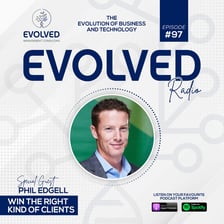
the underlying premise that we have in both of those strategies is that the customer understands their problem. And I don't think that that's true anymore. Welcome to Evolved Radio where we explore the evolution of business and technology. I'm your host Todd Kane. This episode is brought to you by Evolved Management training courses. A whole series of courses built specifically for your MSP training needs. There's a project management for MSP's course, an MSP service manager boot camp, MSP security fundamentals, and an IT documentation done right course. Check out the full suite of courses at training.evolvedmt.com. Or look for a link in the show notes. Today on the Evolved Radio podcast, I'm joined by Phil Edgel of Edge Consulting. Phil and I met early on in our tech careers and went on a similar journey in an explosive growth phase at a company we both worked at. Phil's experience is extremely wide-ranging from starting as a tech to leading a world-class IT company and building the sales channel for several high growth SAS companies like Hoot Suite and revenue.io. In today's conversation, Phil shares his insights on winning more business, the importance of role playing, why cold calling gets a bad rap, and some actionable tips on identifying your ideal customer. This is an excellent conversation with lots of actionable takeaways, so please enjoy my conversation with Phil. Phil, welcome to the Evolved Radio podcast. Yeah, thank you. It's great to be here. All right, so we're going to be digging a bit more into sales. It's been a topic a few times recently and it's just something that I recognize that people have a high interest in. It's definitely how you grow your business and it is not a necessarily a skill set that comes easily or naturally to a lot of people unless they've either been in a sales role historically. So I just find there's a lot of good lessons learned and potentially a lot of myth busting that could potentially be happening in in the sales and development business development space. So, love to get your input on a few things here. If you maybe want to kick things off, just tell us a bit about your background and your origin story. Yeah, sounds great. Well, Todd, you know a little bit about my background, but I'll share it with the rest of your listeners. So, and I empathize with the feeling of feeling like sales is a bit mysterious because my background actually traditionally has not been sales. So, you know, if I go all the way back, how I got into computers was in university, I did a history and poly side degree and there wasn't a single job available. So naturally I went on to be a NT4 administrator. So, and I figured out pretty quickly that I was horrible at actually administering computers. I didn't want to be in dark rooms all by myself. So I transferred more into client management and so the smart technical guys were in the background and I was often talking to the customers explaining to them what was broken, what was wrong, how long it was going to take us to fix it, what the implications of fixing it were going to be. And so I kind of naturally fell into this role of interpreting what the technical guys were doing for the business people who had to use the systems. And so as my, you know, my journey continued in this computer world, you know, I ran into this company called Long View Systems, which is, you know, where we met each other. And I ended up spending 15 years there. That was a great journey for me in terms of, you know, being part of a company that was very, very small at the time. I was employee number 30 and we were in the single digit millions of dollars of revenue and getting to grow that all the way to $400 million in revenue, 1,200 people in three different countries. And got to do every job along the way as we scaled that business. And what I really learned from that experience was the power of culture is actually palpable and meaningful and that scaling a business is really, really challenging when it's a people-based business. So I took those two experiences and and decided I wanted to learn a little bit about the SAS business. So that was a systems integrator style business, a lot like probably the the the audience that listens to this. Maybe just a little bit larger than what they do today. So I wanted to learn the SAS business, so I went and spent a couple of years at Hoot Suite. Um and at Hoot Suite, I was the global sales operations executive, but I also ran territories for them. So I ran Latin America, Western North America. And that's where I really learned and honed the sales craft and the sales operations craft. So we grew that little sales operations team into a revenue operations team, which included marketing. And and Hoot Suite really taught me the value of brand. So, you know, it was so interesting to me as I took this culture scale sense from Long View, put it together with the skill of sales and brand and wanted to try something on my own. And so I joined a pre-product market fit company that was trying to build a data platform for the amusement industry. We created a product, we launched it in the fall of 2019 at the big annual conference in Orlando. And of course, we all know what happened in March of 2020. So we built up a global funnel of about $50 million that just went poof, you know, in the in the beginning of 2020. We were able to keep that business alive. Uh we did some pivots into contact tracing and a few other things because we had created some technology around location awareness. And we got that business to its first million dollars of ARR and then I went on to be the CRO of a company called Revenue, really specializing in sales enablement software embedded into Salesforce. And that's really where I would say I honed my craft in terms of this ability to string together a value proposition right from a marketing messaging right through until customer success and all the stops along the way that a customer might take. So, spent a lot of time both in operational roles, you know, at Long View, I was I ran the US, I ran Canada, I ran service delivery, I ran branches. I spent a lot of time in sales and uh have always gone flip back and forth between operations sales all the time. So that's a little bit about my background and today I I run a company called Edge Consulting. So preneuring, uh mostly coaching and managing go-to-market strategies for companies and doing some strategy advising. So, I have to ask you, um, I think it's be a really kind of an interesting snapshot. I mean, it must have been a hell of a scary event when you sort of saw the impact of what COVID was going to reap in in March. Uh having just sort of built this platform. I have a follow-up to this, but maybe just put us in that like what where were you? Can you recall sort of when you realized like, holy crap, like this could be a crippling event for this for this business. Yeah, I mean, we probably saw it earlier than most other North American businesses because our primary market for the products that we were we were building was actually in in the Middle East and in Asia. And so we saw that market crumbling and basically, you know, the the all the amusement parks that we were talking to were closed, all the people we were talking to, you couldn't find them. So we started, you know, right in January, we started thinking to ourselves, uh oh, this is this is trouble. And you know, where where we were was we had this plan just the way that the amusement industry, the the business cycle, so they have this huge conference in in the fall just before US Thanksgiving. That's the global conference. And so typically the whole industry goes to sleep over the holidays, over the North American holidays, and then picks up again in January. So we had this whole hiring plan to to seize the opportunity of the funnel we had built starting in January. And luckily we saw the signs early enough where we put all that on pause. So, you know, relative to where we could have been if that happened three months later in terms of the the huge scale around the world that we were going to grow our operations group, we were fairly well contained. And really we went immediately into pivot mode. So, you know, when we started to learn more about what COVID did and how it worked and and the pressure on understanding who's interacted with each other, we realized that the wearable that we had created, which has low frequency Bluetooth in it, was actually perfectly situated to help in terms of understanding proximity of people within closed spaces. And so we actually just, we didn't even miss a beat. We pivoted immediately into building a test case inside an age care home. We put our our wearables and the uh low frequency antennas into the age care home and started mapping out an interface so that you could do contact tracing within confined spaces. And that distracted us long enough that that, you know, then a vaccine got created, so that whole need went away just as the amusement industry was coming back back alive. So we had enough cash to keep going. We were distracted by all these pivots and by the time we realized that that thing really wasn't going to work, the amusement industry started coming back and so we started brought that funnel back. So, I would say it kind of delayed the business by about two years, but it was actually, you know, the level of scariness was low, mostly because we were so busy just trying to figure things out. And so you didn't really have time to sit around, you know, twiddling your thumbs or thinking about all the bad things that can happen. It's just total pivot mode in terms in terms of trying to figure out how the business can survive. Just maybe a quick aside because I was curious like when you guys pivoted to the the contact tracing for care homes. I thought that that was absolutely genius in a couple of different ways because it's not like older folks are necessarily carrying around iPhones and and smart devices which we like a lot of industries and countries were trying to use for some type of contact tracing methodology. I not now with COVID being sort of having less of a material impact, it's still absolutely there. It's it's a problem, but you know, neurovirus and things like that are still a problem in care homes. So I'm surprised that that that business is is sort of faded away to some degree. Is it still active or like there just was not enough of a market to focus on it at that point. Yeah, you know, we didn't really pursue it mostly because our expertise level was not in age care homes. Although, I mean, we, you know, there's a dementia village just, you know, in the Fraser Valley from us that's really a fascinating place that's attempted to use a similar product from Philips. There's absolutely a market associated with tracing seniors around spaces for for disease control, but also for safety purposes. But it was none of our passions, it was none of our level of expertise. Uh the primary funder of our business was an amusement industry giant, so it also not their level of expertise. And most of the age care homes that we were working with, um, were all government funded. So access to money was was challenging from the perspective that they get a certain amount of money per bed, it's already tight margins, they're already constrained on labor. So trying to find a little bit of margin to take for the product, it was it was a hard, hard road. And none of us were passionate about it. So there could still very possibly be a great market for that. It just wasn't something we were going to pursue. Okay. Sorry, I had to take us off track there because I was I was curious about that when I, yeah. Yeah, no problem. All right, so back to the other podcast that we were recording. Yeah, original original broadcasting. That's right. That's right. Yeah. So, first, I I want to get your sense of this because I'm I'm always looking for what are material beliefs that people have that are maybe misled or, you know, they heard something a long time ago and they they take it as gospel and they believe these things that may or may not be true. I'm always curious about counter-intuitive opinions about sales and sales management. Do you have any opinions around that that you feel run against the grain of what people typically say or parrot? Yeah, it's a great question and like I think the the topic of sales, especially for people who are not naturally sales wired or sales trained is scary. Because they think of the fancy tricks and slick elevator pitches and as those being the key to sales. But I think we know now for sure that the the era of the feature function benefit style sales, which is really where sales kind of got its bad name, you know, think about the elevator or the um uh vacuum cleaner sales people who would come knock on your door and it's like 3.5 horsepower where you know, the functions and features of that device is really its differentiator and if I can just convince you that you need those things, then you're probably going to buy it. And if I just keep the pressure on, you're finally going to relent. That's what people think of when they think of sales. And that's, you know, where a lot of people get turned off if you're not not naturally gregarious or grew up in that environment, that's where people tend to get turned off. I really think era sales has come through a few different eras to where we are today where I truly believe that the skill of sales is now more about very really, really good discovery and value realization than it is about this idea of a slick pitch and an elevator pitch and a slick sales. And so I actually think the skill of sales is shifting more towards, you know, what I'll say because Todd, I've know you for a long time and we've known each other. It's shifting more to people like me and you who are curious, who are looking to help people solve their problems, who understand what our businesses truly do at like the technical detail level, and we can match up needs of a business with skills that we have. And so if I just take you through the eras of how I think we've landed here, you know, I talked about sort of that feature function benefit, you know, very high pressure sales where sales got its bad names. You sort of think about like the 50s and 60s and kind of that mad men, that kind of era, right? That's where sales kind of got its bad reputation. And then we transferred into this much softer approach, which basically says, you know, consultative selling, right? Like, what keeps you up at night? So if you sort of think about the 70s and 80s and even how when we started working together, right? That's that was the key question, remember our our good friend Andrew Bentley or or Alister who I know's been on your podcast, right? The key question was get in to see the CIO and just ask him, what keeps you up at night? For me it was always who carries the pager around here. That was always the hot question, right? Yeah, exactly. And so the whole purpose of that is not that you're all that interested in the answer, what you're trying to do is actually, okay, whatever they say, I'm going to figure out how to position what I've got. Right. Meet your needs. I'm going to help you sleep better at night because no matter what you say, I've got a solution for you. The underlying premise of both those sales tactics or strategies is that the customer truly understands their problem. Wow. Say that again because I think I think that's incredibly insightful, right? The underlying premise that we have in both of those strategies is that the customer understands their problem. And I don't think that that's true anymore. Agreed. And so when we move into this idea of sales becoming more about value realization, the very first step in sales is actually to help your customer truly understand and quantify the problem that they have. This is really helpful. I just a quick aside for me in in processing this because it's funny that that you describe these as different because in my head, I've always equated consultative selling with this type of of framework of of helping them to understand what the problem is. But I don't think I ever really truly sort of took to heart the fact that this is why it doesn't work in a lot of cases is they can't tell you what the problem is. They just know something isn't working, right? They know symptoms of why their business isn't working, but they don't necessarily know what the problem is. And so if you think about how the evolution of technology has become more complicated, more integrated, and you think about the businesses that a lot of your podcast listeners are probably dealing with, right? International in nature, lots of employees, uh lots of dynamics associated with interest rates and inflation and supply challenges and all these problems that exist within a business, there's no way that a a business owner that we're interacting with as a supplier is going to understand or be able to keep track of all the dynamics that are driving some of these technical issues within their business. And so the job of sales people now is to help the customer first find and then quantify the types of problems that they have in their business. And it's not until you get to that full discovery point that you even venture into the potential of giving them an offer or a proposal. And so it's so, to me, it's so fundamental this shift and it's why I really believe, you know, as we were talking about the the characteristics of your audience, right? The the business owners probably started more as technology people, less as the business sales people, they fear sales a little bit. This this skill of sales is swinging more in the direction of their natural skill sets than ever ever has in the past because of this need to truly understand what you do as a business, but put it in the terms of the problems your customers are having. So I'll say that again. The idea of value realization is not to describe, I'm an MSP, I do managed services, we do Office 365. That's feature function benefit selling. What it is is, we know because we have a whole bunch of customers that are are businesses like yours, that you neither have time nor interest to truly understand what goes into making your technology environment operate. We also know your budget constrained. We also know that you need to operate globally seamlessly. The services therefore, the services that make sense for you are these. So it's getting to the point where you're being able to drive into and get the customer to agree to the problems that exist within the business. And then and quantifying those and then it's offering some sort of solution. So it's very, very discovery oriented. Yeah, this is interesting. So let's uh let's sort of wrap on a couple of scenarios that I've seen. You can give me your perspective on this. I know enough about sales to be dangerous. I feel like I'm sort of good at it, depends on the day in a lot of cases. And I always wonder sort of what it is about the days where I I feel like I nail it. And some of the circumstances that I see, I'm very observant about being in a sales situation about how the person approaches me. And one that I've seen a lot that I I feel like I understand the principles of and sometimes I'm good at it, but I certainly observe when I feel it's being done uh sort of out of sequence or incorrectly is uh that discovery process exactly. Where you try to ask someone like, hey, can you tell me about your product and what does it cost? Because a lot of people come into a sales situation very well armed with what they're looking for. They're often just looking for the price and the outcome, whether or not they can justify it. And I've been in these situations where a salesperson will often push back and say, well, hang on, hang on, before we talk about that, can you just tell me a bit more about your problem? And they they really want to spend time asking a lot of questions and sometimes it feels more forced, but I feel like it it's it's laid inside of that same methodology. Uh bit of a a mashed up question, but any thoughts on sort of like your sense of that and where that comes from? Yeah, I mean, I think the the question that you're asking is as the value realizer or the seller, when somebody just says, you know, just tell me the price. I just need to know if it's in the ballpark. Or they say something along the lines of, can I just see the demo? So, you know, they want to they want to skip a bunch of steps. Yeah. Resisting that urge. Now, look, um, every scenario, you got to read every scenario a little bit and you won't always get it right. But the risk of just jumping and giving them what they want without context risks the opportunity to actually find out what some of their problems are because what they perceive their problem is versus what their problem might actually be, might be different. Now, it depends on the type of product that you're selling, how transactional is it, um, how what's the price tag, how big is it, you know, like I'm talking about, you know, even even MSPs who are dealing with smaller businesses, they're still relatively large valuable transactions when you're looking at the recurring revenue. So, you know, we're we're talking about fairly complex sales. We're not talking about transactional B to C, you know, I just need a pen. I'm not going to ask you 20 questions about why you need the pen. I'm just going to this pen is 99 cents, do you want it or not? We're not talking about those kinds of sales. So with that as a backdrop, you know, the approach that I might take is we need to respond to the question reasonably to the prospect, but we also need to put it in the right context. And if you've done the right level of preparation to understand a little bit about the business that you are about to interact with, what you can say is something like this. Okay, let me just put this in context for you. What I've learned about your business in the research that I've done that it sits in this vertical and it does these things and I know these things about it and it's a lot like a customer that we have that looks like this and like this and like this. The services that we do for that customer, which looks like this and this, cost this much. And then the follow on question is always, how accurately did I describe the challenges in your business? Ah. And then shut up. Yeah, so you you did the zipper mouth motion there for for the audio. Yeah. So so you're honoring, you're honoring the question and answering it, but you're putting it in a context that allows you to start the discovery process. Yeah, this is again really helpful of of sort of understanding some of the mechanics behind this because I I I think I have a better appreciation for that that push back of like, hang on, let's let's talk through this a little bit before we we jump to uh discussing sort of the the the terms of this because I think you put it well again. Like they may have a sense of what they need, but you want to make sure that there's parity between what you offer, what they require and what they think is actually the problem. Because you may crack something open for them if you ask three or four more questions rather than just sort of skipping to the end where you realize, oh, okay, you think this is your problem, but what you just described, I know from my experience, this is a symptom, not a not a root cause, right? Right. And if you think about where we jumped into that particular question, you know, we we started with, okay, we're sitting in front of them and they're asking how much. But if we go back a few steps in the process, like how did you get to sit in front of that person in the first place? Yeah. Here in lies some of the skill, I think that that is necessary as it relates to being able to be a a successful salesperson or value realizer on behalf of your customer. And it's understanding what types of customers you service best. So your individual business has a set of characteristics and capabilities and and if it's if it's a thriving business, it means that they are a good set of characteristics and capabilities for a certain type of customer. Not all customers. Like we know from our experience at Long View, not every customer was the perfect Long View customer. So truly understanding who your and you know, the technical term inside of sales would be your ICP, right? Your ideal customer profile. Truly understanding your ideal customer profile. And then understanding the different personas within that customer profile that you might be talking to or selling to before you get into the room, allows you to be highly, highly prepared to demonstrate to that prospect. That one, you understand their vertical, which is important. Two, you understand the characteristics of their business and you're educated about what it is that that you believe, again, using big words, the value hypothesis you're coming to this conversation with, uh around what the potential problems could be in their organization. And it's more of an exercise of confirmation than it is an exercise of, hey, what keeps you up at night? Right. Yeah. So this preparatory process puts you in a way better position to be able to answer that question if you've done your homework ahead of time and understand that what you're uniquely good at and differentiated by is indeed what this customer actually fits that profile. So I'm going to I'm going to jump on my soap box and do a bit of a gripe, but it it's useful because it does lead to another question I wanted to ask is, uh what you noted is is sort of like even just the basic amount of research. I think is really practical and valid and I don't see this as a commonality in the industry. And sure like a lot of this comes from a sense of people are just sort of dialing for dollars and and like essentially kind of war dialing or socially dialing for for customers. But I can't tell you the number of times that I get pitched by vendors and organizations who think I am an MSP because they got me from an MSP conference database, right? And they're like they're just throwing spaghetti at the wall. And and it bugs me because like if you had done even 10 seconds of research to look at my website, you would see that I am not an MSP consulting company. I think it speaks a bit to sort of this mentality of of, you know, take your job seriously. And if you take that 10 seconds, you're not going to waste, you know, what would accumulative be kind of 15 or 20 minutes of your life following up and chasing a lead that is absolutely not who you're trying to market to. So that's my rant. Yeah. And if I was to and can I can I just springboard off your rant just a little bit? Sure. You know, a lot of the coaching that I do with executives is dispelling this busy versus productive paradox. Right? And so what you're trying to do as the business owner of a small MSP or or a salesperson of a small MSP, the fact is that specialization with most of those organizations doesn't exist, right? Because there's a small number of people and everything needs to get done. So you wear multiple hats. So even more important in those size of organizations than maybe, you know, when Long View was the 1200 1200 person behemoth. You know, when we were there, we had specialization across every role. The value that you need to get out of every increment of time is enormous. And so what you want to be doing is spending that time for the most productive output. And so if you think about what you just talked about, busy work is spraying all kinds of people with all kinds of messages that aren't honed in, that aren't specific, that are genericized. And it feels good. Yeah. But it's not going to net you much of a return. Productive is understanding exactly the ideal customer profile for your services, having a series of look alike companies that are like companies you're already being successful with and targeting personas within those organizations to share with them the fact that you've got industry expertise, you've got vertical expertise and you're already being successful with their competitors and you'd like to help them too. That's the difference between busy and productive. Yeah, so uh busy and productive that's that is also another podcast that that I spend a ton of time on because I I have sort of this running joke of hashtag ban busy. Because in any industry, especially in the tech industry, it's used as a crutch of defense as to why you didn't accomplish anything. Well, I was busy. Okay, well, you know, answer busy. Like, what were you busy with? is the throw quote, right? But it doesn't make any difference, right? So that one really bothers me and I think it hits on exactly that point, right? So we're we're we're hitting the same tune here of if you had reached out to five highly targeted customers through the course of the week. And got one good lead, you might actually get a sale. But if you spam 500 people and get none, like you could say you were busy, but like you if you had taken 20 minutes to figure out your your ICP and figure out who you should be targeting, then like the the exponential increase of the quality of your outreach is there, right? Yeah. And if you think about the about the extension of your sales organization then, if you as the business owner or the executive leadership of the business don't know exactly the characteristics that make success for you and the type of organizations you're most successful with, how do your sales people have any chance of being successful in in being anything but busy? And so, you know, really spending time to understand what your unique differentiators and capabilities are and what type of organizations benefit from that is really, really valuable when it comes to getting the most out of your most return out of your sales investment. And it also cuts down on the busy work. It allows you to target. And and you're you're exactly right. I I would take five high quality outreaches over 100 to anybody at any time spammed messages. Yeah. And I think people that are not sort of don't have a good history in sales, like this idea is makes sense but feels counter-intuitive for whatever reason, right? Like I I often tell people like never be afraid to go up market. And I think this applies in the same place here of like take time, focus on those those five good prospects and you don't need to sell to everybody. And I think people are often, especially in small business where they're scrappy, they're trying to win every all business, whatever they can get their hands on. There is a there's a point in time for that when you're first getting started. As soon as like you can kind of pay bills and things are starting to to flatten out. You need to be more cognizant of who are the people I want to work with and target those. And it feels scary because you're you're automatically constricting your prospect funnel where, you know, you're intentionally even ignoring certain business where like someone says, hey, you know, can we hire you to do some IT work for us? And you're like, I should say yes. I know I should say no, but it's really difficult to sort of deflect what are what appears to be an opportunity when it's outside of the funnel of what you should be looking for as good business matches for your growing business, right? Yeah. I think you said an important word there and and if people are challenged with the concept of sales, shift the mindset into the concept of matching. Right? Yeah. There's a set of organizations out there that will really benefit from your services. And you've just got to go find them. Yeah. And so in order to match, you've got to know what it is that you're good at. What what's the service or offering that you have that's a great match for somebody else? Yeah. Uh you know, if I took an an example, I was talking about the pre-product market fit company that I was at. Um it was called Vantage Technologies. Um we were building a data platform for the amusement industry. We were starting in the water park space because that's the a company that was funding us. And so we had built a product and sort of we had we had built the answer before we ever found the question, right? So we kind of did things a little bit backwards. But what we figured out was the the our target businesses were the businesses where they had a real focus on operational efficiency and guest experience. So, as we were trying to find these organizations, if they were if they were just guest experience only and didn't care about profitability or they were profitability only and didn't care about guest experience, then our platform wasn't for them because what we were doing is we were using their operational platforms, their ticketing systems and all those things. And then we had a whole guest engagement platform that had to do with apps and wearables and and virtual queuing lines and all these type of things. And we were mashing these two data sets together to provide insights that the amusement industry had never had before. And so if the if organizations didn't weren't interested in both of these things at the same time, the co-lessing of the data was never going to be interesting to them either. So, you know, it took us a long time to figure that out because we kept going after big brands thinking, oh, they must care. Really you find out that actually not that many of these amusement industries care about the guest experience. They just care about getting them in once they're in the door and they've paid their ticket price, all good. Yeah. Um, so, you know, I think really truly understanding what the benefit of your services are and then being able to put those in the language of your ideal customer profile or your ideal customer target is is kind of the most important part of sales. And it's about matching rather than selling. There's another reason why the the vantage product was particularly interesting to me just as a as a sort of the theme of data and analytics and and business intelligence around sort of human behavior and and uh like I there's just there has to be a a ton of amazing insights in that data. So as a data junkie, that was part of the reason that I I found that product so fascinating, right? Yeah, yeah. Yeah. All right, so let's hit on some of these insights and and maybe correct some narratives for me or give me some insights on what what people out there and myself included in this is people are trying. So, you know, I I think the targeted approach, I always tell people like pick five clients that you would love to have as as uh or five prospects like that you would love to have as clients. And just go start knocking on some doors and ringing people up and trying to attract those people. Again, back to that targeted aspect of who you actually want to match with. Versus like some broader tactics, like like more of this of the gorilla style tactics that that we may see out there. Like LinkedIn outreach for for one is I feel is sort of the new modern age of of cold calling. It still feels like a little scary, maybe you're going to get so so a lot of push back from people, but to some degree it actually does feel quite effective if you do it in a very natural way where you're just trying to build a circle and eventually sort of build uh some some reputation with people and win some prospects. So, cold calling, you know, maybe works in some industries. I I I for meeting retention and and getting meetings, somewhat effective. And then the other one that I like is is simply just walking around industrial parks. Like especially for MSPs, just like go visit some businesses, meet some people, introduce yourself. Like the this to me that's a far more effective strategy to virtually visit people rather than cold calling. So a couple of strategies there, the social, your thoughts on cold calling and then like kind of the the walk around. Any any thoughts on those as sort of biz dev tactics? Yeah, I mean I I wouldn't put cold calling out. You sort of when you think about sequencing, I think the general philosophy would be, you know, seven to nine touches are necessary to get a hold of, you know, any one prospect just for an introduction. And the fact is that no one median is going to be the guaranteed winner and no one median should really be left out in terms of your sequencing capabilities. You know, where you started was pick five prospects. You know, I can't tell you what the right number to have. I just use that as a as a as a just a general number, yeah. Right, but more but I think you're the concept that you're getting at is be more constrained. So like think about rather than saying, you know, one of the things that we that I've done in the past with in in sales management jobs is taken huge territories and constrained them down to only a small number of companies. Because you get this like comfort in saying, oh well, the you know, the computer sales vertical is worth, you know, 17 trillion dollars and we just so we just need like a quarter of a percent of that and we'd be killing it, right? But the fact is it doesn't work that way. Right. So I think, you know, I think being constrained in your thought process and and you know, when somebody if I was to say, let's say it's five, what who are your five prospects? The next next question I would ask is, okay, why are they your prospects? Because typically what people are going to do is they're going to go, oh well, Lulu Lemon's a huge company and they're in Vancouver. I'd love to have them as a customer. Right. But does Lulu Lemon really meet your ideal customer profile? So it's it's about picking the right five and then being very intentional about how you connect with those five. And so, you know, why are those five going to connect with you? They're not going to connect with you because of your business. They're going to connect with you because they believe you can help them solve a problem they've got. So if you sort of think about what's what is your exercise in terms of proving to them that first you understand their business and you understand the problems that they have and you've been successful in solving those for other people like them, you sort of have to think about, so you take those five, how am I going to transfer that information in what source to them? So, you know, there's there's a there's an element of being a knowledge expert, right? So in in whatever area it is that you're great at that these people need. There's an element of connecting, maybe getting a reference. So who's your half a degree of separation from that person? How can you get a warm introduction from somebody else? There's nothing wrong with calling them. Um, now, a cold call doesn't have to be cold. You can make it a warm call by having done a series of things ahead of time and setting up the fact that you're going to call, right? So there's no issue with sending an email or or a cold outreach of some sort that's short and snappy that just says, look, we do this for lots of people. We know these are generally the problems that the business like yours have. I'm going to call you 9:00 a.m. on Wednesday. So you're trying to set up that it's not a cold call, right? You're it's a warm call. But I'll tell you the the the voice to voice interaction, whether it's in person or over the phone, the value of that is enormous. And the fact is that not many people do it. So it also is a an opportunity to differentiate yourself. So I wouldn't leave, you know, the the cold calling. As scary as it is for the people on the other end of the phone that need to do it, but I wouldn't leave that out of the mix. I think that's fair and I think I think like just quickly the the the way that you described that is different than how people perceive cold calling. Where you're just making a hundred calls and everyone's going to tell you to F off. Like and it just feels so deflating. But again, like being hyper specific and targeting who you're actually trying to contact and why and looking for reasons to get a hold of them versus just like onto the next number, onto the next number. That's different, right? Yeah. Go ahead. Sorry. Yeah. And I think and I think, you know, that the cold calling hundreds of calls, all rejection. I mean, that has its place, you know, in in SAS scale, but that's not the industry we're talking about, right? We're talking about MSPs, small MSPs. that need to be really conscious of their time and be targeted. And so I think, you know, preparing those scripts to be very specific around proving industry and vertical knowledge and understanding of the business that you're calling and that your hypothesis around the problems that most of those businesses have and your success in in solving those, you know, those those are really meaningful contacts to try and make because the fact is is that businesses are trying to solve their problems. If you can prove that you can help them do that quickly and efficiently, they're going to listen. Yeah. Okay. Awesome. No, that's that's really a good way to sort of again, make it hyper specific and actionable. And so it feels less sort of daunting or I don't want to do that. That feels icky. It's like, well, no, you can do this. Like just just be targeted. Yeah. And I would and I would suggest for anyone who has a sales organization, you have to think about um practicing these skills. Yeah. Uh and you know, if I was to make a sports analogy, for any pro athlete, they practice 80% of the time and perform 20% of the time. Yeah. The thing is is that most sales organizations don't ever practice at all. Yeah. And so getting really good at these things requires practice and feedback. And so, you know, you you've got to spend time as a as a leadership team and as a sales organization actually getting good at these things and you shouldn't be practicing in the face of a customer. You should be practicing together in terms of what is our value proposition? How are we targeting these? What knowledge articles are we building? How are we doing, you know, what's what's our cold email outreach? What's our cold phone script outreach? What does that first meeting look like? These are all things that can be practiced uh on on a regular basis by the sales organization to get really good at them. It's really interesting you mentioned that because it is a cultural aspect to this of of sort of normalizing that practicing, right? Like sort of role uh uh role playing and doing scenarios for sales people is something everyone's aware of. But like every time I've seen it done or tried to practice it with teams, like people get really uncomfortable with it and break out of it. And so they never really take it seriously enough that it feels like you're building reps. And I think you're 100% right. Like it requires that level of practice. So if you're not doing some type of role-based scenarioing, I I think you're kind of missing out on on that training opportunity, right? Yeah. And look, we're focusing on our sales conversations right now. But the fact is, I mean, the the people that I coach who are in all kinds of different roles, I've got some customer success managers, you know, I've got a CEO. I role play with them, you know, we're talking about preparing for a tough conversation with a customer or with an employee. We actually role play it right there. So we'll tell, share with me how you're going to enter into that conversation. Yeah. You know, how would you turn that statement into an open-ended question? Yeah. You know, how are you going to prompt yourself for all these feelings, all these anxiety feelings you're getting inside about the potential conflict you're about to have? How do you remind yourself that questions are the answer? So all those statements, all those defensive positions you feel like you're about to take, how do you turn those into open-ended questions when they come out of your mouth? So these are all just to me, this the whole idea of role play and practice for performance is fundamental to being a great leader, a great salesperson, a great professional, your your architects should should practice those things when you're when they're supporting you in a, you know, in a uh bid defense situation. Negotiating is another example of where you could practice and and pre-mortem those types of scenarios. The the idea of practice is under under appreciated, I think generally speaking, especially in the sales organization. Yeah, I'm glad we hit on that one because I think that is that is again, something very, very practical that people at all levels of business could start to do more of and and win a a ton of benefit from as well. All right. So, LinkedIn outreach, what's what's your feeling on that as a as a sales or biz dev strategy? To me, whether you're doing it for general branding or you're actually doing it to to build up a profile of of the individuals on your team or your business, or you're using it to actually link to people. It's just part of the game. I like I I can't tell you that there is an exact return on that effort that you can expect. But it's just something you got to be doing. And and I think you'd be surprised for people who don't spend a lot of time on LinkedIn, as soon as you start to get a bit of a presence and repeatedly posting and getting information out there, you're actually surprised you run into people and in fact it happened with me and you when we were chatting, right? Like you're putting stuff out there and and certainly as part of building my business, I've been using LinkedIn to help build my personal brand and you're posting things all the time and you're not really getting a response and you wonder does this even matter? And then one day somebody says to you, oh, I I really like that post the other day. Exactly. You know? So, you know, to me, it's just part of the game. And it doesn't have to be onerous, it doesn't have to be exhausting, but it is part of building that profile because what you want is people to understand or believe that you're the expert at solving the problem in this thing. And it does get back to if if you're going to be successful at that, you have to be specific. Right? You it can't be generalized. You do have to hone in on an industry, a vertical, an area, a a solution, a something that you can then start to build a brand around. So on on LinkedIn, being specific, I think is important. Yeah, that seems to be sort of the recurring theme, right? So I wrote down sort of start with ICP, individual customer profile. Like that seems to be sort of the root of all of this and and is the I I think the the skeleton key as it were, right? Like kind of unlocks everything else because then it allows you or or helps you to focus on what exactly you're looking for, who are the people you're trying to target. And then all of the materials that you build are are built in that vein and you can be more specific and and target those people directly. I think that makes a huge difference. Yeah. Yeah. This has been amazing, Phil. Uh tons of insights for me as well. So uh appreciate all of your your uh your wisdom here. If people want to reach out to you and get some more info on what you're you're up to, any profiles or spots on the interwebs they should look for you? They can find my website at Philgel.com. Um they can find me on LinkedIn, Philgel and email address is Phil at Philgel.com. So all pretty easy. Okay, awesome. We'll uh link to that in the show notes and keep up the great work, Phil. Really appreciate your time joining us here today. Yep, thanks for having me, Todd. Part of the MSP Radio Network.