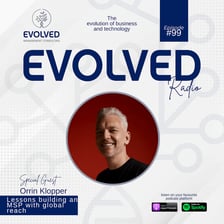
this this discussion I have with people in the dreams program that might think, you know, they're not going to get any value participating. Well, it's not just about you participating in our purpose that's going to give you value. When you participate and share your life experience, how you got through challenges in a not I'm giving you advice, but like, yeah, I had a similar challenge. You're actually enabling someone else as well to achieve what they want in their lives. So there's this this ecosystem and this reciprocity that happens, which is so, so powerful. And uh, you know, people that truly engage get that. And then from a customer dynamic, there is definitely a piece of it where it's like, wow, this is a people focused organization that really cares about their people. Welcome to Evolved Radio, where we explore the evolution of business and technology. I'm your host, Todd Kane. This episode is brought to you by Evolved Management training courses, a whole series of courses built specifically for your MSP training needs. There's a project management for MSP's course, an MSP service manager boot camp, MSP security fundamentals, and an IT documentation done right course. Check out the full suite of courses at training.evolvedmt.com. Or look for a link in the show notes. On this episode of the Evolved Radio podcast, I'm speaking with Oren Clopper, CEO of Net Shert, a veteran of the IT industry since 1997. Or shares his journey from high school to becoming a leading figure in the field. But it's not just Oren's personal story we explore in this episode. We also discuss the current state of the managed service provider industry, or in sheds light on some of the consolidation happening within the industry driven by private equity and owner's desire for liquidity events. We learn about the challenges that MSPs face in finding new customers and the impact of emerging technologies in particular AI. Furthermore, Oren reveals his company's unique approach to customer support agreements, highlighting the importance of incentivizing customers to follow recommendations. We also explore their company's managed innovation service and how it differentiates from their competitors. Moving beyond the industry, Oren shares valuable insights into building a purposeful and supportive culture within his organization. We discuss the importance of supporting employees' dreams and aligning the company's purpose with that of the clients. We also dive into their programmatic approach to management and focusing on personal and professional development. Throughout the episode, Oren emphasizes the significance of cultural alignment and its differentiation in the industry where IT services are becoming increasingly commoditized. Join us in this episode as we explore the MSP industry and the power of supporting the dreams of the doers. Don't miss this valuable insights shared by Oren, a true industry expert with a passion for growth and purpose. Orin, welcome to the Evolved Radio podcast. Thanks so much, Todd. So, we'll start where I usually do with entrepreneurial MSP owners is how did you get into IT in the first place? My my high school did not actually offer IT. To be honest, I wasn't a guy that was tinkering around with computers at school and at home. I was actually in boarding school, at boarding school. So I wasn't really very exposed. But the other thing I realized at school as well was there were some teachers who just felt uh inspired me. And I felt like I really respected them and I just saw my performance was at another level because of that. And then there were other teachers where I just didn't feel that connection and so it had a had a negative impact. And I I started to dawn on me that what happens if I end up getting a job and I don't connect with that my boss or something. I started to think, well, how could I navigate my own path? And then I at university, I did a Bachelor of Commerce with majors in economics, account, well, it's actually general to start, then I chose my majors in second year, which were economics, econometrics and accounts. But I could do an extra major in information systems. which I actually loved. I really, really loved information because if you look at a commerce degree, with the commerce degree I did, a lot of the subjects were boring. And they just want you to regurgitate stuff. They didn't actually want you to think. There was some thinking in economics that I enjoyed. But when you look at the exams, it was all just regurgitating stuff. But uh information systems, there was real thinking required, which I loved. I don't think I was that good at it though. Those guys that, you know, the programming exams, we'd get given like five hours, I'd use all five hours. Okay? The really bright guys will walk out of there in 12 minutes, you know? But I enjoyed it. And yeah, kudos to a very good friend I made at the time who was doing an engineering degree, he'd already started engineering, he'd already started a company selling engineering calculators and computers to friends and family. He saw I'd taken information systems, he invited me to come and join him. So I sold for them. And when they were on vacation, they used to take these proper vacations. I would often work during my vacations to pay for my studies. I would cover things. And technically I was very challenged. So my growth was fast during vacations and and that's really how I started. So that was 95 I did information systems and I've been doing this full time since 1997. That's how I got into it and feel very blessed and grateful to absolutely love what I do still to this day. It's obviously evolved and changed the nature of my role and what I do, but like I really, really love what I do. Okay, great. And then sort of next step, you know, uh starting your your IT organization, throw us back to those days. Like first off, I'm always curious why people start a business to begin with. Like what do you remember sort of the inspiration or a moment in time where you're like, you know what, I can do this on my own. What did that look like for you? Yeah, so in so I I started my degree 94, 95, 96, so I should have finished my degree in 1996, but I failed the subject. I remember sitting there on my bed counting cash and my mom walked in. And bless her soul, legend. And uh, my mom's like a classic. I wanted to apply for another another line, phone line because to run the business from home. So my mom then says to me, her normal thing, my boy, we need to go for lunch. So when my mom says we need to go for lunch, you can't go the next day or even the next week. You've got like you you got to. So I'm like, mom, let's just go quick if you've got something to talk. No, we need to go for lunch. So two weeks later, go. Sit at lunch, opens a sealed envelope, takes out a paper, you know, the thing you used to open your envelope, envelope opener, takes out the letter, reads me the letter crying. My boy, you got to move out of home basically. Now you're old enough. You if you failed the subject, you got to So she kicked me out of home, which is one of the best things. I moved into a small one bedroom flat. We had nine people working out of there at one point. And it was just kind of in 97 when I finished my degree, there it was kind of the tipping point where a lot of my friends got good jobs and there was a big demand for the skills that I had. Yeah, I just I just managed through through the the partners I had right in the early days and the people around me, it felt like something was happening. We we closed a couple of deals here and there that just created some some some reasonable cash flow that funded things. It just kind of gradually organically grew. We grew every single year except for the since since 1997, we've grown every single year except 2020. We we shrunk by 5%. So the first time we ever did, but but it was transformational what happened in that year, which was a big part of our growth. So that's that's kind of and then I think from a purpose and a meaning perspective, Todd, in that year of 19 1999, it's we started to see SMB smaller, medium, entrepreneurial businesses that really needed technology, they were being taken advantage of and they were being sold solutions that were not really appropriate for their size of business. And so the purpose of supporting the dreams of the doers was in its form created at that time, which we called enabling organizations through technology. It was more it was longer than that, but essentially our purpose is exactly the same. And we saw that Y2K, people being ripped off with that. And that kind of was where our purpose came in. And then early 2000, we came up with an annuity model that had a reimbursement structure that had a trust mechanism built into it that was very, very well received. And this saw us um go through some really nice growth. Interesting. So can you expand a bit on that model? Is that still something that that you guys use for your offering now or was that more sort of a point in time thing? We yeah, we've got an evolved version of it, but at that point, so how it worked was if you are our customer and you are paying us $5,000 a month as an example, Okay? So that accrues now to $60,000 for the year. So one of the challenges we had was if you do not take our recommendations as a customer and you just abuse our kept $5,000 support agreement, it's going to be very unprofitable for us. So we said, how do we incentivize this for you to how do we incentivize the right behavior? So we said, if you take our recommendations and the average ends up being $4,000 a month, so you only use $48,000 of those sports you paid 64, we will reimburse a portion of that $12,000. We'll give you $4,000 back, we'll give $4,000 back to the at that time it was we assigned one engineer to it, we would give him $4,000 because we felt he was very key in the relationship and then we would keep $4,000. And it was unbelievably well received. What it's evolved to today is we've come out, you know, obviously the MSP space is a red ocean. There are 30,000 plus of us. And anybody that wants an MSP, they put it out anywhere, you know, they're going to get 10 people replying. So the the core managed service offering is a very commoditized offering. And the even the core managed security offering is a very commoditized offering. So the blue ocean we have created, which is we is very exciting and we're really getting in front of a lot of customers around is what we call it's our managed innovation service. So for $5,000 a month, I'm just using the same numbers just as an example, we will find $60,000 worth of ROI. Direct that you have to approve and sign off. Okay? Or we carry on working until we do. And the key technologies we're leveraging there is the Office 365 technology stack, and then power platform, and then other elements in and around that ecosystem. Because what we found is organizations are are investing in these tools and investing in this technology, but they have not really leveraged it to see the the the most optimal return. Yeah. Oh, that's great. So effectively kind of uh guaranteeing the the value of their their spend on IT by money back or, you know, you get that value back in in sort of the outputs that we provide for you. That's interesting because it's it's not a it's not an easy model to do at scale. Like uh especially in a services-based industry. You know, if you buy a product, say, you know, something that's a thousand dollars or something like that and you're like, you know what, I don't think I got the value for this. Like, okay, you can return it, especially knowledge-based products or something like that. That's different than, you know, I have sunk costs, we've been working here for three months. I've seen people do this where they, you know, they guarantee if you don't like the services, we'll refund you after the first three months. But, you know, that that that's a bit of a harrowing thing to do for for a lot of organizations. I would say you're kind of you guys are kind of taking that to the next level of, you know, well, we're here to we find that 60k, right? Yeah. Yeah, no, and I'll be honest, Todd, when we initially routed it out, there was some glazed looks in the team members's eyes. And it's it was two years in the making. It wasn't something that we just kind of flippantly did over night. We did tons of customer interviews. We hired a professional UX research firm. We kind of went into great, great lengths. Uh we leveraged um the input of one of our advisory board members. So it was heavy lifting to get there. And the team, some of the team, you know, as you got in any team, some people just love the new stuff and they have faith and they'll go out and evangelize something before all the proof and the reality is there. And then you have others who sit back and wait for those and that's just the nature of a team, but no, it's it's be it's be it's been a it's been a great, it's been a great journey. And I think also just being an MSP, knowing that we have something truly value-based and differentiated, it kind of makes you feel good in your heart, right? You know, that you actually are doing something different uh in a part of your offering and it's really 100% focused on the value it creates for your customers. And it feels good. Yeah, yeah, it's a really important aspect and I think that sort of tips towards uh one of the things I wanted to hit on here is uh your organization. And I get in chatting with you like uh you in particular are highly, highly focused on sort of the cultural element of your business. Do you want to expand on that and just tell us sort of how you think about the culture of your organization? For sure, for sure. You know, I in 2004, I came across a a journaling tool called Map for Life. And the guy that came up with this is a legend. He's a pastor and he's an engineer, okay? Dangerous combination. And then he said he's going to map out the maths and science of how to set goals and achieve them. And his journaling tool is just unbelievable. So it's called Map for Life. So I kind of grasped this and I thought, wow, this is exciting. This is really a blueprint of how to achieve what you really want. And uh, you know, it also kind of comes from the perspective, I never really was that talented at anything at school. I was an okay sportsman. I did well at maths. I was academically probably predisposed to do well at maths and science, but I still had to work hard. Nothing kind of came just like that. So this idea that you could have a methodology to set your goals and work towards them, measure yourself, hold yourself accountable, I really loved. And then in that year of 2004, the business was just in South Africa at that time, and most of the SMBs did not have cloud-based servers. And it was in a like a broom closet was the server and in summer there's no cooling, the server would overheat, it would crash and we had one of our best engineers actually on our New York team now, who would just go from one server crash to the next. And at that time we didn't insist on branded beautiful equipment with on-site warranties. We were the warranty, you know? And uh he would just go and this guy was an he's to this day, he's an absolute legend and a machine. He just he was sitting in front of a server, front of the screen, and I got a call from one of our guys saying, Sean's sitting in front of the server, he's not typing, he's not talking, he's not answering his phone, and uh we don't know what's going on. He totally burnt out. So I realized at that point, if we're going to build something significant, we need to deeply think about the balance and and and and our culture. And uh so that's kind of where the seed was really planted. And then in 2007, I attended a program at MIT where one of the one of the lecturers mentioned a book called The Dream Manager. The author's name is Cameron Harold. Really, really great guy. You know Cam, yeah. Yeah, yeah, he he mentioned it in passing. He didn't go into great detail, but I I I took it down and I read it and I absolutely loved it. And it was just this case study about how and we always aspired to this and thought about it where your personal lives and your work lives are inextricably linked and if you can create a safe space within the workplace culture where people can really think about and talk about what they really want in their lives, that is a very powerful force. Uh so we we we took Map for Life and the Matthew Kelly's book, the Dream Manager, made our own version of it. So, you know, it's one of the key pillars. Our purpose is supporting the dreams of the doers, which the primary focus of that is our people. And the the the aspiration there is you could do truly great work, but you can also be an active present father, an active present mother, husband, wife, you know, whatever roles are really important and meaningful for you, we want you to be present in those roles, but at the same time, do truly great work. So this dreams program, so we have out of about 330 people, I think we have about 300 dream books. Your dream book is your your top 10 personal goals and dreams. And some of them might be work and some might not, you know? And it's almost part of the fabric and the DNA and the operating system of how we operate the business. It lives in the line management relationship. So if you were my line manager, we would want you to know what's in my dream book so that you can in an authentic way, balancing my performance against that, support me in achieving that. You know? And it's not do it, just support me in achieving it. And it's just, yeah, it's just been such a powerful way. You know, we've got we've got people in Poland, we've got people in the Philippines, we've got people in South Africa, we've got people in Marla, New Jersey, we've got people in Kenneworth, New Jersey, we've got people in Brooklyn, we've got people in Manhattan, you know, and uh it's funny, something happens Todd when you share in an authentic way, you know, what you really want in your life with another human, there's something that happens, there's a connection that happens. And something to this day that I still try and check myself on is we assume we know someone. Yeah. Oh, I know they're kind of guy, you know, or I know they're kind of girl, you know, and then they tell you a little bit about their real story and what's really important to them and it never ever it almost it constantly inspires me, you know, just to hear what people really, really, really want. So that's one of the key parts of our culture and we leverage that in a way to create this this glue that not only provides almost an invisible elastic concrete to support the growth that we've got. We've doubled the business in the last two years. But what's interesting because initially it came out of we want this for our people and then we saw how clearly great great people results in great stuff for our customers. But what we've realized with our our our acquisitive growth where we're looking for other MSP entrepreneurs to join us on this journey, one of the most important things they're looking for is a home for their people. And so it's landing and resonating with them on that. But it's not for everybody. Some people hear it Todd and they're like, no, that's too much. You guys must just calm down. Okay? Because it is, it's it's a lot, right? We're kind of like people are sharing like what's going on in their personal lives and, you know, we we don't force it, but there's a level of vulnerability which some people maybe that's just not what they want, you know? And that's a part that I wanted to hit on because like I've worked on several organizations that were very culturally attuned with these types of programs. where it got in depth where, you know, it was it was a programmatic approach in management to spend time detailing like what is your life going to look like personally, professionally, all of these things. And, you know, the organization that I worked at, we were trained in career life planning, which is still sort of this methodology that I coach other people to work on. And it's funny because all of the organizations that I've been in that I think have been hugely successful, always have this type of element, but, you know, and it's not like not, I don't know how to qualify this. It's not that the organizations that don't do this won't be as successful, but I feel like this is I think the missing component to the other organizations that are a little sensitive around this. Like I've proposed these types of ideologies and these management frameworks for for certain organizations and there's naturally this sort of like, oh, that sounds like, I don't know, I'm kind of uncomfortable with this. Like, are people going to think this is stupid? And like technical people, like they don't want me digging around in their lives. Like they seem very resistant to it. And I'm not sure how much it is their own personal resistance versus like what they think the resistance that they'll get from their staff. But I I think that it is sort of a false assumption that like that people don't want this, right? I think people are tentative, they don't really understand it. But once you give them a taste of this and people start going through these types of programs, it is absolutely transformational and I think the key part, especially to the people that you want, right? Like this is how you really identify people that will create sort of a solid performance culture, right? Yeah. No, no, that that's it. So like we had um had this guy now, Jonathan Costa is his name. Man, he just he he he just grew. Like he's one of those guys that came in as a tier one, entry level, and he ended up being one of our best architects. And he's gifted. And uh so he just passed exam after exam. He ended up leaving and he just got our culture. He was so tuned in. He ended up leaving and on the on the most amazing terms. I think he'd been with us for like 10 years. And he just came back last month. Nobody told me. I just saw the post on LinkedIn. I was like, that, what? And you know, you can see how long ago the post was done. I was like, no ways. So I reached out to him. I was like, dude, that's amazing. So that's the thing. If if this culture resonates with you, we have, I can't even tell you, I reckon we've probably had like 30 to 40 boomerangs of people that leave and then come back, you know? And uh so it fits. If it fits and it resonates, it literally, I think it's it it it it just creates an optimum level of engagement and performance that is that it just feels very real, you know? So yeah, and and people that it doesn't really resonate or they they don't connect as much, it might not that might result in them wanting to move on or there's not as much glue keeping them there, you know? So, no, there's a definitely a piece of it which is is self is self-regulating. Yeah, yeah. I I love this idea around culture and and I think that the internal component is just as important as the external component and how you build a performance-based culture with your internal team, but also how it actually reflects with the clients and marketing and how you're building your business because people talk a lot about books like start with why, but I think they actually get wrong the fundamental thesis of the idea around like, okay, I have my why. So now I have this marketing angle that I'm going to try and build upon it. When really, if you understand the basic thesis of the book is that people don't care about what you do, they care about why you do it. And I think this is an incredibly powerful way to select and work with organizations that will work with you not because you do IT or you're the cheapest. These are not the ways that you want to find and select customers. It's because they actually understand what you do, why you do it, and have a cultural alignment. And those value alignment principles both internally as well as externally, I think are incredibly powerful from a point of differentiation for your business. And this is something we've kind of talked about a little bit about like the the IT is somewhat commoditized. And I think going forward with the enablement of AI and sort of the flattening of like all the services and business model that the MSP ecosystem uses, what is the differentiation if not those cultural alignment and why you do things or how you go about it and what is different than everybody else on the street that also does MSP IT services, right? Yeah. The way you you focused in on, I think the heart of what your purpose really is, and it's not just a cool marketing angle. You know, we had we had Simon Sinek come and spend, I did a program was just just for you, he came and did a with entrepreneurs organization, we did it at Stanford. He hosted a session with a friend of mine's business. And he said, and anyway, so Simon said, who wants to volunteer to be interviewed live? So, I know that I'm very emotional and I didn't feel like crying in front of everybody because Sebastian, a friend of mine told me that Simon had interviewed some of his people and they were, well, Sebastian said he was in tears in front of all these people. So I just thought, let me let someone else go. But he has a way of peeling back the layers to the key moments in your life that connect you to your why. And it was out of that that we started realizing how important it was to and and it was after that we came up with supporting the dreams of the doers. You know, so for me, the thing, this this discussion I have with people in the dreams program that might think, you know, they're not going to get any value participating. Well, it's not just about you participating in our purpose that's going to give you value. When you participate and share your life experience, how you got through challenges in a not I'm giving you advice, but like, yeah, I had a similar challenge. You're actually enabling someone else as well to achieve what they want in their lives. So there's this this ecosystem and this reciprocity that happens, which is so, so powerful. And uh, you know, people that truly engage get that. And then from a customer dynamic, there is definitely a piece of it where it's like, wow, this is a people focused organization that really cares about their people. And we purposely try and avoid customers where they do not have that type of orientation. And we've made a mistake, Todd, where we've closed some customers like that before, you know, and if they there's a certain line that they cross, we we will walk away from that relationship because we don't. You know, sometimes in IT, customers can abuse IT people and we don't allow it. We don't allow it. So it's no, the purpose piece is has just it's um it really is the bedrock on which we've built this business. And then, you know, someone says to me, Oren, why do you want to grow so big? Why do you want to, you know, be such a large organization? Well, the exciting thing is, the more we grow, the more MSPs uh that are able to join us on this journey, the more people's lives we can touch in what I believe is a relatively unique way, okay? The more customers' lives we can touch, and you know, so it just grows the momentum of the impact that that uh that we that we can have. So, yeah, it's very it's it's very exciting. Yeah. Okay, cool. And I guess like how do you think about this and what we talked about of the differentiation going into the future of the IT industry? You know, AI is going to change things, the consolidation in the industry is is somewhat changing things, you know, there's going to be lots of market influences and and as you said, it is a bit of a bit of a red ocean. Gone are the days when you had to educate people on what a managed service provider was and why it was better than a time and materials provider or a var. Yeah. That's long gone. Yeah, like you you it's you're people are just now sort of swapping managed IT providers and, you know, it it's not it's not an insignificant effort for the client to make those changes, right? So what do you see as sort of the the future of the industry in in sort of that broader picture and the market influences that that that you see? Yeah, so I think there's uh, you know, I suppose I've been kind of doing this full time since 1997 and you've touched on some of the huge forces at play right now. So there's a consolidation happening in our industry. There are about 70 to 80 private equity firms that are are involved in consolidating the MSP industry. The size of this economic force is transformational. So even if you might never want to sell your MSP or you you you think P private equity is just the worst thing in the world, you need to understand it. It's a massive economic force and it's one of the key reasons, it's one of the forces that is driving consolidation. And another is many of many of the MSP founders are further on in their career in their late 40s, early 50s, late 50s, something even early 60s and they're looking for a liquidity event. You know, so so this consolidation, there are many elements at play there, which is which is very, very significant. Part of what's driving that consolidation on some of the even is like a lot of these MSPs we're engaging with, they're struggling to find new customers. And they're cutting their marketing budgets because they're just not seeing the return because it's a red ocean. You know, some some have differentiated and got different angles and so forth and that, but a lot of them are just really struggling to find new customers. And then, you know, so that's another piece piece of it that is driving the openness to to potentially look at traveling a a journey with an acquirer. And then, you know, the lights of of AI, I've been reading in the space of AI for so long. And there's a book, I think it's called super intelligence or superhuman, I forget which it is. I think it's super intelligence. And they spoke about it at length. There was a chapter where he said, the 99.999% is not going to feel like it's really achieved anything significant. And then 99.9999 suddenly it just tips. You know, so that's coming. Yeah. There's no doubt about it. It's going to impact our space and what we are doing is we've embraced it in our innovate offering. So it's part of how we're achieving this ROI leveraging it in various industries and so forth. But it's coming. It's coming. I think in my time, it's going to be the single greatest disruptor. Yeah, it's interesting. I like I like that quote because uh I've seen that to be true, you know, like chat GPT was a thing that no one really talked about and that was sort of the 99.99. Like it was really good at what it did. But then you got to like chat GPT3 and everyone's like, wow, this thing's pretty capable. Like this is amazing. And then you went chat GPT4 and like it's just like everyone's head cracked open. Like it was it was the best thing since sliced bread overnight, right? And you're right, like like it's it's sort of interesting, it's interesting and then it's earth shattering, right? Like it just overnight. Yeah. Yeah. No, it's so so that's coming in different forms and incarnations, which I think can be tectonic plate shifting changes coming, you know? And it's uh we're trying to stay ahead of it and we're investing in it and we're building it into our offerings and engagements, but it's it's it's exciting, but also scary times, you know? As an entrepreneur, I've I've been I've always been paranoid and uh in a healthy way, but uh yeah, my my my paranoia seems a bit amplified on on this front. Yeah, that's amazing. All right, so this has been great. I really appreciate your perspective. I I I love your philosophy on on culture and I think obviously it's it's certainly working for you guys. You guys have seen this sort of continued growth and then meteoric growth. And definitely seem on the right track and really appreciate your inputs. I'll share your links to you and and uh and so people can reach out to you. But any uh sort of parting words of wisdom or uh ask of the audience or if people would like to connect to you, where is the best channel that they reach out to you on? Yeah, reach out on LinkedIn. It's probably the easiest. Um but yeah, we we share, we share very openly. I think any discussion I ever have with another MSP owner, I'm looking to be as open as I possibly can. We've made so many mistakes and I love sharing those mistakes because if if if one person can learn from some of the costly mistakes we did, then it just makes it even more worthwhile. So yeah, we love talking to other MSP owners. And uh reach out. Yeah, happy to happy to have a discussion. And Todd, thanks. Yeah, just really great discussion. Awesome. Appreciate your time.