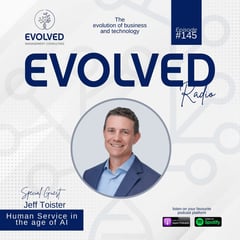
Todd Kane: Every MSP I talk to is working out how much of the help desk to hand over to AI. My guest has spent two decades training service teams, and he has the data on what happens when a customer needs a person and can't reach one. Jeff Toister courses have been taken by more than five million people on LinkedIn Learning. His new book, Human Service: The Skills AI Can't Replace, is built on research from over 370,000 phone calls, and he calls it a pro-AI book. We get into which tickets your techs should hand, uh, handle, and what goes to a bot, and why making a human easy to reach pushes more clients towards self-service. Jeff, welcome to the Evolved Radio Podcast. Jeff Toister: Hey Todd, how are you? Todd Kane: I'm very well. Great to see you Jeff Toister: Good to see you as well. Which, it just strikes me as odd people are listening and they're like, "I, I can't see either of you." But you should. You should be watching us Todd Kane: Yeah, yeah. Jeff Toister: your mind's eye Todd Kane: you can check out the, the, the YouTube feed if you like, if you wanna see our smiley faces as well. Uh, but, uh, we… otherwise we are in people's ears coming to them about AI and service. You, uh, you and I connected years and years ago, uh, and we had sort of this common theme of, uh, you doing a lot of the work in more enterprise space helpdesk to, and service, and that's the space that I actually came from before I kind of found, uh, the majority of my career in MSP. But I think a lot of this is incredibly relevant because I've always felt that the work that I do in both the operations that I did working inside of IT organizations and MSPs was really lending from what I learnt in enterprise and trying to apply it in an SMB space. And I think, uh, the, the conversation today is, is sort of a retreading of exactly that, is what are we seeing at-- we can learn at an enterprise level that should be applied at SMB and the MSP space about the human and AI interface? This is, as I noted in the open, this is something that's coming up a lot, right? Like I, I, I was initially a little concerned at how slow the a- the adoption of AI was in MSPs, but it's starting to come a little more fast and furious. But there's a lot of sort of hand-wringing and consternation about what is the right approach here. And I've seen the tale of two MSPs here, for example. One organization, you know, we will not use any type of AI in user-facing activities. And then we had another MSP that I saw, you know, e- they went to the, the full extent where, like, they didn't even pick up the phone anymore. The AI was answering the phone for them, and I was like, "How does that work for you?" And they're like, "Clients love it." I was like, "Really?" Like, I was actually really surprised by that. So I find, like, the ground is very shaky on this about, like, what people could and should do. So I'm, I'm excited to get your perspective on this because you've got a lot of data, a lot of history that, uh, I think informs this. So maybe, uh, all of that to say, we can start with kind of your thesis on this of like the interface between human service, and AI? Or, uh, maybe to start, what is h- how do you define human service as the sort of the title of the book? Jeff Toister: So human service, that's a good… I think that is a good place to start. It, it's, it's any service in any environment that involves uniquely human skills. So a few examples of those would be connection, that ability to just build rapport with someone that you're serving so they like you and they trust you a little bit better, or understanding. A- and understanding goes beyond just, let's say, finding the root of the issue. You know, "My computer's not working," but it's understanding the intent behind it. "My computer's not working, and I have a big client presentation, and I'm worried about not landing the deal." And then advocacy. Advocacy means I'm working on your behalf to try to get a result. A- and so those are things that humans do. Now, I think there is a very important distinction between human service and people who are providing service, but they're not using human qualities. So these are people who are very transactional. They're, they're almost trying to impersonate a robot. I mean, they're, they're trying to be AI without the capability, and that's what I found writing the book is that that's kind of the worst place to be. I, I don't want an uncaring, inefficient human. So it's a better choice to say, "Can I automate this and automate it effectively?" Or in these specific situations, will a human add extra value? Todd Kane: I think this is huge, right? Because, uh, I think you get to the heart of the problem that we see in a lot of tech industry is highly logical people, you know, not terribly emotive. Em- empathy is something you sort of have to, like, teach them and train them to some extent, and that- that's not-- that's a broad generalization, but I think it's also generally kind of true. Um, and, you know, this gets to sort of the fundamental disconnect, I think, at a lot of service desks with around IT is, uh, you know, I'm here to solve a problem, not to be your best friend, and I think there is obviously a middle ground in that, especially when you're doing, you, know, phone support. Uh, you're interacting with someone, you're talking to them. There, there is obviously an emotional and human connection because they're frustrated. Something doesn't work, and most people are mystified by technology, and they kinda hate it. And the, the technical, uh, sort of wizard on the other end of this is just like, uh, "Yeah, yeah, I know what this is. Hang on, let me get this fixed for you right? And they, like, they're just not interfacing with the humanity on the other end of the line here or sending them an email and not recognizing how they come across, like what the, the implied intonation in how you write something. Or the one that drives me the most crazy is like, "Hey, did you call that client back?" They're like, "No, I don't have an answer for them yet." Well, like, call them back and let them know that. Like, that's a part of this communication that is necessary to service them as a human, right? Jeff Toister: I think you, you hit upon a big challenge and, and it, it's made worse in a way because we're in a world that thinks in terms of tickets. So we, we've taken the human almost out of the equation because of the process. "Hey, can you help me with this?" "Yeah, I don't see a ticket, so maybe I can't." But you also raise a good issue about that disconnect between, you know, you know how to fix the issue so it doesn't bother you. And, and, and s- and you might even be almost amazed that I don't know how to fix the issue. Like, it's so easy in your mind, so tapping into empathy is, is extra hard there. One, one of the exercises I've often asked teams to do is think about, you know, why is this person really frustrated or anxious? And, and if they can get to that, then ask yourself, h- have you ever f- had that same feeling? Like, you might not have been anxious because your computer crashed right before the big presentation, but maybe your car broke down on the way to work, and you knew you couldn't be late that day, and you didn't know how to fix your car. You can fix a computer but not the car, and now you're helpless and you're waiting for that mechanic, and you hope that they're cool and they show up on time, and they don't make you feel like an idiot. Uh, I mean, it's a similar enough feeling for then you can ask, "Well, what would've made me feel better in that moment?" Or, "What did make me feel better in that moment?" And if you understand that, then you can probably tap into empathy and say, "Okay, I can do the same thing for this person I'm serving." But there's a lot of intention behind all of that, and it is really easy just to be dismissive of it and say, "Look, it's another ID10T issue. Let me just get on it and away we go." Todd Kane: Yeah. Well, I guess, and that kind of gets to, you know, um, what you're, you're noting here is sort of the human in the loop, uh, in this. Because quite frankly, like an AI can solve this stuff. Like we're getting to this place where, you know, it can recognize what the issue is, it deploys a script, and whoop-de-doo, like problem is resolved. So if that's where we're headed, where is the human in the loop? What value does the human interaction, uh, provide, uh, when s- a lot of this will start becoming sort of first contact or first call resolution being done by a bot? Jeff Toister: There's a few places where humans add, I think, some unexpected value. Um, and, and we'll go maybe obvious to not so obvious. One of the obvious places is, is where AI reaches the limits of its capabilities, and that's where we need a human. So those are more so edge cases or, um, you know, we still rely on humans sometimes to document properly what's actually going on and what they need. And, and, and sometimes we need a human just to kind of suss that out. So that's the kind of more obvious. Um, there's a second where the human's just not confident in the output. A- and there could be a lot of reasons for that, but, you know, typically the higher the stress levels, the more urgency, the more perceived complexity of the issue, the less tolerant we are of entrusting the issue to automation or AI, especially if it doesn't feel highly competent or easy. But then the third area is, I think, some of these unexpected places, let's say, where relationships are really, really important. And it's more than just troubleshooting an issue. It's more about providing confidence that, hey, we're on it, and we're going to help with that. And in those cases, that's where a human can really add a lot of extra value. So it's, it is a little bit of a moving target, and A- AI is able to do more and more each day. Uh, but I think it's a mistake to just we're gonna put everything on AI or we're never gonna touch AI a- and, and it's all humans. I mean, AI, like anything else, is a tool, and right tool, right job, you probably get the job done well. Todd Kane: So what about like, uh, like first contact, right? Like, uh, 'cause I, I noted, you know, the story that I heard about this MSP that just went pure AI answer, uh, of phone calls, and I was shocked that the clients didn't, like, revolt around this, uh, because that's what I tend to see is like, you know, uh, we're of the generation, I suppose. Uh, I find a lot of this is generational actually, because, like, the older generation than us, like the sort of people in their 50s and 60s and beyond, they'll pick up, pick up a phone. Like, they wanna talk to a human, and that's very much sort of a generational, uh, approach for them. Um, you know, I don't know how old you are. You, you look like a young guy. But in those, in those 40s and below type thing, um, that, Jeff Toister: No comment, and definitely not 40s and below. Todd Kane: Okay. Well, you look great. You look great, Jeff. Um, that, you know, I'm, I'm there, like mashing zero, like yelling agent into the phone when I'm stuck in a phone tree, but I'm also the first one to go to the, the web and look for a chatbot that can actually solve the problem for me, and then the generation below that is just like, uh, either I will solve this myself, or, you know, maybe I can send a text, or I can find a chatbot, but I am, I am absolutely not phoning and talking to someone about this. So there is a bit of a generational split, but, what would be your opinion about, you know, having that first line of interface with a client being more agentic? Is that a good or a bad thing, or is It circumstantial? Jeff Toister: It gets circumstantial. Uh, however, I, I think generally there are some real advantages. So if we think about first line, if I have to go to a human, I'm probably going to have to wait, and if that wait time is tolerable because it's not urgent, that's okay. Um, but also one of the things where… So AI can often answer this question immediately, especially simple stuff. You know, my, my internet is down. Okay, well, let's start, let's start a process. We c- we can walk through a troubleshooting process without waiting in a queue or submitting a ticket. That, that's an advantage. One of the other challenges e- especially when we're reacting to issues is having the right amount of information to diagnose the problem, and that is classically a challenge. But if we can have a conversation with AI, it could probably guide us pretty quickly if it's programmed right to provide the correct information. So there's definitely some advantages there. I think when it exceeds complexity, uh, or, or there's a level of urgency where I don't have the tolerance to go back and forth with AI, especially if it doesn't initially seem to understand me, that's where the human is, is gonna be more needed. So sometimes it's first contact is okay, but do we have a clear escalation path? And, and, and what we're seeing it is kind of all over the place, but AI is sometimes way too tenacious in terms of holding onto the issue versus being able to recognize, "Oh, this is an edge case. Let's get you to a human, and we're gonna send you to the human with context." Or, "Oh wow, you're super, uh, this is super urgent. We're gonna get you to a human." Um, I think you're probably right about there's some generational differences. I think there's also some power differences. Your… Is your CFO or CMO going to tolerate chatting with an AI, AI agent because they have a need that's urgent or are they just going to talk to the person that they know is gonna help him, help them right now versus I just started with this company, I don't know anybody yet, and I'm trying to get my, you know, my, my workspace set up for day one? That's probably a different level as well in terms of what people are willing to tolerate. So not a clear answer, but I think it's good to think through those things. Todd Kane: Yeah. Well, let's, let's explore this a little more then because, Jeff Toister: Yeah Todd Kane: examples that I find frustrating in my interactions with, uh, with s- uh, help desks and service desk in general, uh, it's funny how you become sort of critical and you see this everywhere in your life when it's a part of your job. Like, I never thought much about, like, phoning, uh, you know, an airline or, uh, support for a product back in the day before I was in this industry, and now I'm keenly aware of all of my interactions with some type of help desk or service desk. Um, and one of the things that I think bothers me is there are lots of places where I almost feel like an interaction with an AI that was sufficiently capable would be better than the human interaction that we have to wait for in a lot of the enterprise environments, Right Like, you phone, uh, you get someone who, uh, uh, you know, is potentially offshored, uh, they're doing their best, But the part that bothers me about those interactions is that they're incredibly scripted, right? And it's to the extent of, like, the feigned empathy bothers me, of like, I tell them what my issue is, and they're like, "Oh, I'm so sorry to hear that blah, blah, blah. That must be really frustrating for you. I'll see if I can help you with the blah, blah, blah, blah, blah," right? And it's like you can tell they're just reading from a script, and if you try to, like, break them out of the script and interact with you in some way, like, it, it just, it's, it doesn't derail the conversation. It just seems to, like, go down the script. You can't break out of it, right? So, like, I may as well be talking to a robot Jeff Toister: Right Todd Kane: The human interaction is not additive. In fact, it's actually a detractor from my experience in that interaction, right? Jeff Toister: But I think that that's what I would consider to be, uh, not human service. That, that's, it's transactional service. It's, it… That person is impersonating a robot by sticking to the script. They're not bringing their humanity, so they don't add any value. And I, I think you're right. If, if I put that person up against a capable, um, AI, um, AI is probably going to be just as charming or not as as… But, but it's probably going to, to be a little bit faster at working through the issue, I hope, right? If it's programmed correctly. I, I think we have to look at places where humans add the extra value. So, uh, let, let me give you maybe two examples. One is I was about to start a webinar with a client, and I, I desperately needed this webinar software to work, and it was not. And I was able to, to… I, I didn't see a clear option to troubleshoot it. I didn't have time to go through a whole script and, you know, Clippy, the AI bot, to tell me how to reset the software and all that. I just needed a person who could just handle it. And I fortunately got a person right away, and they solved it. But then they did something that AI just can't do yet. They understood the real source of my anxiety was that I'm starting this client webinar. I'm worried about letting my client down. And I'll never forget, she said, "I think we've solved it. But I know your webinar's about to start, so I'm gonna stay on the line with you, and if anything goes wrong, I will be right here to help fix it. And if it goes smoothly, which I think it will, then I'll just quietly get off the line and you can facilitate your webinar." That's a, that's a different level of understanding where that person is adding value, and I was ready to cancel that service, and I stuck with it for two more years, despite it being an inferior product. And then Zoom came along and, you know, some other really good products and, you know, enough is enough. But they bought me two years more of service from that person. Now, the flip side of this, the other day I was trying to solve a problem that involved both payroll and accounting, and it was after hours, so I, I didn't wanna wait for a human. It was, this was my time to get it done. And I first started with my payroll provider's AI bot, and they had a hole in their documentation, which means the AI bot couldn't solve it. And then I go to ChatGPT, which is able to kind of source from multiple places, and I solved it on my time, and it was a very helpful thing, without having to wait for a person. So I, I think, you know, there's a, a case to be made for having both, and both have their place. Todd Kane: I think the, the, the first example I think is what that reminds me of is that in, in problems is almost some of your best options for creating loyalty, right? Like, I tell this story all the time. We're in an enterprise, uh, consulting environment that I was in. Um, we made a huge error and deployed like s- over 60 servers into the field for this very large client with the wrong image on them, right? And like a huge i- issue because we paid, you know, $400, $500 shipping to get these, all of these servers out and all the work that had been done to build them. Um, and everyone's like, "Oh my God," like, "This is such a problem. We're gonna-- Uh, we have to pull them back." Like, "The price of the project is gonna have to go up." And the CEO is like, "Nope, this is our error. We own this. We are not charging them any more, and we're gonna communicate that to them." Two things about that. Like, um, one, owning it. Two, the fact that you own it and that you're not charging them more. A lot of people will s- try to hide these issues and, and sort of s- like circumvent to, to make themselves look good when in a lot of cases, like how you handle an issue is far more i- impactful than the issue itself, And they became an incredibly loyal client of ours because of what we were able to do. Same thing for you, right? Like that person is probably incentivized by their call handle time and the number of, uh, uh, tickets that they're able to close through the course of the day, but they took that extra five to 10 minutes to hang on the line with you to make sure that you were okay. They didn't have to do that. But that simple action of rather than saying like, "Looks like you're good, Jeff. Let us know if you need any, any help in the future," and then click, right? Uh, they h- they held on, and that, that created that sense of loyalty for you. So I think that's massive. Jeff Toister: And you're bringing up a, an even broader issue, which is, you know, uh, taking ownership of mistakes. That's, uh, that's something that does, it, it, it creates a s- a different set of trust and builds a, a relationship with your clients. So, you know, I don't know that a machine knows how to do it, but, uh, people certainly can Todd Kane: Yeah. And maybe we're sort of getting to that, that state of the world as well is like when an AI does something wrong, like how do they, how do they take responsibility for that? Where does the responsibility lie, right? Like this gets into some weird spaces on, uh, you know, errors and omission, uh, insurance. Like our AI did something, uh, and it went rogue and did something it shouldn't have in your client environment. Like that's something to consider as well. Like what's the scope of control that you give these things? But also, you know, it can't really be held responsible for the good and the bad things that, that, that it, it should be doing or shouldn't be doing as well. yeah, this Jeff Toister: We've seen a case already about this. Um, I, I, I'm, I'm not gonna, I'm gonna get the details wrong, but I think there was a case, or maybe it's going through the courts now about are we responsible for what our AI does Todd Kane: Mm-hmm. Yeah. No, I wouldn't be surprised. I think that's, that's super, super relevant, right? Because e-especially as they become more agentic. Jeff Toister: Ja Todd Kane: and we've seen sort of the previous cases. I've personally not run into these issues, but like when Clawbot and stuff s- first showed up on the scene, and it would just sort of rip through and start deleting stuff for users. Like, "Hey, I'm cleaning up your inbox. I'm deleting the 4,000 emails that you've archived." It's like, "No! Stop." All right? So I've never had an issue like this, but you know, you could see that being an issue where, um, I don't think it was an AI necessarily, but I've seen those i- the issues where automation deleted all of the backups, Jeff Toister: Ja. Todd Kane: in order to make room for, for, for the new backups. And it's like, well, no, like we have a regulatory compliance requirement for keeping these backups. Like, you can't just go and delete them. Um, so there, you know, this is maybe gets into those spaces of like, where is AI useful? Where is, you know, the, the, the human in the loop needs to be required? So we've kind of touched on like empathy being one that, you know, robots right now are not terribly good at, and it's an important component for especially the service desk. I believe a lot of sort of the IT support in the future will be back to the future of more consulting, a lot more human interaction, because everything else on the back end is largely commoditized. Like I don't think having an AI being able to resolve your client's issues for you actually differentiates you in a lot of ways. It may make you more efficient, but I don't think the clients particularly care about how the issues get resolved as long as the experience that you create for them is, is positive, right? So I think that to this place of like, what are the skills that humans are still highly adapted for that are necessary in, you know, the IT future that, you know, for now, maybe the next, at least the next year or next three years, uh, AIs are not particularly good at taking on some of those tasks or being capable of doing those human activities. What would those look like? Jeff Toister: I think one of the biggest things is, you know, go back to advocacy, that when something falls out of a normal process or breaks, do you have a human who's available to run with it? So as an example, you hire a new employee and you're counting on your MSP to make sure that that employee is ready on day one. Whether or not they're ready is critical for that day one to be a great experience, "Hey, I'm starting to learn how to do this job and understand the culture," or, "My day one is spent tracking down that computer they sent me and, uh, trying to get the right credentials and log in." And so there's, uh, two very different scenarios. I think AI can help monitor and run processes like that, but what happens if something goes wrong? Who's going to find that solution that is not in your normal process? I mean, if that laptop you shipped out got stuck in a, a shipping hub somewhere because of a snowstorm, what are you gonna do about it? That-- And I think those are, those things, humans are the ones that can find creative solutions. They can work around systems. They can work through bottlenecks and limitations. They can think laterally at, at, at a very different level and understand when a rule is a rule and more of a suggestion. A- and having a human available for those more complicated scenarios or when something goes wrong is, I think, a good way to use your human talent. It's okay to mo- to automate, you know, a normal request, for example, that, but you still need somebody to monitor that and fulfill it. So that's-- I think that's where you, you run into challenges is where companies either go all in on AI and forget that you still have to train and monitor it and have a fail-safe. But also, if we're just having humans do all of that, that's inefficient as well. So there is a balance to be had, but those edge cases are, to me, one of the biggest opportunities to have humans involved. Todd Kane: Yeah. You, you mentioned kind of the advocacy, I would say, versus process. Uh, I think this is a, a big piece that, that I'm fascinated by because, um, I often say that, um, critical thinking skills is one of the hardest things to actually teach to people, in my opinion, because so much of it is experiential, right? Like you can, you can give them sort of, uh, value-driven judgments and, uh, give them as much process as you can, but either they get stuck in following the letter of the law and like we talked about of like, "I'm supposed to follow this script. If I go off script, I'm gonna get in trouble, so I'm just gonna follow the script," and, you know, it devalues the relationship that I have. Versus, you know, "Okay, I'm gonna go off script here outside the scope of what I'm responsible for and do something amazing for this client that may help them, make them a memorable experience that they really value." But, you know, I also can't bury four hours on every ticket that comes into me, and I think the judgment between these is really difficult for people, and how you actually train that I find is quite tricky. Do you have any thoughts on sort of like how you educate or give people the tools to figure out where should I draw outside the lines and look for something creative and really bury some time on this versus I just need to follow the process, and if the process is wrong, then I'll tell my boss about it after this call? Jeff Toister: It's the system and the culture that usually creates one or the other. A- and so I'll give you a couple of examples. For the s- typical MSP, if you're listening to this, a- ask yourself, have we collectively defined what a great experience looks like? And the answer is no for most organizations. A few have, and that's a huge first step. But if we haven't collectively defined it, yeah, Yeah Todd Kane: that they've defined it is it's, "I want the customer to feel great," or, "I Jeff Toister: Right Todd Kane: customer outcomes. I want them to, you know, give us a good, uh, CSAT or NPS score." Right Like, that's, that's not really a definition. That's just sort of like, how do we know that this is working or not, Right It, doesn't give you the guidelines of what to do. Yeah. Go ahead. Jeff Toister: it, it, it's, it, it has to be something like, what did you do for your client? And, and how did you… If you're on a good day when your client is happy, what are you doing? And you can test that. Ask a group of employees at random, and if they all give you the same answer, you're on target. But if they don't, what people probably default to is process and procedure. And if you look closely at the process and procedure, we're trained to follow them. So critical thinking is almost pushed out by process or by procedure because, uh, you know, my boss is gonna notice if I didn't follow the process, and maybe I'm gonna get in trouble if I don't follow the process. So, uh, now, I don't even, I don't even worry about going outside of that. But I, I will tell you that I was lucky to learn a lot of lessons from, from customers and clients, and years and years ago. I had a client, um, I, I, I had given this client all kinds of excuses why I couldn't get something done, and it was all because of process and procedure, and my client said something I'll never forget. He said, "Isn't that what they pay you for?" And it just, it stuck with me. It like, wow, I'm adding no value here, and I need to find a way to add value. And I worked for a big bureaucratic company, but I've, I worked hard to find a way to get things done. And then I started visiting all these other departments that I thought were holding me up and realized they had challenges, too. And so instead of just saying, "You're a jerk and you need to work harder for me," I realized that wouldn't land. I started asking them, "Well, what would make it easier for you to get this through faster?" And they would say, "Well, you know, this is how you do it, and I don't know why no one knows this." So I start kind of documenting and building relationships, and eventually I'm able to get more done, get more done quickly. But that took a lot of effort, and none of it was encouraged. In fact, my boss actively discouraged that kind of work. So I think as leaders, we have to define what great looks like, make sure everybody knows it, and then we need to make sure that all of our processes and procedures are aligned with that definition of greatness Todd Kane: I love that example because it's something that I see so commonly in companies writ large, MSPs in particular, certain st- friction points between like sales or account management and tech, uh, and let's say the owner and the service delivery teams or the administrative group or, you know, the service team and the professional services team. Like, there's always sort of this conflict between these groups, and I agree with you. Like, I would say 90% of those issues are strictly communication and process, right? Like, we have not talked about what this process looks like on both sides of the fence, and we keep on just pushing work over to the other group and then, like, getting upset when it doesn't get done in a timely fashion without any consideration as to like, could this be done better? Or if I just gave you these five points of information before I shuttled this work over to you, all of a sudden it's so much easier. It's just like, "Ah, why don't these guys know what they're doing? How come they can't get this done," right? Uh, it's just so incredibly common. So I think that's, that's a huge takeaway is just, you know, go over and investigate. Like, sit with them and understand what their workflow looks like, and then I often tell people, like, um, if you're, if you're having trouble interfacing with another department, build a form that, like, says, "Hey, hey, here's all the information I need you to submit to me to get this done, And I guarantee you the, the effort will be worth it because I'll probably get this done like three X faster if you just give me this information." You get their buy-in on that, and then all of a sudden everyone's winning, right? Jeff Toister: And you solved a problem for them a- and you're right, now they're saying, "Okay, well now we're on the same team. Let's, let's go." Todd Kane: Yeah. Yeah. It's, uh, it's, it's funny how so many of these things are… I often describe, like, so much in business is just back to basics, right? Like, we just do the simple things, and then magic just starts to happen, right? It's Jeff Toister: It really does. But I, I think even when you think about basics, like, you know, we could go the other extreme. Like I, I worked with a team where, you know, they, they said, "Dude, take as much time as you need to solve the problem." And that in a way became part of the culture. That the problem with that is that if I take as much time as I need, you s- you'd see people in like tier three that would just say, "Well, I'm just gonna focus on this one ticket today," and they would ignore all this other work that would pile up. Or I, I saw this issue where everybody was doing their own thing and there was a kind of a new issue that was taking people on average 30 minutes to solve. But, but one person, Stephanie… Stephanie figured out how to solve the same issue in five minutes. And Stephanie was frustrated because she didn't have a mechanism to share her five-minute solution with the rest of the team. So if, if you think about the inefficiency of the rest of the teams, like, "Take as much time as you want," it was killing their queue. And Stephanie's like, "Um, uh, how do I share this?" And, and so even having this culture of do whatever you want is… That's not it either. It's how do we constantly serve our clients better? That's the culture we're trying to get to Todd Kane: Yeah. Uh, there's so many rabbit holes here. This is great. Like we could, we could jam on this stuff all day 'cause what that reminds me of is, like I encourage people, uh, to give positive feedback. I, I have this structure around this of like five to one ratio. You wanna give five points of positive feedback to every one point of negative feedback because quite naturally we are, uh, adaptably evolved to have a negativity bias. It's so much easier to nitpick and find things that are wrong in any business environment, and people just become disheartened with this when, your example, if you had taken Stephanie and held her up to the rest of the group and be like, "Stephanie, you're absolutely killing it. Like here are all the KPIs that are 40% lower than all the other peers in your team. Can you tell us what you're doing differently to be able to do this?" And then she does like a little dog and pony show, does some cross-training with the team and every- all of a sudden everyone is benefiting from what she figured out and, and you maximize that across the team rather than just like, "You guys are doing terrible. I wish you would do better. This needs to improve." Like, I'm trying to be constructive and tell you that you should do better, but you're actually demoralizing the team rather than using the positivity of a single person and promoting that in some po- positive fashion, right? Jeff Toister: Oh, that's, that's very true. Uh, or, uh, y- you just kinda let it, let chaos slide, right? Todd Kane: Yeah. Jeff Toister: And then that's when we say, Todd Kane: I wish they were better, yeah Jeff Toister: now we need AI because AI will be way more efficient." Todd Kane: That's right. Yeah, yeah. It solves all problems. Jeff Toister: That's right Todd Kane: the oth-the other one I, I wanted to get your thoughts on is, uh, the reachability paradox. I find this really fascinating. I wanna hear a little more on this of like, um, because, uh, the example of where I see this show up a lot is people will ask me like, "Hey, you know, what's the best portal that I can use, uh, so that my clients can enter their tickets and manage their tickets and see their tickets?" Uh, and I'm like, Well, you know, the portal and portals in the industry are okay at best, like none of them are great, but, you know, here are your options." Before you spend a lot of time on this, is this something that a client is specifically asking you for, or is this something that you want them to use and you think it would be really cool? Because these two things are very, very different. Most portals go largely unused. A little bit in enterprise, I think there's some sort of general uptake of this and a, and an assumption that these things will be utilized. In SMB, if you tell people to go check a portal, I, I think you're, like you're, you're, you're kind of pissing up the wrong tree. Like the-- people are just not gonna be interested in this in general, unless you have maybe an IT director who wants to actually monitor these things. Um, you, you know, we're talking a bit about, you know, using some portals or maybe an AI entry point for these things, but, you know, if we're directing them away from people, what is, what is the impact on whether or not people actually feel that there is options to use this and, you know, you're triaging on, on bots versus humans, um, and you have an idea, uh, the, uh, of the more that you amplify these things, the less that they have an adoption, which seems sort of counterintuitive here. So let you take it on that. Jeff Toister: let's start with one thing. Is, in this example, is the portal, if people were using it, does it save their time or make their experience better in any way? And I'm, I'm asking you just generally, does it Todd Kane: Uh, I think it would give them better insight, right? So like one of the things I really advocated for, we had some portals back in the day at the MSP that I ran, uh, and one of the things that I really liked about it is it showed like this race car track, and it would s- show like this is when the cr- the ticket was created, here are all the time entry points of when it was updated, and here is when it was closed or when it's predicted to be closed. And I think that that, that timeframe of visualizing the life cycle of a ticket can be very beneficial. Problem is I think you're telling people like to self-serve, like, "Go find the information yourself," and they're like, "Really? Like you're giving me homework? Can't you just tell me like what's going on here?" And this is why like people will do like the, the ticket m- the, the ticket messenger. Like they'll call the service desk and be like, "Hey, I just opened a ticket. Do you guys have that ticket?" Jeff Toister: Right Todd Kane: "Yep, we got the ticket," Right 'Cause they just don't trust that anything's gonna happen unless they contact a person and are able to chase someone down on it. Jeff Toister: Well, I think you're, you're bringing up, I think the core issues, right? There's trust, and then we're also asking people to change how they do things. And it's counterintuitive, but if, if you have a system or a portal or anything else that actually can be beneficial to the people who use it, even if it's in certain situations, one of the ways to improve the adoption of self-service is by having a human readily available. And so at first it's a little more labor-intensive, so maybe I'm talking to that person who checks on the ticket and says, "Hey, um, I wanna show you something because if y- you have another ticket and you wanna check on it, it's actually a very easy, faster way for you to do it. Do you have a minute?" Right? And so that takes a little extra time, but if the person says, "Oh, wow, this is super easy," and then you send them a, you know, a message with a link to it, a couple of steps, that person is more likely to try that again. There's also been multiple studies, I've been part of some of myself, that just knowing a human is available if you need it makes someone more likely to try it on their own and be happier with the outcome. And I think we have to design that, you know, for humans. Often these, these things are designed saying, "It's gonna save us more time if you don't contact us and you just go to the portal." But we're not thinking about the person at the other end of that. A- and I'll give you two ex- two quick examples. One, a CIO was getting a lot of flack because his, his service desk was way behind on things like, you know, they're setting up a new office in Europe and, you know, they're not ready in time, that kind of thing. And he goes to investigate a- and the issue is that executives in the home office would bypass the ticketing system completely and just walk in and find an employee and say, "I need help with this." And what are you, what are you gonna do? You're gonna tell the CFO no? I'm trying to set up this office in, the network for this office in Europe. Get in line, buddy. Todd Kane: shoulder tapping is difficult. It's even more difficult when it's an executive Jeff Toister: Exactly. So that's what was causing all the problems, and it, it's, it's really not the employee's fault in this case. So… But the CIO just wanted to give them some training or something. I mean, that, that process was broken. Another company, same issue. They said, "We're just gonna recognize this is what happens." So each member of the executive team was assigned a person. That's your person. You need help, you go to them because, hey, that investor presentation's coming up, and you probably do need someone to just make sure it happens. And then we're, we're just going to acknowledge that, and by creating those, uh, relationships, having a go-to person, it allowed the, the work for the entire team to be smoothed out so that the shoulder tapping was a lot more predictable now. I just have to check on maybe one person or two executives, and that's it, and the rest of it I'm going to be working the queue like normal. And, and so just, it was acknowledging this is how our humans are going to work, so let's design a system that's efficient and works the way our humans work. It, it just ended up being a way better solution Todd Kane: Yeah, I think, uh, that hits on sort of the point that I rail against this is, uh, it has to be a full court press of behavioral change and education if you're gonna get people to adopt this stuff and change the way that they work. I like your suggestion of, um, you know, you take the ticket and then at the end you're like, "Hey, by the way, there's this cool tool that you could use in the future," and just re-educate them on how to use that. You give them support. It's not just sorta, "We sent an email last month about this portal, And no one's using it." Like, no, of course they're not, right? Because, you know, you can assume 70% of the people didn't even read the email, right? So, like, that's, not the extent of communication, and I think making it more human of like, uh, uh, as you said, like, "This… Here's how you can do this in the future because you may have multiple tickets open. You don't have to wait to get ahold of us. You can just open this link, and then you can check on the tickets yourself. Like, isn't that cool," right? And they're like, "Oh, yeah, cool. Okay, I'll use that in the future," versus just quiet being frustrated by the fact that people are not using the tool that you deployed but didn't really educate them on how to use, right? Jeff Toister: And that's that's exactly it. The framing is this is how it helps you. And, and if people believe that, then they're more likely to try it. A- and if they say-- and if you say, "Hey, I think this will save you some time. You'll get an answer quicker." And you can even add, "But if that doesn't work for you, I'm always here to help. It might just be a little delay 'cause I'm working on some other issues." Now you've given people the option, and you've opened the door for them to say, "Well, maybe I'll try it 'cause I know I have to wait to get that person. Oh, hey, it's a good experience, all right. This works Todd Kane: 100%. right. So Jeff, uh, this has been great. Really appreciate all your input. Uh, maybe we'll close out with, uh, sort of an actionable here. If an MSP owner is like, "Cool, I think I'm gonna start deploying some AI on my service desk next quarter with XYZ tool," uh, what is one thing that they must protect in doing that, in your mind? Jeff Toister: Well, that's a great question. I think you have to protect the experience. And what I mean by that is the goal is not to deploy AI. The goal is to create a better experience for your client to do it efficiently and profitably. And if AI is a tool that can help you do that really, really well and your client is happy with that, then that's a good move. And if it's not the right tool, then don't do it. So it's right tool for right job, but think about the experience first and finding the right tool and the right way to deliver that experience consistently. That should be the correct order of thinking rather than, "Well, let's use AI. Oh, let's see, how do we make it work?" Todd Kane: Yeah, I like that, um, thinking about it more holistically in the client experience and how that, that tool is a component of the overall experience rather than the tool really being focused on an internal deployment in order to make things more efficient, right? I think you kinda mentioned that earlier as like thinking is not incorrect, it just, it, it, it, uh, it sort of loses the forest through the trees essentially of like what is the ultimate thing that we're trying to do here is to create a h- high value experience for our partners so that they feel value in us as their IT partner and will continue to use us in the future. Not like, "Well, we shaved, uh, you know, 14 calls off of our, our queue today, and therefore that's a win," despite the fact that we don't know if the clients liked it or not, right? Jeff Toister: Exactly. I, I think the real easy way to think of like customer or client-facing AI is it, it should meet three conditions. One is confidence, that your end user is confident using it, so they probably will. If they're not confident, they won't. It's routine, so in other words, we have enough process procedure to be able to train AI. This is how to do it correctly. This is not how to do it correctly. And it's predictable. Uh, we have to be able to get the same result every single time we run the same procedure, and if we're not getting predictable results, it's not working for us. So the, it, it's confident, routine, and predictable. That spells CRAP. We're just gonna automate the crap that our clients don't want to have to wait for a human for, and frankly, our humans don't wanna deal with. And if you can focus on that first, I think you'll be okay Todd Kane: That's awesome. All right, Jeff, this has been great. Uh, I'll link to your LinkedIn profile, your book, and, uh, any other fantastic links to check out your content. Anything else that you would call people to or, or ask them to, to check out if they wanna see more from you? Jeff Toister: I think the book is a good place to go. Uh, it's, it's human service, so humanservicebook.com. And also, I, I know a lot of MSPs, a lot of help desks, et cetera, uh, subscribe to my, uh, newsletter. It's my customer service tip of the week, and you can find that at toystersolutions.com/tips. One email once per week, one very specific tip you can use to help your clients this week Todd Kane: Links in the show notes as well. Jeff, this has been great. Thanks for your time Jeff Toister: Thank you. I really appreciate it. It's been fun