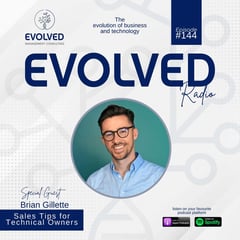
Brian Gillette took his first MSP job as VP of sales and had to ask what MRR stood for. Three years later, that company had grown from about 700K to over 2 million in recurring revenue, and he did it without a marketing budget. MSPs, he was an actor in LA, which is where he learned to hear "no" at auditions after audition and kept his self-worth out of it. Today, he runs Feelgood MSP, hosts the MSP Sales Podcast, and wrote How to Sell a Shitload of Managed Services Without Selling Your Soul. His approach, the Feelgood Close, is built for technical owners who hate the idea of being a salesperson. talking about why fear-based selling stopped working for MSPs and what replaced it when the person running the process would rather be fixing a server. Brian, welcome to the Evolved Radio Podcast. Thanks, Todd. I'm, uh, very honored and excited to be here I'm glad to have you. Uh, I, I mean, obviously I know you in the industry and have, uh, sent, sent some, some people your way as well, heard great things. But I saw you on the stage at ScaleCon, and there was a, a whole series of things that I was like, "Oh, damn, I gotta have Brian on the podcast." So, uh, this is gonna be great. Um, I love a lot of your takes. I feel like a lot of it is founded in really good data and information that you have, the systems that you use. But it feels somewhat counterintuitive, I think, to what also a lot of other people see or hear in the industry. So looking forward to the takes here. Um, maybe to, to start us off with something fiery, um, I would love to hear you rank the worst to best typical prospecting strategies for a traditional tech-led MSP Oh, boy. Okay. Um, eh, I'll do my best to keep these in a linear order, but it might be sort of clusters, you know, o- of, of tiers, you know. Dat is mooi. Let's call D tier is, uh, what most people do, which is nothing. Like, Excellent start. Okay. doing… Let me say it this way. Doing a great job for your customers is not lead generation. That's just being a business, and you will get some customers just because you've hung a shingle if you just don't, if your business just doesn't die for several decades in a row. Yeah, but that's not what sales is. So waiting is gonna be, I'm gonna call that D tier. But then really anything else in the D tier Oh God, uh, how many enemies do I wanna make at once? Um, using canned material over and over again and then sending it out in mass. Um, like if we're still email- if we're still mailing people baggies of aspirin in envelopes, uh, I think it's just D tier. I think, I think it's… I just don't think it works. Um, and if it does work, you're not attracting the kind of people that you actually even wanna work with. And then the, uh, the prescribed Lenovo posted LinkedIn material, right? Ja do something like, like you said, doing nothing is the worst, but Yeah. know, that, that is, uh, not Yeah. it And I, yeah, I'm gonna put that stuff in C tier of, like, vendor-generated syndicated content. Like, what did Microsoft make for you? Like, they don't know how to sell this stuff. That's why they're channel. Like, they don't know how to-- They don't know what end users even want. So, uh, that's gonna be your C tier, and then I'm gonna call your B tier… A-and also down in there is just, like, AI forward automation is the worst possible way of building a high-trust relationship. Um, we're building high-trust relationships, so you can't start by looking like a schmuck who is sending them, like, "I noticed you breathe air. Our company synergizes with…" It's just nonsense. But then you're gonna get up into the B and A, A-tier stuff, and S-tier stuff is, like… I think one-to-one cold email is probably B tier. It's way better than people actually think it is, but it's not, it's, it's not the most effective. But if you're actually doing one-to-one emails, it works great, just nobody has the discipline to do it. Uh, A tier is gonna be your sort of marketing-supported cold calling, be that, be that in-person cold calling, like w- door-to-door, hitting people over the phone, uh, with lead magnets and marketing resources and follow-up, uh, cadences. And I'm gonna call S tier, like the best thing you could possibly do is going to be going to trade shows for your ideal markets and sending individual video prospecting to your prospects, sending videos of you talking to people one-on-one via LinkedIn or email So like actually recording like, "Hey Jim Yeah. and such company," like, Yeah. to a person, right? Hey, Jim, Sarah here. Just want you to know I'm not a robot. Listen, I was looking at your website the other day, noticed you guys work with Clio. Uh, we actually have 12 law firms in the greater Cleveland area that are working with Clio, and I wondered if you guys had figured out how to solve that pr- this one problem. We actually automated a way for another firm. We saved them, like, four hours of admin work a week. Anyway, just wanted to say hi, introduce myself, and, um, would love to connect I love the idea of sending video on LinkedIn because it, it sort of, again, like makes sense, but it feels counterintuitive because, um, video itself, depending on sort of the day of the week of the Microsoft algorithm, doesn't do great on LinkedIn. Uh, I think they're, they've been- made a couple of attempts to change that, but I think that's different if the video is directed at a person. So I think that's Yeah. That's a great suggestion. Even if it's a bad cold call, man, like I'm gonna open seven out of 10 videos that I get DM'd 'cause I don't get that many. But I'm not gonna open all the text ones, but I'm gonna open the video ones, and I'm gonna give it five seconds Yeah. Okay, that's cool. So, um, I love that. That's, uh, gives you good sort of ranking of, like, where we stand on what we should be using. Um, cold calling I think ranks higher than maybe people would want to do. We'll certainly circle back to that one in a minute here. Um, as technical people, we tend to overexplain the solution and talk a lot about features. Why is this a bad strategy? Because I think in our head as technical people, we're trying to explain a lot of the value of what we're delivering or what we do or what a solution has. But I get a sense that this is, from the limited sales training that I've done, uh, this is not the right play. Why is that? Yeah. Well, this is a good question, and it's one that I have an answer for, but then I have to give a, I have to give a second answer on top of it. So the reason it doesn't work is that nobody cares about how the sausage is made. They care how the sausage tastes. And actually, sausage is the example I use in Feelgood because the more I learn about how they made it, the less likely I am to buy it. So you don't sell sausage by showing people the factory, you show sa- you sell sausage by asking people if they're hungry. And that's my example for you have to go to the outcomes. But this is the thing, Todd, that's actually really, uh, irritating to me. Somebody… There'll be a talking point in the zeitgeist about sales, and then you'll have, like, an influencer say it. Then you're gonna get your tier two influencers will start parroting it. Then you get your tier three influencers, which is, like, somebody reposting an Alex Hormozi tweet on their LinkedIn account. Like, they're not… And then they'll get 20,000 re- likes, likes on that image. They didn't originate anything. They're essentially just distributing other people's thoughts, right? And then it, then it gets down into the layman, the everyday people, the you and mes of the world. You know, the MSP owners who were all at the, at IT Nation together going, "You gotta sell outcomes. You gotta sell outcomes." But nobody knows what the hell that means, and nobody knows how to do it. So they say, "Don't sell speeds and feeds. Don't sell jargon. Don't use acronyms." Okay, but what are you gonna say instead? You're just gonna say, "We just handle it." And they go, "Handle what?" "Everything." "I'm good." Because they don't… There's no direct value. So yes, it doesn't work because the more people understand the product, the less likely they are to want to use it, uh, the un- the inner workings of a product. But you have to replace that sales, that airtime of your sales process with something that's worth talking about. Any sales thought, quote-unquote thought leader can tell you what to not do. But this is the evidence of somebody who's creating value for the market or parroting other thought leaders, is the people who only ever disparage methods and they don't give you a replacement method, which drives me up the wall. So instead, this is how you actually create outcomes. I'm gonna explain it. Look at the speeds and feeds. Look at the technical stuff. And by that I mean look at your tech stack. Write it down on a Google Doc. Or I mean a, a… Sorry, a Word doc. Who am I t- who am I talking to? MSPs. Write it on a Microsoft Word doc, every single thing in the stack. Then give me one sentence that says, what does that thing do? And this doesn't have to be public-facing, so internally. What does SentinelOne do? What does IT Glue do? Fill in the blank. Then after that, say, um, why should my prospect care? That's a new column. Now I need one sentence that explains why the prospect should care that that tool does that thing And then you wanna go one layer further that says, what does it help the prospect do? So, okay, the fact that I have documentation all centralized and keyworded and indexed is amazing for helping me run my MSP. But actually, can we find a through line? So now, why should my customer care that my documentation is on point Well, on the top of my head, um, they-- we are not going to have repetitive conversations. If they-- If you spoke to Clark on my team two weeks ago and you're speaking to Rubio on my team today, Rubio knows what you said to Clark. So they don't have to repeat themselves, which is one of the biggest frustrations of any outsource support is getting transferred and starting the story over again. Absolutely And then you could, you could extrapolate, like support calls are faster, tighter, and we will get better over time so that they are going to get white glove, individualized custom support every time, and that they will build a relationship over time with their support team that's just going to make it easier to work with us. Does that make sense? Yeah, so I love this because, like I am of two minds of this because I think a lot of what MSPs struggle with, especially in sort of a modern sale, is f- uh, combating commoditization, right? And the way that we go through this, I think it kinda lends to a bit of commoditization, but I think the answer is also in the same recipe of if you're talking about these things in a unique way that the rest of the market isn't, right, because you have a more sophisticated approach to how you're communicating the value that you're delivering, you're already differentiated. Is-- Do you think that that's true, or is sort of, is there like a more advanced class for how you differentiate as an MSP, assuming that we kind of have very similar stack and we're producing the same outcomes for a business? Yeah. Um, I have a lot of loaded… I have a lot of opinions on the topic of differentiation, and yes, we have to differentiate, sure, if we don't want to be in a c- a commodity. But also, some people just might be fine being a commodity. Like, maybe you just wanna be a commodity, and you wanna have 10,000 clients. Like, f- good for you. That's not what I personally wanna do, but if that's what you are interested in, there's th- you could go that route. You could go super specific, you know, and low friction. You could be the, uh, the Electric AIs or whatever that… You remember that company that, Yep, absolutely Or, like, the, the Ripple IT now is, like, they're trying to get into the MSP space. That's a commoditizised, uh, commoditized version, and that's going to be very successful for those people. But everybody obsesses over different, but you have to remember that they don't want different for different's sake. What they want is not different. What they want is better, right? So, like, "Hey, we're different because all of our techs also speak Klingon, and nobody else can do that." Like, well, congratulations. You're different than everybody else in a way that benefits me not at all. So we get so obsessed over differentiating the method, and we need to differentiate the effect. I'm gonna give you an example. Are, is this on video, Todd, or we only release audio? Most, like 80% of listeners are audio only, but yeah, Okay is, is usable. If, if we want- if you wanna see what's happen- about to happen here, the magic trick, then uh, then check out the YouTube channel as well, but So magic trick, do, do you know what I'm holding in my hands right now? A deck of cards. Oh, holy crap. Okay, I called it. So you did call it. So literally, uh, uh, you can listen along or you don't have to … I, I'm not a professional magician, but this is my, my ADHD fidget totem of choice is a deck of cards, right? But point being that magicians like to fixate, they like to impress other magicians by getting, finding unique methods, and the truth is that you could use the same method for every single card trick, but if the effect is different, then the audience will have no idea that you did the same trick over and over again. You know what I mean? Like, if I have a way of getting a card… Hang on. I can't believe I'm doing this, but like I have a way of showing you that jack of diamonds, right? I already flashed, but if I can take the jack of diamonds, put it in the middle of the deck And then produce it on top again. So I could do that. That's one method. I could show you all sorts of different methods. That's a totally different method, same trick. So I'm not gonna get credit for two different tricks. The audience is gonna go, "You just did that trick." No, I did a totally different trick, but it was the stuff that you don't see. The method was different. The outcome or the effect was diff- was the same. I took a card from the middle of the deck to the top of the deck. So we have to differentiate not the method, but the effect. And it has to, again, not just be different, it has to be better. I know this is a long answer, Todd, but we can cut it down. Um, so what does better mean? That's the question you need to ask yourself. To the people you're doing IT support for, if you can't give them a better experience on the effect, it does not matter whether you do it the same or different than all of your competitors I think this is where a lot of MSP owners and s- like, uh, junior salespeople try to go to and do a pretty, average job at it, maybe sub average, because they're communicating things that really don't matter and are not sort of like differentiated value, right? They say, "We're better because we have the best people." Like bullshit, like how can I judge that? Like ev- the other three people that I had in the boardroom here said they had the best people too. Or, "We're proactive," which, you know, quite frankly has never really been that true in the industry anyway. Uh, you know, "We're, we're, uh, we care." Uh, okay, do you? Right? Like I don't know how you operate, so like why am I gonna believe you that that's gonna be true when the previous two MSPs that I've had relationships with were kind of terrible, and I'm judging you based on those relationships. So what are we, we then trying to communicate? 'Cause these are not the things, in my opinion That's right. You have to remember that managed services is a service business. We're a customer service business. We're not a technology business. Like, our job is to help businesses do their job. So it's not to be impressively intelligent. Like, who gives a shit, dude, how smart you are? Who gives a shit? If it doesn't help me, why would I care? So you have to ask yourself those really hard questions, and the only way to do that is to understand who you're trying to do IT support for, and then talk to those people and ask them the questions. Like, "What do you want from an IT partner that you've never gotten before?" And then figure out how to work backwards from that. So they go, "Can you make the card come out of my pocket?" Like, yeah, let me build an a … Let me build a method that will give y- that effect. Let me figure out how to work backwards from the desired effect. That's how you build a good magic trick. And so the way you build a good sales proposition is you work backwards from what they want out of you So again, comes to personalization, right? Like the best outreach that you kind of noted was, Mhm a high level of personalization. And in the sales process, again, I would say it also echoes in account management. The more personalized, the more specific it feels to this conversation that I'm having with you is about you and not just sort of like the script that I'm talking to everyone else with, then that feels differentiated, right? Yeah, exactly. Yeah. there are tactics we, we could get into. We could ha- I could tell you how to make people like you more and make people feel more special with, like, two or three essentially conversational gimmicks, you know, to help people with low social IQ, like, feign higher social IQ. There's some of those moves we could do, but, um, on the front end of sales, we, we just have to remember that, like, we're not entitled to people caring about us simply because we are very good at what we do, and we're not entitled to people buying our services just because we're passionate about doing it the right way. That is our responsibility to the market, is make them care about it, you know? Um, and that's the starting point. So you, you wanna work backwards. You wanna work from, you know, the outside in rather than inside out when you're talk- meaning s- work from the client back to you when you're looking for differentiation, not inside out and then seeing if the client accepts it Okay. thing that MSPs tend to run into a lot in prospecting is just sort of whatever I have is good enough, right? Like gone are the days where there was lots of golden opportunity of converting people that were on T&M contracts to this amazing, amazing thing called an MSP. And now most businesses either have an MSP or some type of IT provider that, you know, maybe is not knocking it out of the park, but they're just not interested in entertaining something new because they don't feel that it will be different or better, or the pain is too great to sort of make a switch. So if, if you're doing some cold calling or, you know, dropping into some, some offices and people are like, "Oh yeah, we've already got an IT guy," what are some tactics to sort of like go a level deeper and, and sort of push past that resistance? Yeah. Um, I'll tell you the thing everybody thinks is gonna work that doesn't work is basically saying… Looking for missed opportunity cost by them having, like, a mediocre provider, it just never translates. It actually just makes you look desperate to be like, "Okay, well, what if, you know, what if w- I could have done it a little bit better? How do you think that would've changed your business if you were only down for one minute instead of an hour, and maybe you could've gotten an extra client? And how much would that be worth to you?" And, like, trying to extrapolate and find value through hypothetical opportunity cost from the status quo. It just never works. Um, instead, if somebody has somebody that they're happy with, there's a 90% chance that they don't need you to sell them anything, and maybe you should just stop selling and go, "Sounds like you don- sounds like you're content." Uh, and that's where I would start by, by kind of taking it away a little bit, you know? If they go, "You know, I actually have an IT guy. We love him." You go, "Okay, it sounds like, sounds like you guys are set up. Th- this might probably be the last time we need to have a conversation. I just wanna make sure I, uh… If you don't mind, let me ask a couple questions before I go." Because, because under those circumstances we don't want to assume that their definition of IT is the same as our definition of IT, or that their definition of good is the same as our definition of good. So we could be like, "Okay, so just so I cl- what does he do for you, just so I can ask?" And he might only do a couple things. Maybe it's just he sold them a firewall that leased with a internet circuit through Sandler part- Sandler Partners, and then he comes by once a month and defrags their computer, and they're, like, really happy. All right, but that's not what you sell, so that could lead to a different conversation. Maybe it's, like, an MSP that actually is way better than you and you couldn't beat them. But we don't know until we figure out, like, what does this person do, you know? But you wanna do that on the way out the door, i- if you will, uh, um, figuratively speaking, meaning know… Make sure that they hear you and don't ignore what they said. Don't be like, "We have an IT guy, but h- but how do you know he's as good as me, and what, how do you know I'm not better than him?" It's just not gonna be successful. Go, uh, I call it, I call it closing the folder. Like, you have a sales folder in front of them and they go, "We're happy." You go, "Okay," and you close the folder. And now they feel safer. You… They feel like you're not gonna keep pushing super hard, and they might be a little bit more candid with you, and it also demonstrates that you're… it's just a conversation That's right. That's right. And you're listening to them. Um, so that's kind of the move. And then, you know, like, you could always do the, like, "Would you like to see what good looks like from us?" But why would they? If they don't have any pain, then there's just, there's no sale So is this, like this is not a matter of like there's a way to sort of hack this resistance and get past it? It's really just sort of you should move on to greener pasture and find somebody else who is maybe having some pain? It could, yeah, I think very often, yeah. Um, what I… It doesn't mean that the second somebody objects, you just, like, cower away. Again, it's about b- the, the move here is not to become persistent, the move is to become curious. And if you could become genuinely curious and like, "Wow, you know what? I'm actually, I'm really s- pardon me being so aghast, but you don't know how rare it is that I meet somebody who loves their IT guy." And they chuckle, and you go, "Do you mind if I ask what makes you love him?" And talk about, get them to talk about what he's doing right instead of saying, "What is he doing wrong that I could improve?" Because then they, they feel exploited. They're like, "I just told you to go away, and you didn't hear me." You go, "Wow, I'm just gonna be honest, so many people don't like IT guys because our industry, you know it. You know what we're like." And they chuckle. "Do you mind if I ask what you love about him? Like, what, what makes you happy?" And then get some information there, and then go, "Okay, and he's probably got your cybers handled, and I'm assuming that he's got a plan for you guys to use AI, right? He sounds like he's on top of it." And that would be your way of … That's sort of a non-threatening discovery question. "So he's good on AI, you're good on, uh, cyber, and then you gu- are good on X other thing that we do. You guys, your phones are covered and stuff. Well, listen, it sounds like you guys f- found a, found a good, uh, found a winner. Um, you tell me, Miss Customer, is there any reason for me to even follow up with you in the future?" And the truth is, Todd, that if they actually have any cur- any need in there, they're gonna be like, "Well, what do you do?" Right. Yeah Because you've, you've demonstrated like an, being a normal person. But if you just go, "Well, how do you know? I'm probably better than him, and maybe you're overpaying, and let me just see a quote," and, and trying to force people who don't, aren't asking for anything into a sale, you end up in a bad spot Yeah, that's great. I love that. Um, another issue that people tend to face is relying a little too much on FUD, and I Mhm. that you're kind of very much against fear-based sales. Um, but I think people kinda hear this as a way to sort of break through to a business owner that really doesn't care about IT. And quite frankly, like that's most of the MSP prospecting market. They don't know what we do. They don't particularly care. That's why they're partnering with you. So how do you break through to kind of a reluctantly engaged prospect where they're like, "Eh, I don't know. I don't care. I, I, I don't think any of this is very interesting. I don't think I need this." Uh, if you're not gonna rely on FUD, then how do you do that? Saying like, this is past, you know, you've-- you're actually in a meeting with them talking about what you do and what you offer, or even more so in a QBR, like from the, a bit more on the account management strategy, similar approaches, but they're just sort of like, "Meh, I'm not that interested," and people tend to rely on fear in order to drive that engagement. So if that's the wrong approach, how do you sort of get to the same result in a different way? Yeah. Yeah. Well, l- imagine it this way, right? That, like, all business Leader, most of business leadership is about mitigating risk, not just on IT, but like people who go to business school are actually considerably less likely to be entrepreneurs because what they teach you in business school is everything that can go wrong and how to m- how to, uh, mitigate risk and l- like shorten as much downside as possible. And, and yet, is a CFO using FUD when the CFO goes, "Yeah, you can't spend more money than you make here, John Cho. You can't keep doing that. You're gonna run out of money." Like, that's not FUD, that's just business leadership. And so the thing is that when we don't hold ourselves or we aren't perceived at, at an executive level as a true thought leader in technology, then we come across as, like… Did you ever, do you ever watch The Office, the American Office? Well, the memes, but never watched it, well, okay. Well, there's an episode where there's insurance, there's this Italian-American insurance guy who comes in and he's a really pushy sales guy, and Michael thinks he's getting shaken down by the mob bec- just because he's Italian. But he sells insurance, and he was like, "Hey, you never know. A truck r- runs off the side of the road, there's injury. This place could go up in flames tomorrow." And he just sounds like a schmuck, you know? Uh, and you don't take him seriously as an it… And then he's like, "I'm gonna keep following up. I'm gonna be very persistent." And then Michael goes, "Oh my God, I think he's in the mob and I think he's threatening my life." It's actually, now that I think about it, it's a great example for this. Like, you can talk about risk mitigation without it having to be fear-mongering. It's really more about the positioning and how you wanna be perceived. Do you know what I mean? So yes, when somebody's like, "Hey, I just don't care about cyber," you go, "Yeah, of course. I don't blame you. I wouldn't… Th- that's why I'm here is so that you don't have to care about cyber. But let me explain w- what that means. My job is to close a bunch of doors for you. I just told you that these ones are open, and today I'm not equipped to close them on your behalf. So really, if you'd like to continue not caring about this, you need to empower me to take care of it for you. Do you want me to keep being your IT guy? Good. This will be the last time we talk about it. Just give me the keys to the kingdom and I will keep it safe for you." I don't think that's FUD. Do you know what I'm saying? But where stewardship in a m- more so, it's, it's exactly right. We're steward- we are stewards of their business so that, and they are stewards of their business, and you can empower someone to be a steward without being like, you know, be- being extreme, being the other way. And I will say the last thing, I know I'm, I'm giving long answers, but Todd, a lot of people push back on me because FUD works Read, ja Um, to which I say, "Yeah, do you know what the number one best possible tactic is to close a deal? Bar none, if it's, if the only metric is get the deal closed. It's lying. Works like a charm. Ja. Every time. Just tell them whatever they need to hear, hide the real truth in the fine print, and get them to sign it, and then you say, 'Not my problem. You should have read it.' That's the best closing tactic there is. Does that mean we should use it?" Well, especially in our industry because like I always, I always say like we're, MSP sales is difficult because you're essentially selling trust, Mhm. So if you sell trust by lying to people, that's, that's not gonna work, That's what I'm saying. And so like, yeah, okay, that would get deals done. But I don't wanna… That's not how I'm, that's not how I live my life. That's not how I do it, uh, period. I'm going to rise above my animalistic desire to get to coerce someone into giving me what I want, and I'm going to be a freaking reasonable, trustworthy per- partner. And the truth is that long-term, you're gonna have the relationships. You know, Todd, you've been in this channel a long time. There's a few… If I, if I mention a few characteristics of some MSP vendors, MSP vendors who burn a lot of MSPs, who have been through the market a lot, and who everybody… You know the names. You can see their faces. You know who I'm talking about. Like, yeah, they've made a ton of money by being people that are not admirable. And so, okay, are they successful? Not by my definition of success. I would never want to look to emulate that person You know what I mean? And now a lot of those people, uh, there is eventually a reckoning. You can only sort of be a con man for so long before people catch on. And that's how when, when you're coming in trying to undercut a trust-driven relationship using fear with a stranger, you come across as a con man, rightly so, and your trust is permanently gone with that person So the, the, like the building of a salesperson, right? Like, uh, how much of this, uh, is innate skill versus something that you learn and can build, right? Like I, I, think you come at this as from a different angle. I think you have the t- the stereotypical entrepreneurial sales, uh, um, story of selling kids to… Uh, selling candy to the kids in the school, Ja you're, you're the typical lemonade stand kid. Ja do you think that that had a bearing on your success? And I think you… I've heard you speak of some examples where you took someone who had no skill set at all and Hm. incredibly successful. How much Ja. attribute that to the things that they learned versus the systems that you use? Yeah, really good question, Todd. Um, I mean, undeniably it's helped me, that it's in my temperament to be… I think that would be, that'd be, uh, total BS to be like, "No, it's all, I get all the, all the credit and this was all hard work." Like, yeah, I'm a, a, a charming, outgoing, extrovert, high energy, high drive guy. You know what I mean? And all of those things are to my benefit and I can't pretend they aren't. Also, um, there's a lot of really charming high drive p- losers who never achieve anything, you know? So it's not like I was just… Like, I also had to pick up the phone all those times in a row to, to find those, to start those conversations to close those deals. So, um, the, I think, us- you're, you're gonna have a l- a ceiling if you're like a talent… This comes up in acting a lot too actually. Um, a lot of really famous actors were not natural actors. They had to work super, super, super hard for a long time at it, like decades before anybody gave a crap about them. Mark Ruffalo didn't get his first break until his late 30s. He had been an actor for like 15 years. Nobody cared about Mark Ruffalo 'cause he was not natural at it. And then there's the Margot Robbies who book their first audition for a Australian soap opera and then come to New York and book their first movie audition for Wolf of Wall Street because she's Margot Robbie. And yeah, she's gonna be successful as an entertainer because she's Margot Robbie. Okay? Um, but so many of the top performers actually had to overcome obstacles in order to achieve their results. So I don't think it's necessarily about… It's, it's more about your grit than your innate talent. And maybe grit is innate, so in that way maybe, maybe this is a backwards answer. But it's more like how many times in a row are you willing to do this is going to determine if you can be successful at sales. And if it's less natural for you than me, then sure, you might have to do 10,000 times to my 7,500. So the question is are you going to do it 10,000 times or are you only going to do it 1,000 times? That's the bigger determiner versus do you need 7,500 or 10,000 Yeah. Okay. Uh, I guess related as well, like I'm an ops person through and through, and I tend to always view o- like, I never viewed myself as very good at sales. Um, when I, I was good at warm sales, so if I was brought into like a warm prospect that was second meeting, I would do very well, and that, that worked pretty well for me. Um, m- my lens for sales is very much about the systems approach to it of do these things and you will produce good outcomes, right? Like, yes, there are, um, some sort of emotional sleight of hand, some engagement techniques, some, you know, some prospecting, uh, tricks that you can do. Like, those are some of the things that you can pick up, and the way, the way that you act and the way that you do things I think are, are a big component of this. But my favorite expression that I use about sales to sort of the RevOps side of things is activity precedes results, right? And I'm very curious if people are not achieving the results, I wanna see your activity because, you know, you need to get those reps in in order to achieve something out of this. So how much do you put weight in the idea that there are systems that are required, right? Like I've heard you talk a bit about, you know, if you're a professional, you should be using a CRM, those sorts of things. I don't find that those things come naturally to a lot of people that I see in the sales industry. And how much should we sort of push people towards that, of the mechanics of sales is just as important around the techniques and sort of the, the personal influence part? Yeah. Uh, that's every- that's all of it. It's, it's mechanics is the right word. Like, sales is a series of processes and SOPs, and y- you're gonna get leverage via tools, just like it's exactly like on the operations side. Sales is operations. It's just hard- way, way more ambiguous, and there's a lot more waiting. But then once you have a data set, then you can start forecasting much more accurately. Do you know what I'm saying? When you have data intelligence based off of a data set, you know 500 cold calls gets me a client, then it's no longer ambiguous. Pick up the phone more. That's the answer. So the thing is that because it's unnatural for MS- for technical founders, it sounds like that's really the q- the lens you're asking these questions through is like a technical founder. It's un- it's unnatural, so you just like want to f- you want another answer. You keep shaking the eight ball waiting for a different answer, going to IT Nation again waiting for a different answer. The answer's never gonna change. It's the simple and hard repetitive tasks that will get you new clients, period. Make more … I say in my c- in my coaching community when people are like, "Eh, I tried that, doesn't work," and I say, "You're not allowed to tell me something doesn't work until you've tried it 1,000 times." Ja, That's my number. 'Cause how many tries did it take Edison to make a light bulb? Over 900 tries, right? And he was like, "I found 900 ways to not make a light bulb," or 700. W- it was a high number. Um, so okay, that's like my, that's my metric. If you have tried it 1,000 times, you can tell me it doesn't work. If you tried it four times, you can go quit freaking whining and do the job You see what I'm saying? no, I, I totally agree, and this is what I, I find is a, a bit problematic and why I'm sort of asking these questions through the technical founder lens is I think this is the group that needs to hear a lot of this the most, right? Because they're somewhat introverted. They're a bit pessimistic about these ideas of like, "Oh, that's crap. It doesn't work." Like, "I, I would not take calls from, from anyone. All these vendors are bothering me," right? So they tend to apply their psychology to everyone else that they're potentially trying to prospect to. Uh, and, you know, uh, they always end up wanting to hide behind a keyboard of like, "Well, can't I just put together a really good SEO campaign or an AdWords campaign, and then, uh, the floodgates will open, and I will have all of the inbound that I need?" And like, sure, like, that's not necessarily a terrible strategy, but I don't think it's very reliable, and it's very expensive. Uh, versus, like you say, of just like make 100 calls. That was honestly one of the best pieces of advi- of advice I got when I was first starting my consulting company. A friend of mine, a mentor of mine said, "Todd, it's legs and lungs. Move around as much as you can and talk to as many people as you can." And I was like, "Huh, that seems deceivingly simple. I guess I'll give it a try." And lo and behold, like, there was two things that I think were very, very valuable out of that. One, it helped me to refine what I was trying to say o- over and over and over again until, like, I felt better and more comfortable pitching what I was doing. And then I also realized the second piece was I was not pitching to everyone that I talked to. I was just looking for feedback, inputs, and additional people to talk to, right? Ja eventually they're like, "Oh, that sounds interesting. You should talk to my friend so and so." And then Ja not that I'm pitching this person for the product. And I think that that's a really powerful strategy for people to just get up, move around, and start talking to as many people as you can about what you're trying to provide, right? Yeah. There's a reason everybody knows who you are, Todd. And by the way, this is our first conversation, isn't it? Ja But we both knew who we each other were for years. Yeah, yeah And there's a reason people know who you are, because of the legs and lungs. Like, I love that. Um, but let me say it this way, like, sometimes people hear me and they get discouraged, especially because I can, espec- in contexts like these, I can be very direct on, like, an interview. Um, people take it personal when if, if f- they were to hear something like, "You aren't good enough at this skill today." This is not a personal attack. This is a benchmark. If you, you're comparing somebody's cybersecurity posture against NIST and they're not compliant, it's not an attack on their business. This is a data point, and you're gonna use that data point to create an action plan to close the delta, right? That's, that's all technical people do all day: collect data, identify a goal, quantify the delta, make an action plan, and execute it. That's all I'm asking you to do, is to unemotionally observe the data points of your current skill set. But if you wanted to, you could think of even the soft skills and the social quirks and the stuff you were referring to. Dude, 90-plus percent of that you could write an SOP for how to make a friend. You could write an SOP for how to pick up a partner at a bar. I could do, we could do it, because it exists. Like, psychology is science. It's, it's not just art, and really all art is, is an intuitive understanding of an underlying science. So give you a really excellent example of this, Brian, right? Like, and this is, this is reflecting back, like something that I took away from you in, at, at your talk at ScaleCon, is, uh, yes, you're an introvert. You're not very good at networking. Here's a strategy to help you at one of these networking events when you're, you're, you're, you're stuck as a wallflower, and there are these little pods of people standing around talking. Walk up to one of them, just sort of slide in and be like, "Hey, what'd I miss?" Right? Like, "What's up?" Right? And it's such a simple and deflective way of just, like reducing the mental load of like, how do I show up and introduce myself and not stand there awkwardly for 15 minutes and then just Ja. right? Because to your point, people are actually very, very inviting. They're like, "Oh, hey, this is so-and-so. We were talking about this thing." And then all of a sudden you're in, you're involved in the group, and all of that sort of mental baggage of how difficult it will be to, to network with these people completely dissolves, right? I think that's a really effective strategy around like exactly what you're saying of like, there's these little things that you can do to make these things easier, but it's Ja and it's really not as difficult as we may think it is. No, it's not, and you can fake it. The amount of highly successful entrepreneurs that are really just sociopaths mimicking human behavior like, like, nobody's gonna convince me that Alex Hormozi is a normal dude. There's something wrong with him. That's why he's worth $200 million and he's not 40, you know? Like, but he just breaks things down into checklists. So, like, let me give you one right now. You mentioned QBRs. I'm gonna give you three Cs: compliment, callback, curiosity. Do those three things. So first of all, compliment people. I don't know why people over… Th- they overcomplicate this. Give someone a genuine compliment, this is all the way back to Carnegie, and they will like you more, period. It's not hard. And it, it just has to be genuine. You can't be like, "Nice tooth. Okay, anyway, let's buy this cybersecurity package." It has to be like, "Hey, man, you're looking good." That could be s- that could be it. Then I mentioned curiosity. Curiosity's the most charismatic thing you can have. Be genuinely interested in the person you're talking to and they will like you. Meaning ask them a question, and if there's something in there that sparked another mental thought for you, follow that question and just follow the, the hair of curiosity through your brain, and they will feel seen and loved and liked, and they will like you back. And the last one was callback. If you… This is for the technical people on the call who you're going, like, building friends is exhausting, seeing friends is exhausting. Recall something from the last time you spoke and bring it up again. Something you discussed. Be like, "Hey, whatever happened with such and such?" Or, "Hey, reme-" Uh, even a joke that worked before, like… Or something they said. "Hey, I remember when you said that. It made me laugh." Call back one thing from a previous conversation and that is the recipe to building an ongoing relationship. If you do that in your QBRs, even in your sales meetings, call back something from your last sales conversation, you'll be more likable But all right, um, couple other ones before I let you run here. Um, the other piece that I don't know how much, I suppose you h- I mean, you have lots of opinions, so I'm sure you'll have an opinion on this. It's a bit outside the, the vein of sort of, uh, the typical sort of prospect lead develop type idea though. But one thing I see a lot of organizations struggle with is how do you appropriately hand off a new prospect for onboarding? Like you have the owner or a salesperson that is involved in this, uh, this, uh, relationship development with a new prospect, and then they hand them off to, you know, a project manager or a technical team lead, and they're like, "This is John. He's gonna run you through this process, and it's gonna be amazing." And then they kind of disappear and they're like, "Well, but wait, what happened to Brian? Like we were buddies. He, he sold me this whole thing and now I don't get to be involved with him?" So like what's the crossover that you think is sort of the best, uh, the best approach to this so it's not completely redundant where the salesperson is wasting all of their time, not wasting, but spending sure time with the onboarding process, but still having that crossover so the comfort- the client feels comfortable that they've made the right decision and there's continuity? Yeah, it's a really good question. Um, it's more about, I think it's more about the work you do on the back end because obviously, like, they assume the salesperson isn't gonna be their primary point of contact forever, especially when they know you're a salesperson. Mhm. Um, if you disguise the fact that you're a salesperson because you're ashamed of being a salesperson, then you might end up creating some confusion during onboarding 'cause it like, "Oh, I thought you were my… You said you were a customer success liaison, but I never talk to you again?" No, just be a salesperson, and then they'll, it, it will trigger them. It'll label appropriately in their mind so they have more right-sized expectations. But it, it, to me, it could be as simple as a internal meeting. It could even be a doc now, and it could, frankly, it could be an agent that just scrapes all the transcripts from the sales meeting. But the onboarding team needs to know who are these people, what do they do, why are they leaving their current solution, and what was their most recent solution? You know what I mean? so much in this. That's the, uh, uh, as you say that, I'm like, "Of course you need this information," but I Yeah this happens in most cases. It's wild Yeah, 'cause if, if they have a bad MSP now, like we, we want to start off on the right foot to be like, "And why are they bad? What don't you like about them? Let's position ourselves differently. Let's show them better." You know? Or if they have an IT guy and we need to be more of like a show of force, let's have three people on the call, you know? And we wanna show them that we have a deep bench. Uh, I think work backwards from the sales questions of what do you need, why do you need it, and why don't you have it, and have those pull through, the answers to those questions pull through into the onboarding phase. So we go, "Listen, Brian and I talked extensively about, uh, your conversations. I actually listened to some of your transcripts. I know that the main thing we wanted to resolve was this phone system issue you guys keep having, so that's the top of my list. Um, a- I am gonna get to that in just a minute. Let me set the stage for you guys a little bit and just walk you through what it's gonna be like now that with your new partnership." And proceed your onboarding process with a ten-second spiel demonstrating that the knowledge transfer was successful to the onboarding person, and the onboarding person understands the objectives. Then I think you won't need as much crossover because they will feel like… They'll feel the handoff was successful. But if they don't get any of that from their onboarding people, if they keep pulling back to your sales reps, it means your onboarding people aren't giving them a high degree of confidence Yeah. No, that's great. Again, like it's that, that continuity of not sort of the client having to repeat themselves and you're reflecting back like, "I, I actually understand why you're here and what you need." It just creates so much more confidence as you're kicking off that strategy. That's awesome. right. Brian, um, what is one thing a technical owner should start doing next week to improve their sales strategies? Recognizing like just saying, you know, start making some calls is maybe a bit too much to ask. Obviously, we'll link to your podcast and the group work that you do for, for coaching for sales development. Those would be good strategies. But is there some sort of low bar that people could take away as, as a really actionable strategy that they could start next week? Yeah, for sure. Um, go to your favorite client, ask them to talk to you for 15 minutes, and then run a informal customer discovery interview that basically says like, "What do you like about working with us? What don't you like about working with us? Why did you choose us? And if you were me and you want, and I, and you had to go find more people like you, what would you do?" And just straight up ask your best client how to get more best clients Basic market research, huh? Yeah. Uh, we call it a customer discovery interview. I had one today with a client. I love the guy, and the truth is, like, we basically accidentally secured a contract renewal with him. Was- wasn't even the objective. I was like, "What do you want us to be doing better at, and what are some of your wins so that I know?" But that market research, that's going to give you so much better context for, like, what's gonna work in the future, how do I get the right people putting the right bait on the hook to catch the right kind of fish. You know what I mean? Um, that's something you could do that doesn't require any new relationships. It just requires 20 minutes and, uh, a relationship that you probably already have a strong relationship with that person. That's what I would do Awesome. has been great, Brian. Uh, links to you, your LinkedIn and, uh, your podcast and your, uh, your program as well will be in the show notes. Any other last call-outs or calls to action for anyone listening? Uh, just that I wish I would have asked you more questions because I talked way more than you, I know, in this, uh, conversation. But, um, you-- I appreciate what you do, Todd, and actually you are very highly respected, if you don't mind my saying, uh, by a lot of the people in the channel, and I appreciate, uh, opportunities to have conversations with guys like you about this. But no, just, just keep your head up. My wall behind me says, "This is going to work," and I mean that. Just, uh, treat the unknown… treat the delta between where you are now and where you need to go as a project, and then break down each one of those confusing things into a, a project and make a scope of work for the project. And maybe the scope of work is get better people skills. Okay, fine, then break that into something manageable. And you, you can do it. You can close the gap, and you can become what you need to become to achieve what you want to achieve Awesome. Great advice. Thanks for being here, Brian Yeah. Thanks, man